

Almost every tenant and landlord in India has seen one common line in a rental deal: 11-month rent agreement.
But why 11 months? Why not 12 months, one year or two years?
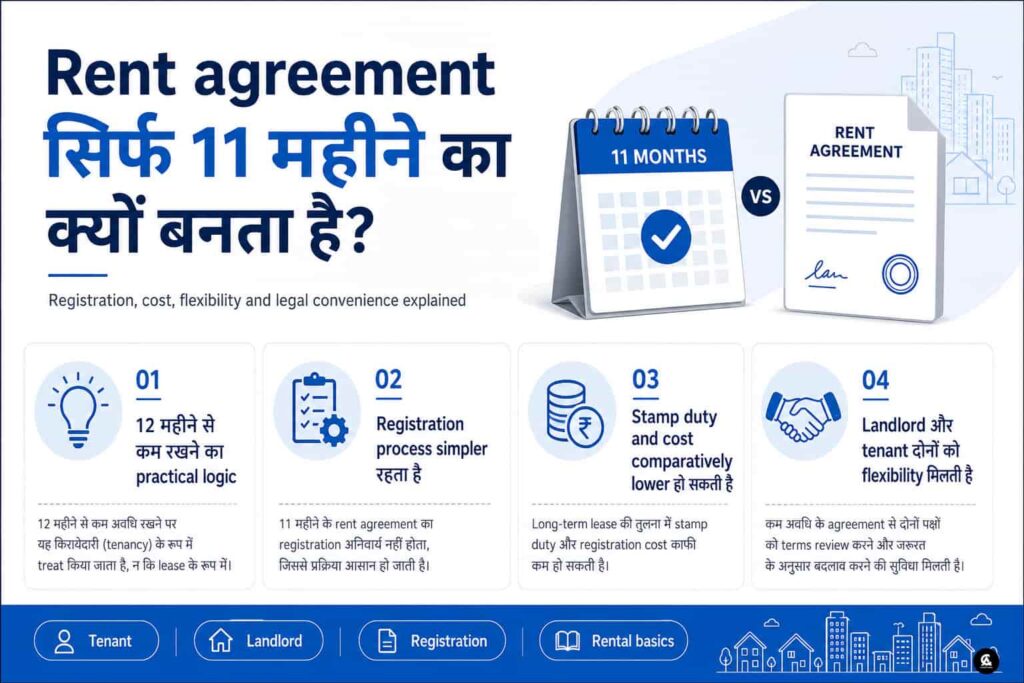
The answer is not just tradition. The 11-month rent agreement became common because it is practical, flexible and often helps avoid the extra registration burden that may arise with longer lease arrangements.
What is an 11-month rent agreement?
An 11-month rent agreement is a short-term rental contract between a landlord and a tenant. It records important terms such as monthly rent, security deposit, notice period, maintenance charges, lock-in period, rent escalation, repair responsibility and exit conditions.
In India, many residential rental agreements are made for 11 months because it keeps the agreement below the one-year threshold. Longer lease arrangements may require more formal registration, stamp duty and legal compliance depending on applicable rules.
The main reason: Keeping it below 12 months
The biggest reason behind an 11-month rent agreement is the registration threshold.
In general, lease agreements for a longer period can require registration under property law. To avoid extra formalities, many landlords and tenants prefer an 11-month agreement.
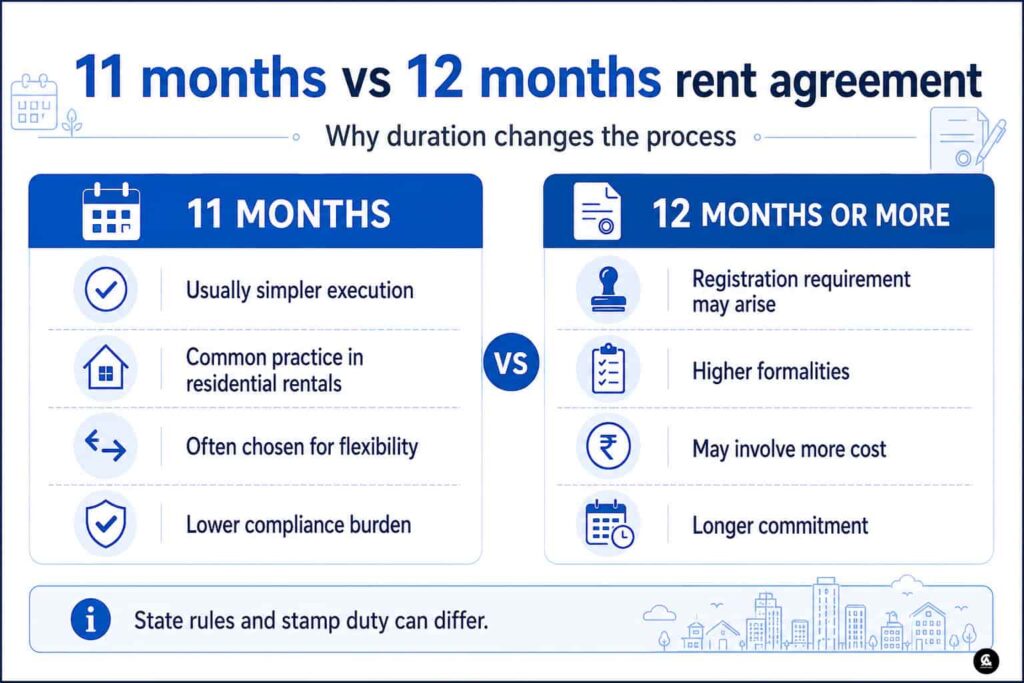
In simple terms:
| Duration | Practical meaning |
|---|---|
| 11 months | Usually simpler, cheaper and easier to execute |
| 12 months or more | Registration and higher compliance may apply |
This is why 11 months became the most common rental practice in India.
Is an 11-month rent agreement illegal?
No. An 11-month rent agreement is not illegal. It is a widely used rental practice in India.
However, it should not be treated casually. A weak or poorly drafted agreement can create disputes later. The agreement should clearly mention rent, deposit, notice period, lock-in clause, maintenance, repair responsibility, rent increase and exit terms.
The problem is not the 11-month duration. The problem is an unclear agreement.
Notarised agreement vs registered agreement
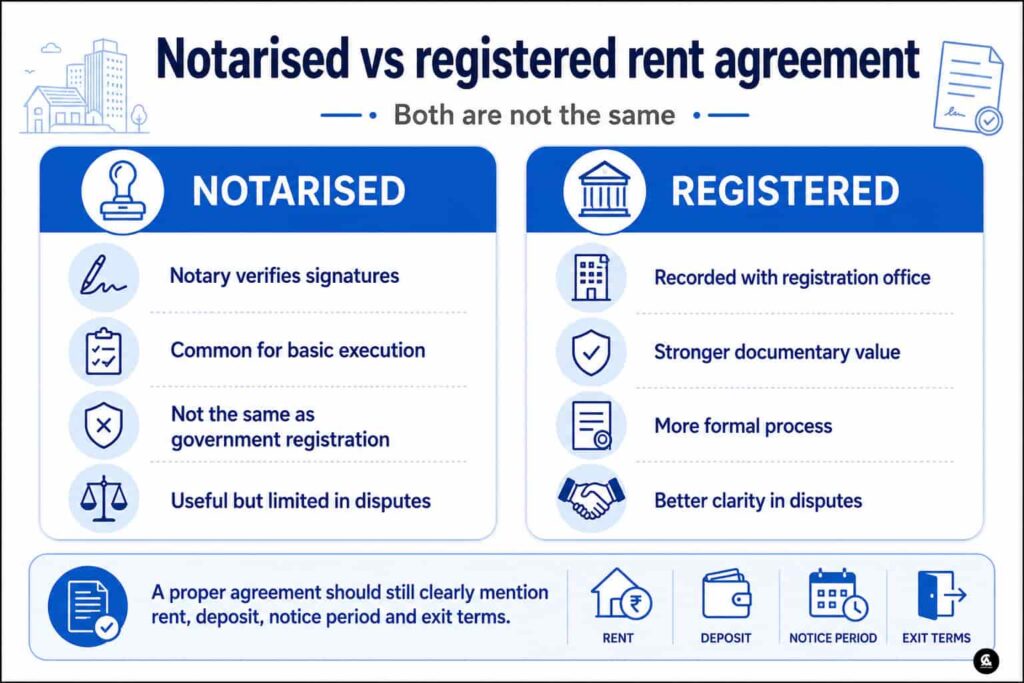
Many people think a notarised agreement and a registered agreement are the same. They are not.
A notarised agreement means a notary verifies the signatures and execution of the document. A registered agreement is recorded with the government registration office and may carry stronger documentary value in disputes.
| Notarised agreement | Registered agreement |
|---|---|
| Verified by notary | Recorded with registration office |
| Common for basic execution | More formal process |
| Not the same as government registration | Stronger documentary value |
| Useful, but limited in disputes | Better clarity in legal disputes |
Even if an agreement is only for 11 months, it should still be properly drafted and executed on appropriate stamp paper as per state rules.
Why landlords prefer 11-month agreements?
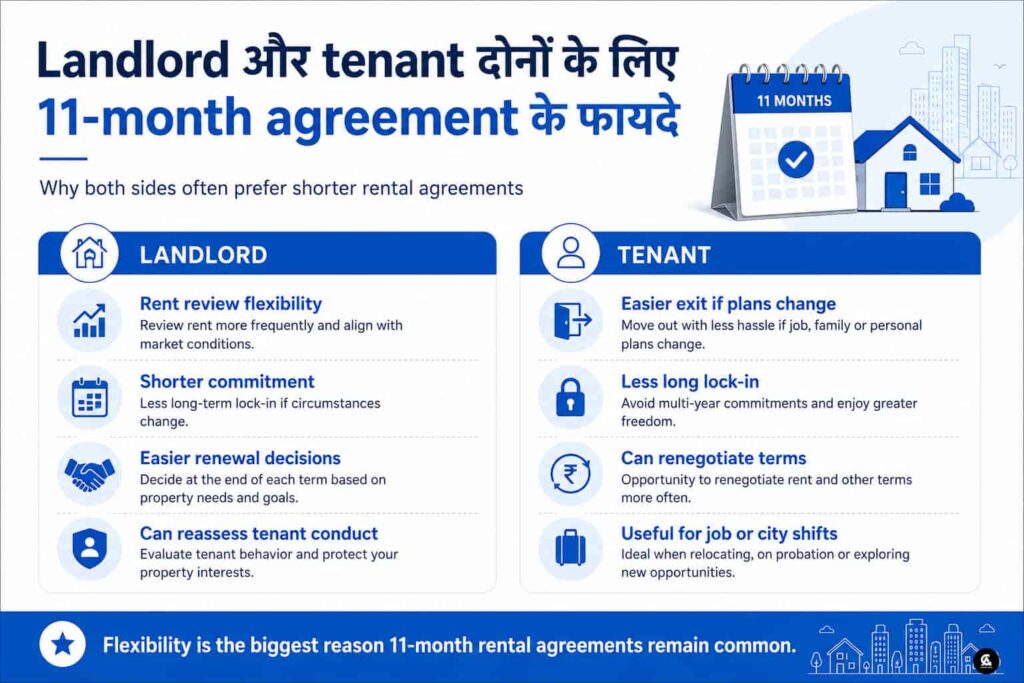
For landlords, an 11-month agreement gives flexibility.
After 11 months, the landlord can review the tenant’s conduct, revise rent, renew the agreement or end the arrangement as per agreed terms. It also prevents the landlord from being locked into a long arrangement with a tenant who delays rent, damages property or misuses the premises.
For landlords, the 11-month format is useful because it allows:
- Rent review flexibility
- Shorter commitment
- Easier renewal decisions
- Opportunity to reassess tenant conduct
Why tenants also prefer 11-month agreements?
Tenants also get flexibility from an 11-month agreement.
If the tenant changes job, shifts city, faces family changes or finds rent too high, a shorter agreement makes exit easier compared to a long lease.
For tenants, it can help with:
- Easier exit if plans change
- Less long-term lock-in
- More frequent renegotiation
- Better flexibility for job or city shifts
What happens after 11 months?
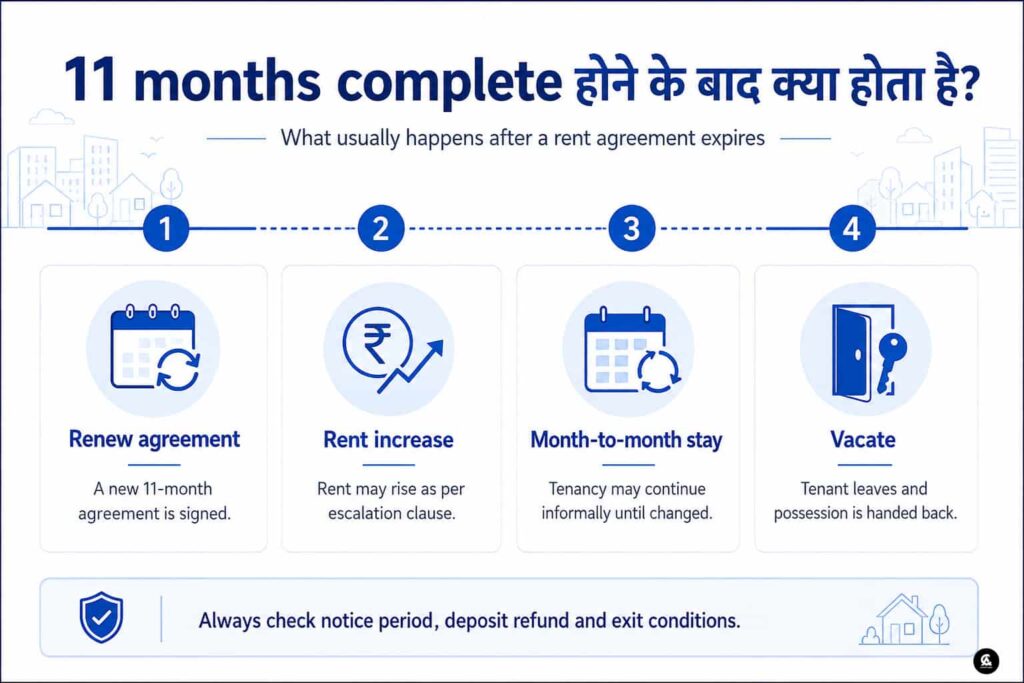
After 11 months, four things usually happen:
| Situation | Meaning |
|---|---|
| Agreement renewal | A new 11-month agreement is signed |
| Rent increase | Rent may rise as per the escalation clause |
| Month-to-month stay | Tenancy may continue informally if both sides agree |
| Vacating the property | Tenant leaves and possession is handed back |
This is why the agreement must clearly mention the notice period, rent escalation, deposit refund and exit conditions.
Does every 11-month agreement avoid registration?
Not always. Rules can vary from state to state.
Stamp duty, registration charges and tenancy rules are not exactly the same across India. Some states are trying to make rental agreements more formal and transparent. The Model Tenancy Act also encourages clearer landlord-tenant relationships, but its actual application depends on how individual states adopt or adapt it.
So the safe approach is simple: check your state’s stamp duty, registration and tenancy rules before signing.
What should every rent agreement include?
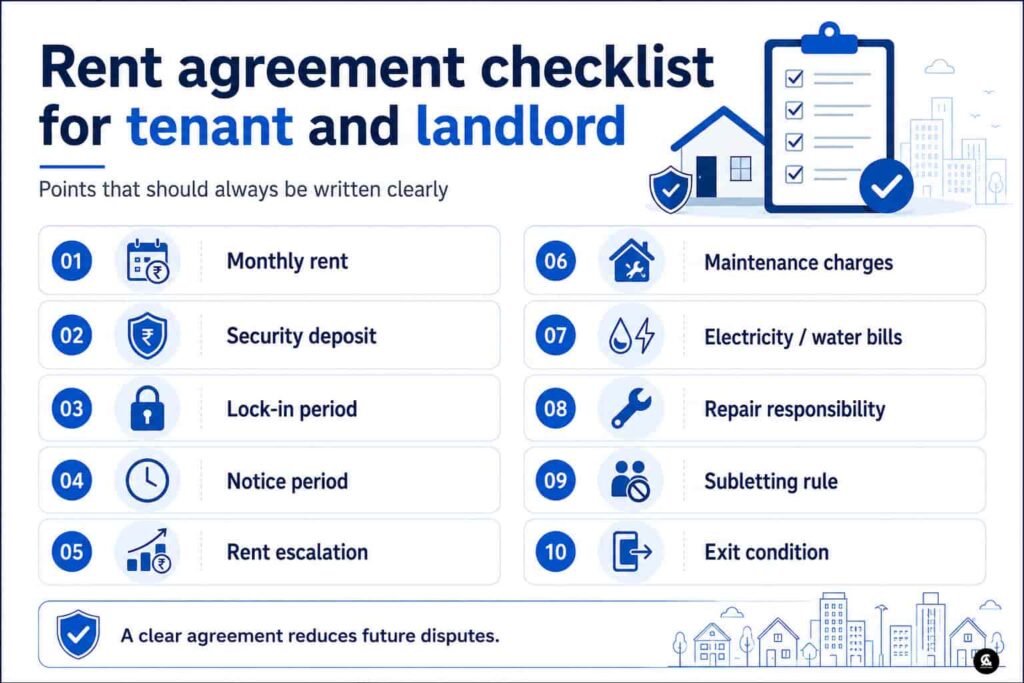
A good rent agreement protects both the landlord and the tenant. These points should always be written clearly:
| Clause | Why it matters |
|---|---|
| Monthly rent | Avoids payment disputes |
| Security deposit | Gives refund clarity |
| Lock-in period | Defines early exit rules |
| Notice period | Makes vacating process clear |
| Rent escalation | Explains future rent increase |
| Maintenance charges | Avoids society/repair cost disputes |
| Electricity and water bills | Clarifies monthly bill responsibility |
| Repair responsibility | Defines who repairs what |
| Subletting rule | Prevents unauthorised subletting |
| Exit condition | Clarifies painting, cleaning and damage deductions |
Common mistake: Downloading a random template
Many people download a rent agreement template from the internet and sign it without customising the terms. This can be risky.
Every property is different. A furnished flat, semi-furnished flat, independent house, apartment, PG and commercial space may need different clauses. The agreement should reflect the actual deal between the landlord and tenant.
A wrong or incomplete template can create disputes over rent, deposit, repairs, notice period and possession.
Final view
Rent agreements are usually made for 11 months because this duration is practical, flexible and often keeps the arrangement below the one-year registration threshold.
But an 11-month agreement is not a magic protection. If the agreement is poorly drafted, unclear or not compliant with state rules, disputes can still happen.
The smartest approach is simple:
Whether the rent agreement is for 11 months or a longer registered lease, it must clearly mention rent, deposit, notice period, rent escalation, maintenance, repair duties and exit terms.
A good rent agreement protects both sides. A careless one creates future problems.
Sources:-
- TOI explainer on 11-month rent agreements in India:
https://timesofindia.indiatimes.com/real-estate/news/cost-convenience-and-validity-why-11-month-agreements-are-a-norm-in-india/articleshow/132138389.cms - Economic Times legal explainer on unregistered rent agreements and rent escalation:
https://m.economictimes.com/wealth/legal/will/tenants-cannot-avoid-paying-increased-rent-on-the-ground-of-rent-agreement-not-bing-registered/articleshow/129568931.cms - TOI explainer on lease vs rent agreement:
https://timesofindia.indiatimes.com/real-estate/news/what-is-the-difference-between-a-lease-and-a-rent-agreement/photostory/127894508.cms - TOI explainer on Model Tenancy Act and rental security deposit rules:
https://timesofindia.indiatimes.com/real-estate/news/security-deposit-rules-explained-what-does-the-model-tenancy-act-say/articleshow/131388468.cms






Leave a Reply