

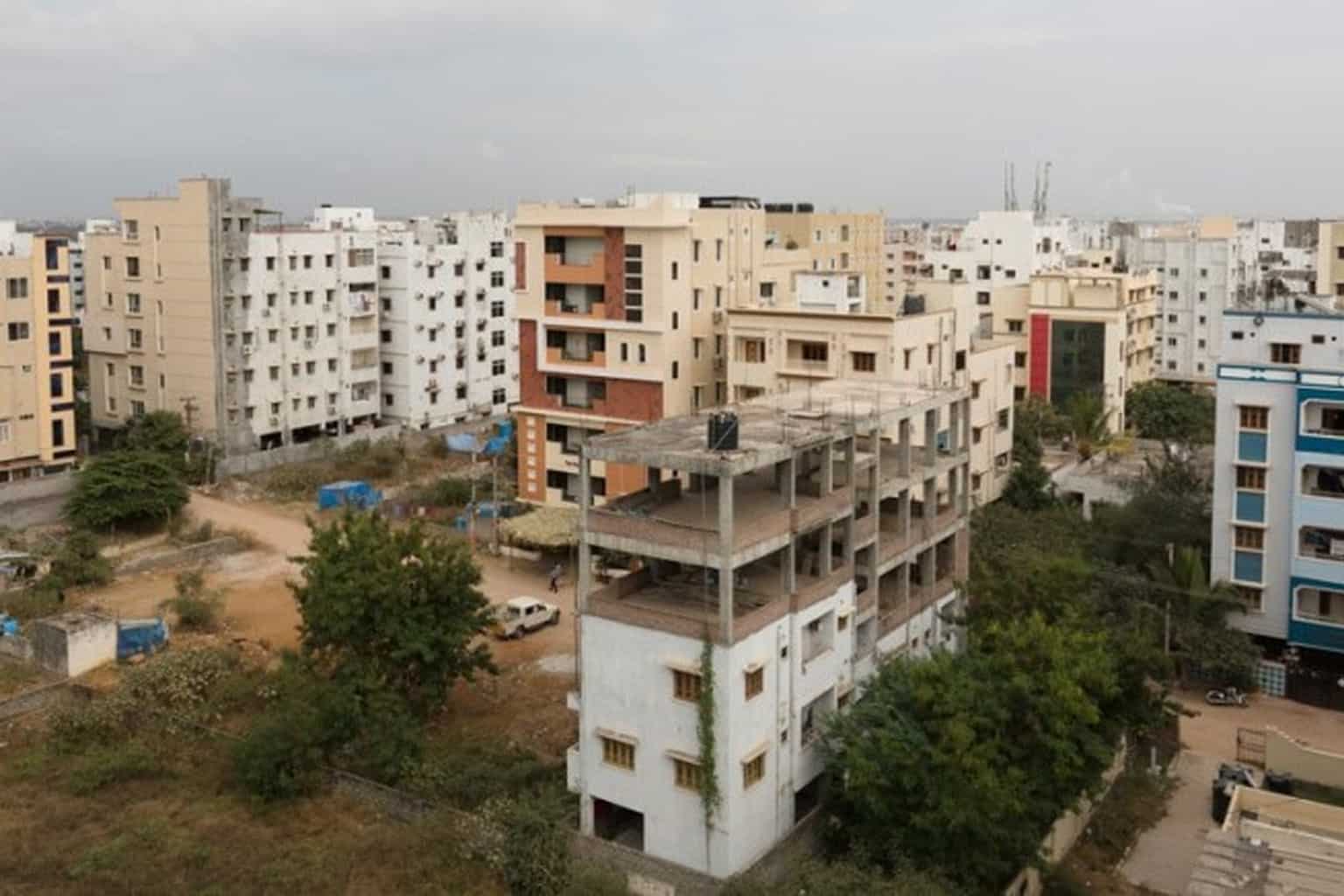
Affordable housing in India is changing fast. A few years ago, buyers used to ask one simple question: where is the cheapest home available?
In 2026, that question is no longer enough.
A city is truly affordable only when home prices, EMI burden, income levels, job opportunities, infrastructure growth and future liveability work together. A cheap flat in a weak location can become expensive in daily life. A slightly costlier home in a better-connected city can be more affordable in the long run.
India’s housing market is still active, but affordable homes are under pressure. Knight Frank’s H1 2026 reading says India’s residential market delivered one of its strongest first-half performances in more than a decade, but premium housing is now driving the market while affordable housing continues to shrink. Homes priced above ₹1 crore accounted for 54% of residential sales, while homes below ₹50 lakh accounted for only 19%.
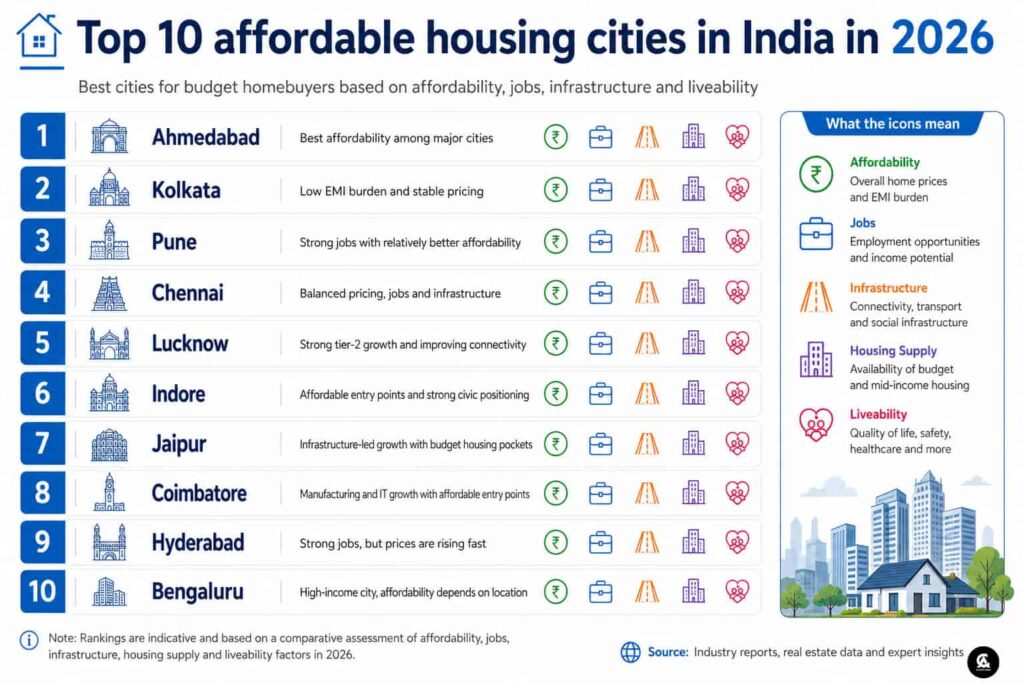
What makes a city affordable for homebuyers?
Affordable housing is not only about the lowest property rate. A city becomes affordable when a buyer can purchase a legal, liveable and well-connected home without putting the family budget under stress.
For this ranking, the cities have been judged on these factors:
| Factor | Why it matters |
|---|---|
| EMI-to-income ratio | Shows how much household income goes into home loan repayment |
| Average property price | Helps understand the real buying cost |
| Job market | A cheaper city is not useful if income opportunities are weak |
| Infrastructure growth | Roads, metro, expressways and business hubs improve future value |
| Affordable supply | Buyers need actual homes, not just low prices on paper |
| Liveability | Schools, hospitals, transport, safety and civic services matter |
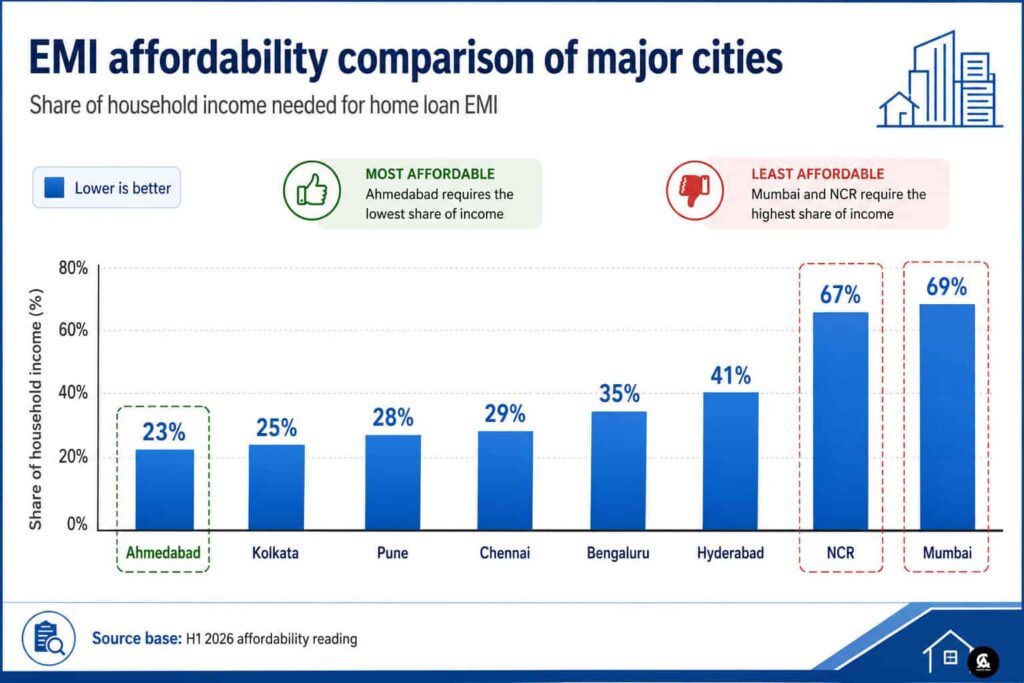
Knight Frank’s Affordability Index gives an important base for major cities. In H1 2026, Ahmedabad remained the most affordable major housing market with an EMI-to-income ratio of 23%. Kolkata followed at 25%, Pune at 28%, Chennai at 29%, Bengaluru at 35% and Hyderabad at 41%. NCR and Mumbai remained difficult markets with affordability ratios of 67% and 69% respectively.
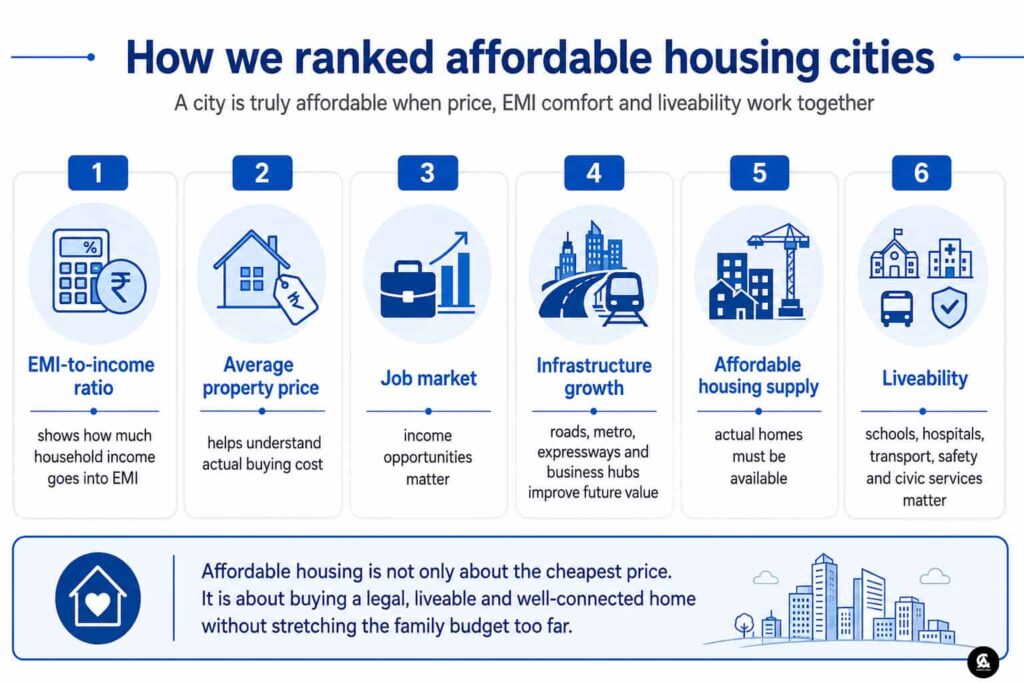
Top 10 affordable housing cities in India in 2026
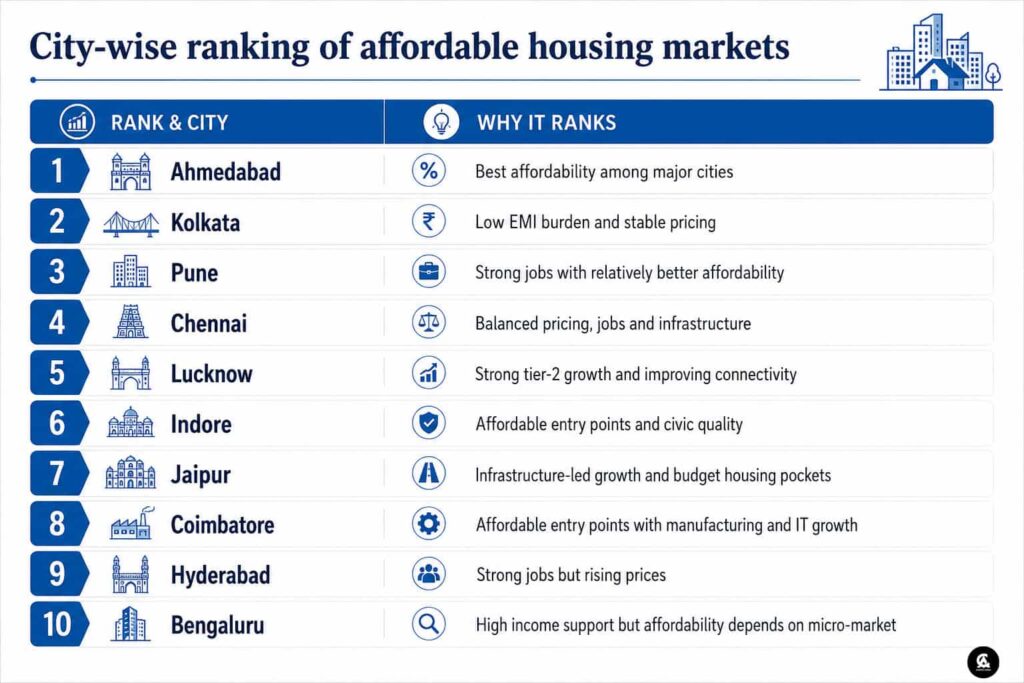
| Rank | City | Why it makes the list |
|---|---|---|
| 1 | Ahmedabad | Best affordability among major cities |
| 2 | Kolkata | Low EMI burden and stable pricing |
| 3 | Pune | Strong jobs with relatively better affordability |
| 4 | Chennai | Balanced pricing, jobs and infrastructure |
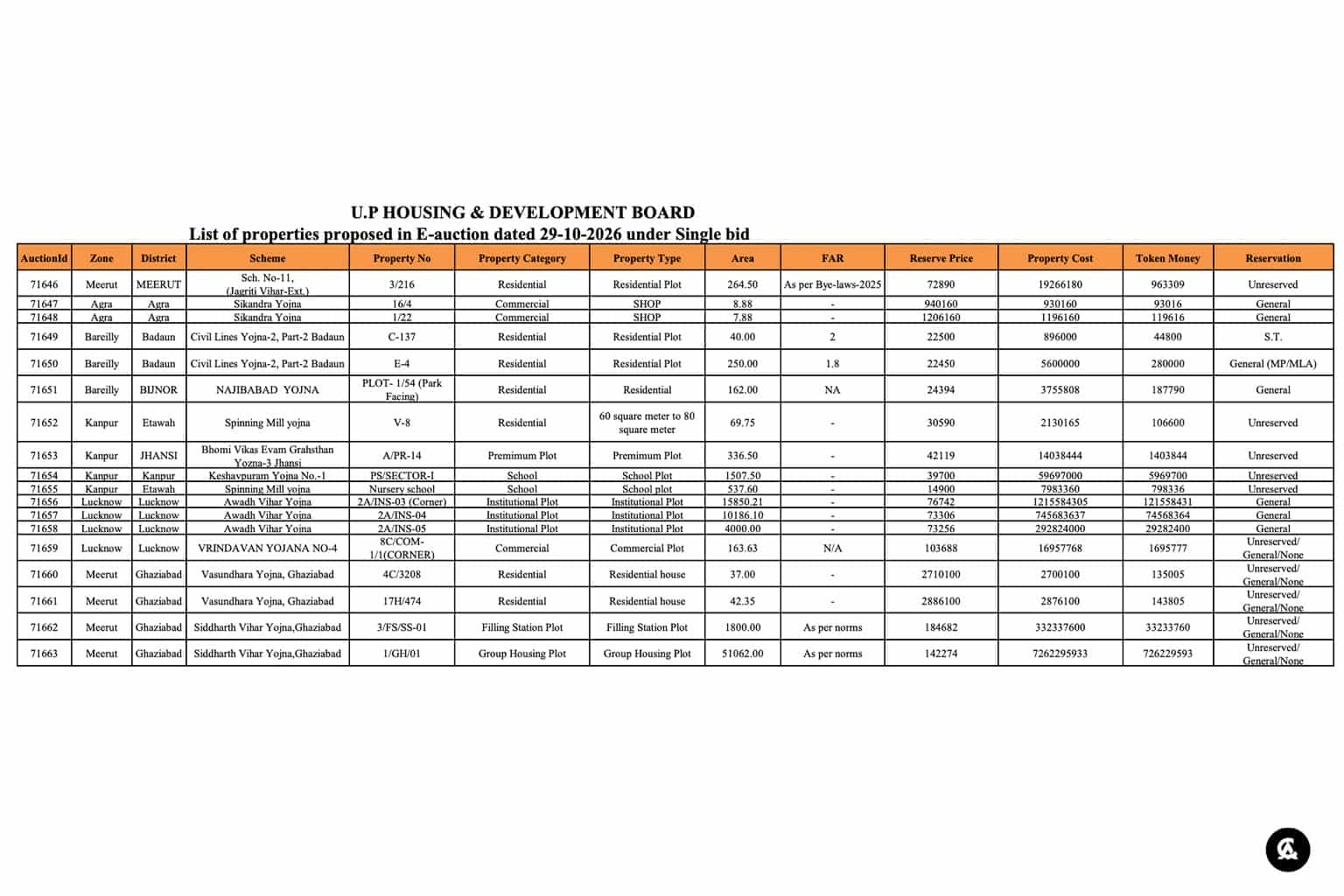
| 5 | Lucknow | Strong tier-2 growth and improving connectivity |
| 6 | Indore | Affordable entry points and strong civic positioning |
| 7 | Jaipur | Infrastructure-led growth with budget housing pockets |
| 8 | Coimbatore | Manufacturing, IT growth and affordable entry points |
| 9 | Hyderabad | Strong jobs, but prices are rising fast |
| 10 | Bengaluru | High-income city, but affordability depends on location |
1. Ahmedabad
Ahmedabad is the strongest affordable housing city among India’s major urban markets. Its biggest advantage is the balance between relatively lower housing cost, industrial growth, improving infrastructure and better EMI comfort.
With an EMI-to-income ratio of 23%, Ahmedabad had the best affordability score among the eight major cities tracked in H1 2026. This means an average buyer in Ahmedabad spends a smaller share of income on home loan EMIs compared with buyers in Bengaluru, Hyderabad, NCR and Mumbai.
Ahmedabad also benefits from Gujarat’s industrial base, road connectivity and planned urban expansion. For first-time buyers, this makes it one of the most practical cities to consider.
Best for: First-time buyers, middle-income families, long-term investors
Watch out for: Micro-market selection, distance from workplace and future civic infrastructure
2. Kolkata
Kolkata is one of the most underrated affordable housing markets in India. It may not have the same investor hype as Bengaluru, Hyderabad or Pune, but it offers one of the lowest EMI burdens among major cities.
In H1 2026, Kolkata ranked as the second-most affordable housing market among the eight major cities tracked by Knight Frank. The city recorded an EMI-to-income ratio of 25%, meaning an average buyer spends roughly one-fourth of household income on home loan EMIs.
Kolkata’s advantage is price stability. The city has not seen the same level of price surge as many other metros. For buyers who want metro living at a comparatively lower cost, Kolkata remains a serious option.
Best for: End-users, salaried families, buyers looking for metro living at lower cost
Watch out for: Project quality, location connectivity and resale liquidity
3. Pune
Pune is not the cheapest city, but it is one of the best cities where affordability and income opportunity still meet. The city has a strong IT, manufacturing, education and services base, which supports housing demand across several price segments.
Pune’s EMI-to-income ratio stood at 28% in H1 2026, making it more affordable than Bengaluru, Hyderabad, NCR and Mumbai.
The city’s strength lies in employment. Areas connected with IT parks, manufacturing belts and educational hubs continue to attract homebuyers. For working professionals, Pune can still be affordable if the buyer chooses the right micro-market instead of chasing only premium locations.
Best for: IT professionals, young families, first-time apartment buyers
Watch out for: Traffic, project delivery timelines and high prices in premium corridors
4. Chennai
Chennai remains one of the most balanced housing markets among India’s large cities. It has employment drivers from automobiles, manufacturing, IT, healthcare, education and ports, while still offering comparatively reasonable housing options in several suburban and peripheral belts.
In H1 2026, Chennai’s EMI-to-income ratio was 29%, keeping it within the affordable range compared with cities like Hyderabad, Bengaluru, NCR and Mumbai.
For buyers who want a mature metro with steady job opportunities and relatively controlled housing cost, Chennai deserves attention. It may not always generate flashy real estate headlines, but it remains practical for end-users.
Best for: End-users, working families, long-term homebuyers
Watch out for: Flood-prone areas, distance from employment hubs and project approvals
5. Lucknow
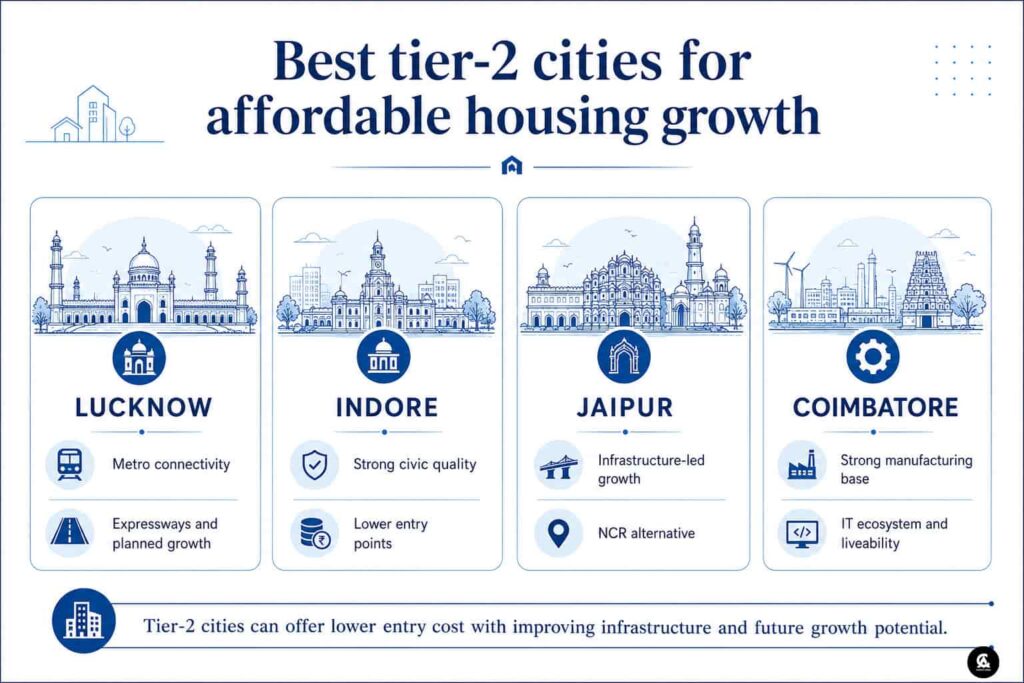
Lucknow is one of the strongest tier-2 real estate markets for affordable housing. The city has improved because of road networks, metro connectivity, expressway access and planned residential expansion.
Lucknow is increasingly being seen as a modern economic hub, supported by infrastructure development, public expenditure and improvement in ease of living.
Its biggest advantage is that it offers lower entry prices than NCR while giving buyers a capital-city lifestyle, government employment base, education, healthcare and improving connectivity.
Best for: UP-based families, government employees, end-users, long-term investors
Watch out for: Unapproved colonies, unclear land titles and distant locations with weak civic services
6. Indore
Indore is a strong affordable housing city because it combines civic quality, business activity, infrastructure improvement and relatively lower property entry points.
The city is suitable for buyers who want a lower-cost market than large metros but better liveability than many smaller towns. Its clean-city image, commercial growth and expanding residential corridors make it attractive for end-users and long-term investors.
Best for: End-users, small investors, business families, buyers seeking tier-2 growth
Watch out for: Speculative pricing near new corridors and project approval status
7. Jaipur
Jaipur is gaining importance because of infrastructure-led growth, tourism, industrial corridors and its location advantage near Delhi-NCR.
The city has budget housing pockets as well as premium micro-markets. For a buyer leaving NCR’s high prices but still wanting a large, well-connected North Indian city, Jaipur can be a practical alternative.
Best for: Long-term investors, Rajasthan-based families, retirees, end-users
Watch out for: Overpriced outskirts, water availability and approval quality
8. Coimbatore
Coimbatore is one of South India’s strongest affordable housing cities outside the main metros. It has a manufacturing base, textile economy, growing IT activity and relatively affordable entry points.
For buyers who want South Indian city stability without Bengaluru or Chennai-level pressure, Coimbatore offers a good balance. It is especially relevant for families, business owners and retirees looking for a liveable, less aggressive market.
Best for: End-users, business owners, South India-based families, retirees
Watch out for: Location selection, water supply and resale demand outside key corridors
9. Hyderabad
Hyderabad is no longer a low-cost city, but it still deserves a place on this list because of its job market, IT ecosystem, infrastructure and income potential. For many buyers, affordability is not only about cheap property; it is also about whether income can support the EMI.
In H1 2026, Hyderabad’s EMI-to-income ratio stood at 41%. This is higher than Ahmedabad, Kolkata, Pune and Chennai, but still below the 50% affordability threshold used in housing affordability analysis.
Hyderabad is best suited for buyers with stable income who want long-term employment-led growth. However, budget buyers must be careful because prices in several major corridors have already moved sharply upward.
Best for: IT professionals, long-term end-users, higher-income salaried buyers
Watch out for: High land prices, premium project concentration and long commute corridors
10. Bengaluru
Bengaluru is not cheap, but it enters the top 10 because its employment base is one of the strongest in India. Affordability can still work for buyers who choose peripheral or emerging locations carefully.
Bengaluru’s EMI-to-income ratio stood at 35% in H1 2026, which is higher than Pune and Chennai but better than Hyderabad, NCR and Mumbai.
The city’s technology and Global Capability Centre ecosystem continues to support housing demand. Knight Frank’s H1 2026 reading also pointed to Bengaluru as one of the strongest growth performers among major residential markets.
For buyers, the key is location discipline. Bengaluru can be affordable only if the buyer avoids overheated premium corridors and focuses on liveable, well-connected emerging belts.
Best for: Tech professionals, high-income first-time buyers, long-term end-users
Watch out for: Traffic, water stress, high prices in IT corridors and delayed infrastructure promises
Why Mumbai and NCR are not in the top 10?
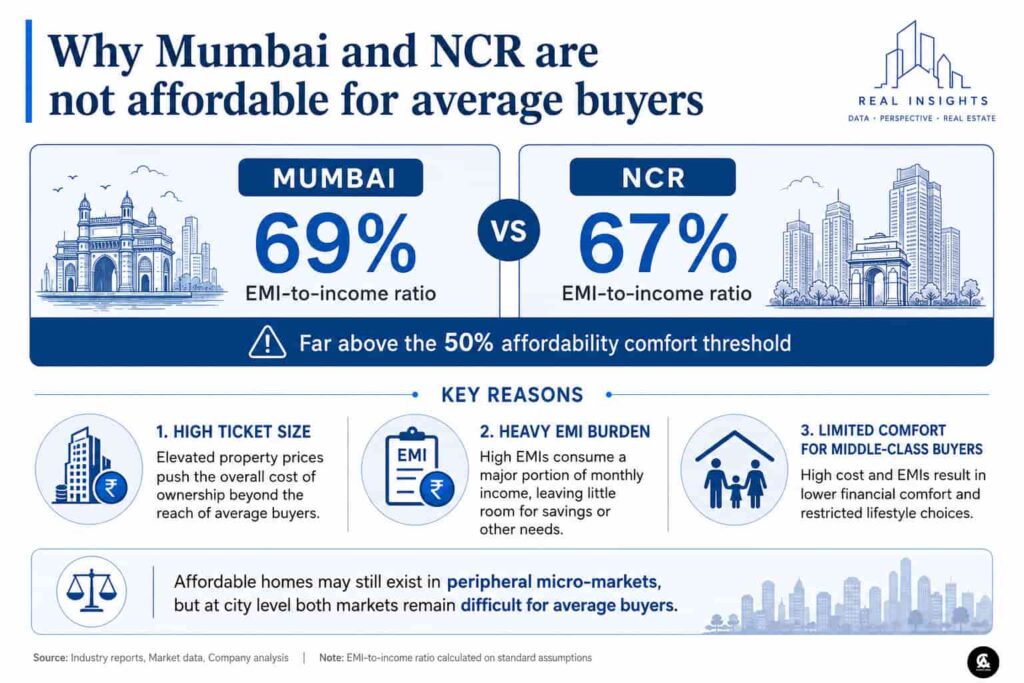
Mumbai and NCR are important real estate markets, but they do not qualify as affordable housing cities for the average buyer in 2026.
In H1 2026, Mumbai’s EMI-to-income ratio was around 69%, while NCR stood at 67%. These are far above the 50% affordability threshold generally used to assess housing comfort.
This does not mean no affordable homes exist in MMR or NCR. Budget homes are available in far suburbs, peripheral locations and specific micro-markets. But at a city-level affordability level, both markets remain difficult for middle-class buyers.
What affordable housing really means in 2026?
Affordable housing is not only a ₹25 lakh or ₹40 lakh flat. It is a house that does not financially break the buyer.
A home is affordable when:
| Question | Buyer should ask |
|---|---|
| EMI burden | Is the EMI comfortable after all monthly expenses? |
| Location | Is the home close enough to work, school and transport? |
| Legal safety | Is the project RERA-registered and approved? |
| Builder quality | Does the developer have delivery credibility? |
| Future cost | Are maintenance, parking, club charges and taxes manageable? |
| Resale | Will the location have future demand? |
| Infrastructure | Are roads, drainage, water and public transport reliable? |
PMAY-U 2.0 also shows that affordable housing is not only about ownership. The scheme is structured around different verticals such as beneficiary-led construction, affordable housing in partnership, affordable rental housing and interest subsidy support for eligible urban households.
Buyer checklist before choosing an affordable city
Before choosing a city or project, buyers should check:
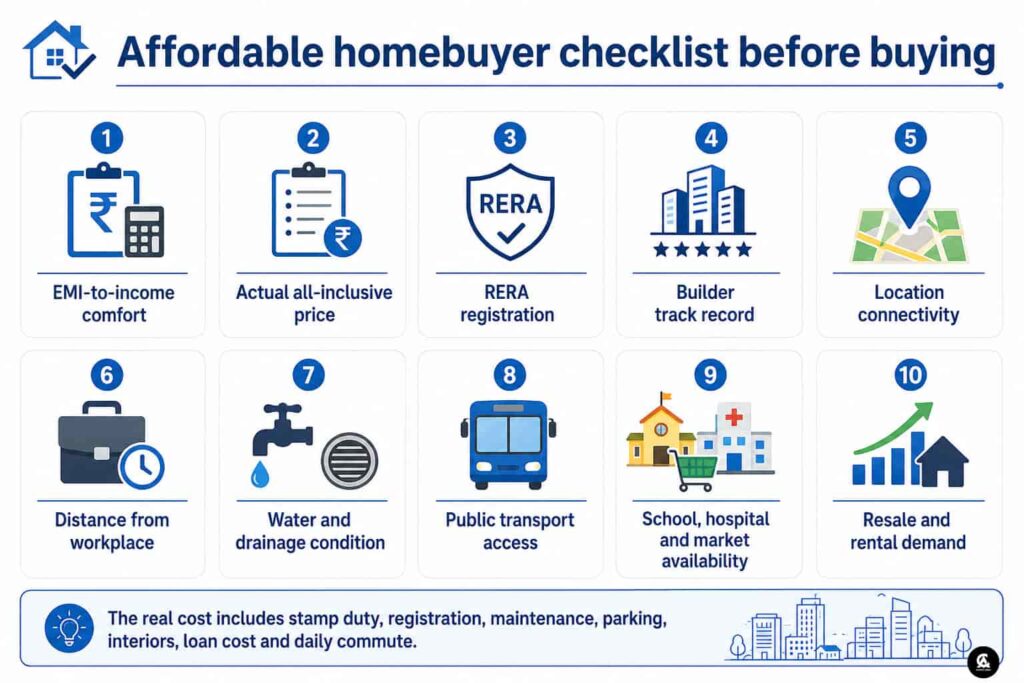
- EMI-to-income comfort
- Actual all-inclusive price
- RERA registration
- Builder track record
- Location connectivity
- Distance from workplace
- Water and drainage condition
- Public transport access
- School, hospital and market availability
- Resale and rental demand
The biggest mistake buyers make is comparing only the basic property price. The real cost includes stamp duty, registration, GST if applicable, maintenance, parking, interiors, loan cost and daily commute.
Carpet Area view
For 2026, Ahmedabad, Kolkata, Pune and Chennai are the strongest affordable housing cities among major Indian markets because their EMI burden is still relatively manageable.
Lucknow, Indore, Jaipur and Coimbatore are strong tier-2 options because they offer lower entry costs with improving infrastructure and better future growth potential.
Hyderabad and Bengaluru are not cheap, but they remain relevant because of strong job markets and income potential. Buyers should treat them as income-supported affordability markets, not low-cost markets.
The final decision should not be based on city ranking alone. It should be based on the buyer’s income, job stability, family needs, loan eligibility, micro-market and long-term holding period.
Final view
The best affordable housing city in India in 2026 is not simply the city with the lowest property price. It is the city where a buyer can purchase a legal, liveable and well-connected home without putting the family under long-term financial stress.
For most middle-class buyers, Ahmedabad and Kolkata offer the strongest affordability among large cities. Pune and Chennai offer the best balance between jobs and manageable EMI. Lucknow, Indore, Jaipur and Coimbatore offer strong tier-2 growth with lower entry points.
The smart buyer’s rule is simple:
Do not buy the cheapest home. Buy the home where price, income, location, legal safety and future liveability all make sense together.
Sources:-
- Knight Frank H1 2026 housing market report — premium vs affordable housing trend
https://m.economictimes.com/industry/services/property-/-cstruction/india-residential-real-estate-market-h1-2026-premium-housing-home-sales-knight-frank-mumbai-bengaluru-delhi-ncr-affordable-homes-for-middle-class-gets-tougher-to-find/articleshow/132306148.cms - Knight Frank affordability index details — Ahmedabad, Kolkata, Pune, Chennai, Bengaluru, Hyderabad, NCR and Mumbai EMI-to-income ratios
https://timesofindia.indiatimes.com/city/kolkata/avg-home-buyers-in-kol-spend-a-quarter-of-monthly-income-in-emis/articleshow/132167934.cms - India housing market consolidation and premium demand trend
https://timesofindia.indiatimes.com/real-estate/news/why-indias-housing-market-is-in-consolidation-phase-premium-demand-to-drive-h2/articleshow/132292500.cms - Lucknow growth and infrastructure story
https://timesofindia.indiatimes.com/city/lucknow/lucknows-rise-making-of-a-modern-economic-hub/articleshow/132209029.cms



Leave a Reply