

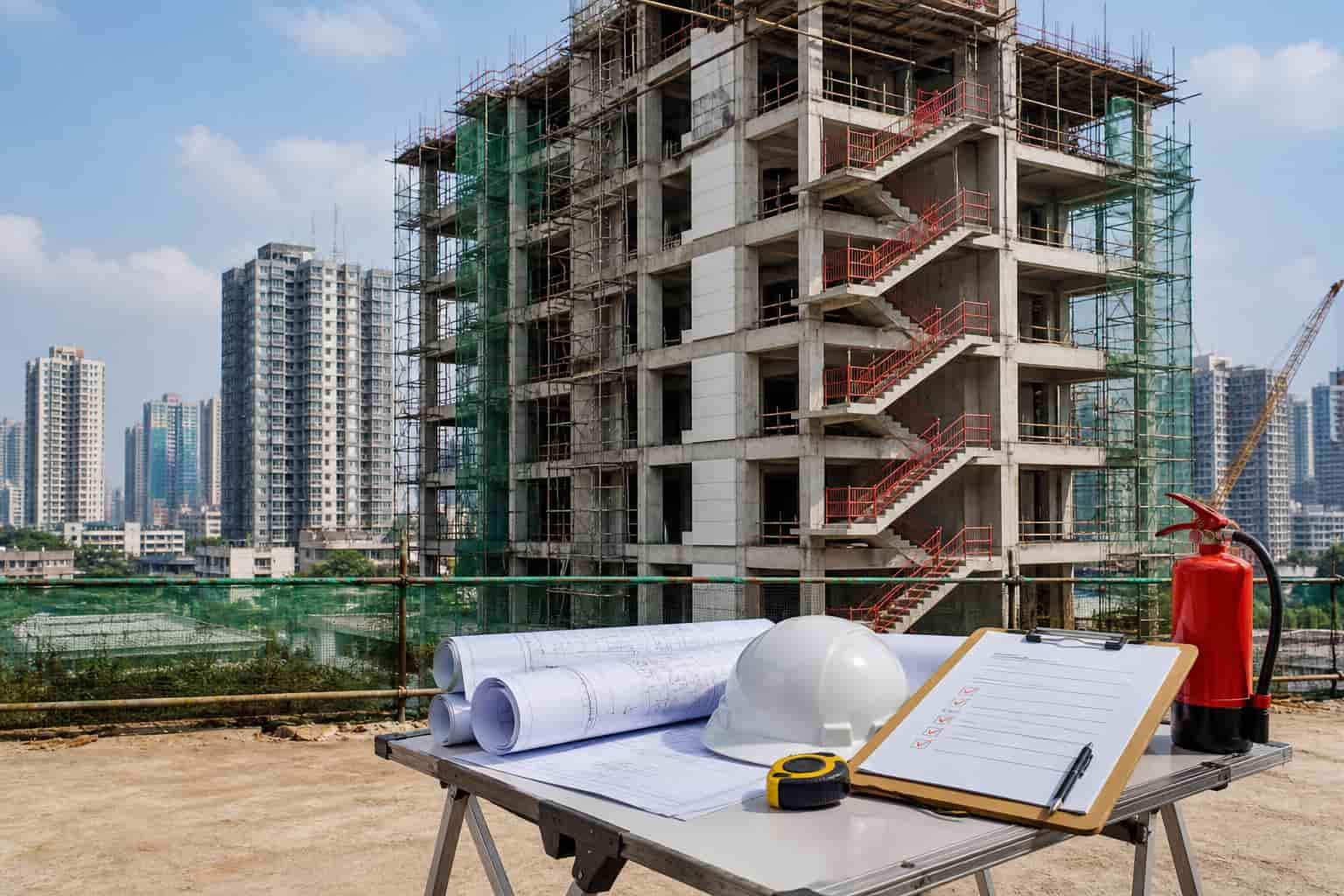
India’s real estate market is growing fast, but the quality of urban construction is now becoming as important as the speed of construction. Buyers are no longer looking only at location, amenities and carpet area. They are also asking tougher questions about safety, approvals, fire exits, emergency access, building design and long-term maintenance. That is why the shift from the older National Building Code to the new National Building Construction Standards 2026 has become an important development for homebuyers, developers and city planners.
The Bureau of Indian Standards has listed SP 7:2026 as the National Building Construction Standards 2026. In simple terms, this is the new national-level reference framework for building construction standards in India. It replaces the earlier National Building Code framework, which had been widely used as a guiding document by professionals, states, municipal bodies and courts while looking at building safety and construction norms.
At first, this may sound like a technical change. But for homebuyers, it matters because building rules decide how safe a structure is, how it is designed, how fire safety is planned, how exits are arranged, how services are installed and how local authorities check compliance. A change in such a framework can affect not just new projects but also the way cities think about construction approvals.
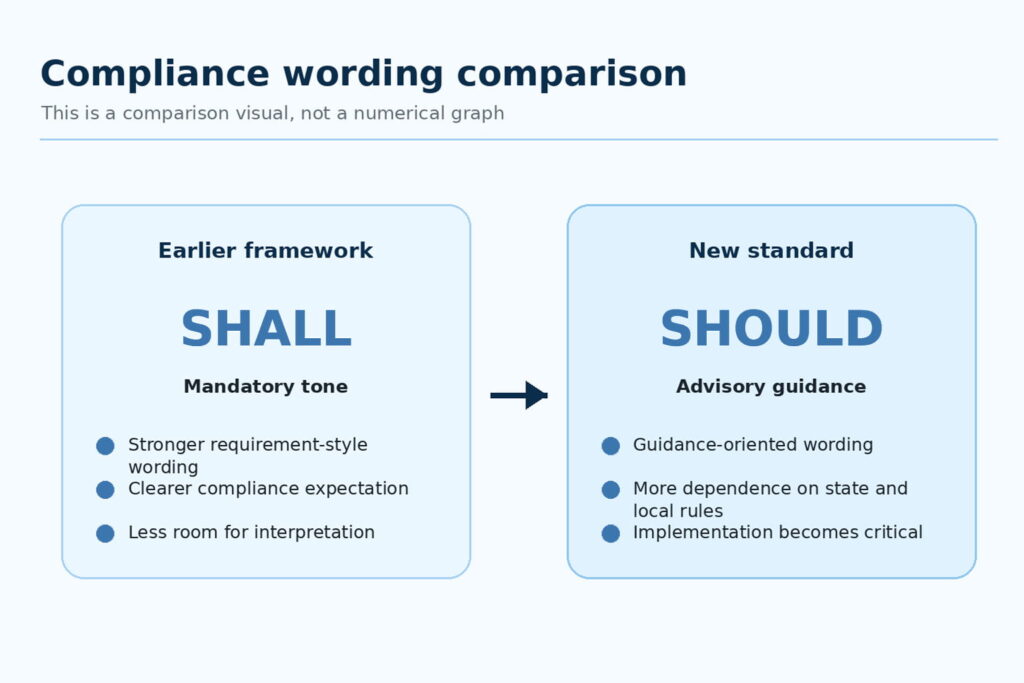
The most debated part of the new framework is fire and life safety. According to reports, the new standards retain fire safety provisions, but treat them more as guidance and referral material for states and local bodies. The reason given is that fire services are largely a state subject and a municipal function. This means the national document may guide states, but actual enforcement will depend heavily on state governments, fire departments and local authorities.
This is where the concern begins. In the earlier framework, experts say fire and life safety provisions used stronger wording such as “shall.” In the new standard, reports say the language has shifted toward “should,” which makes the provisions advisory rather than strictly mandatory in tone. For a common buyer, this small change in wording may look minor, but in regulation, such words can make a major difference. “Shall” usually suggests a requirement. “Should” usually suggests guidance.
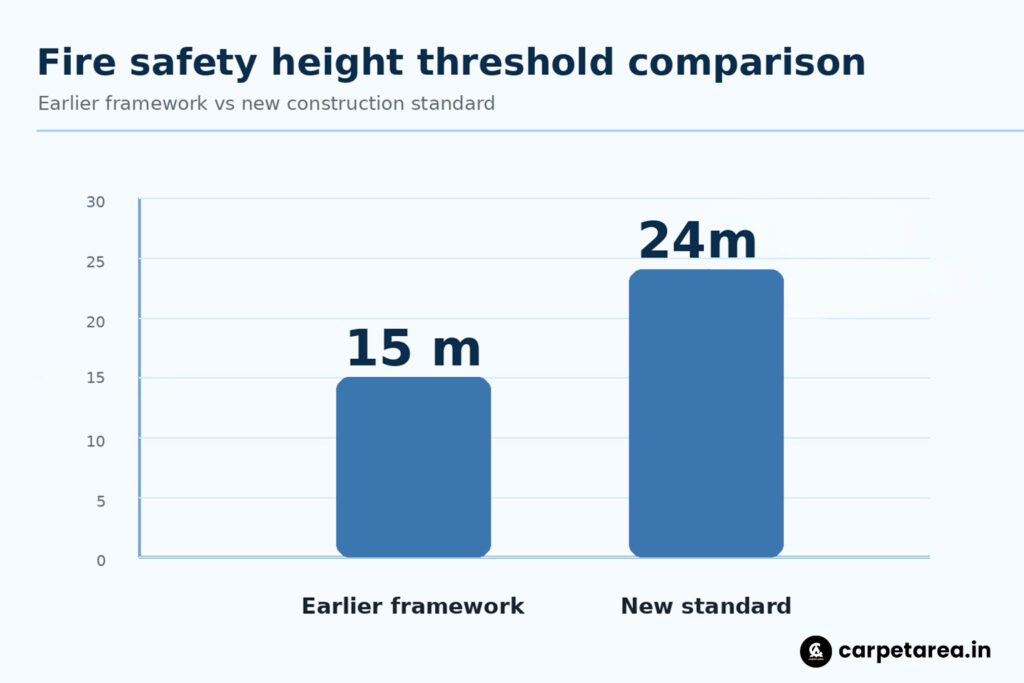
The second major issue is the height threshold. Reports say that under the earlier National Building Code framework, residential buildings above 15 metres had to follow fire and life safety norms. Under the new National Building Construction Standards, these provisions are stated to apply to buildings that are 24 metres high or more. This means many mid-rise residential buildings between 15 metres and 24 metres may fall into a different compliance space, depending on how states and local authorities frame their own rules.
Supporters of the change may argue that construction is a state subject and local bodies should have more flexibility. India is not one uniform market. A dense Mumbai suburb, a planned township in Pune, a hill-town development, a small-city apartment project and a large mixed-use development may all need different planning approaches. A performance-oriented framework can give room for innovation and local decision-making.
But the risk is also clear. Not every municipal body has the same technical capacity. Some cities have strong fire departments, better approval systems and more trained professionals. Others may lack manpower, inspection capacity and technical expertise. If the national benchmark becomes softer and local enforcement is uneven, buyers may face confusion about what safety standard their building actually follows.
For homebuyers, the lesson is simple: do not assume that a new building is automatically safe because it has been approved. Approvals are important, but buyers should ask specific questions. Does the building have proper fire exits? Is there a fire detection and alarm system? Are staircases accessible and usable? Is there enough access for fire tenders? Are refuge areas provided where required? Are lifts, electrical rooms and basements planned safely? Has the project received the required fire NOC from the local authority?
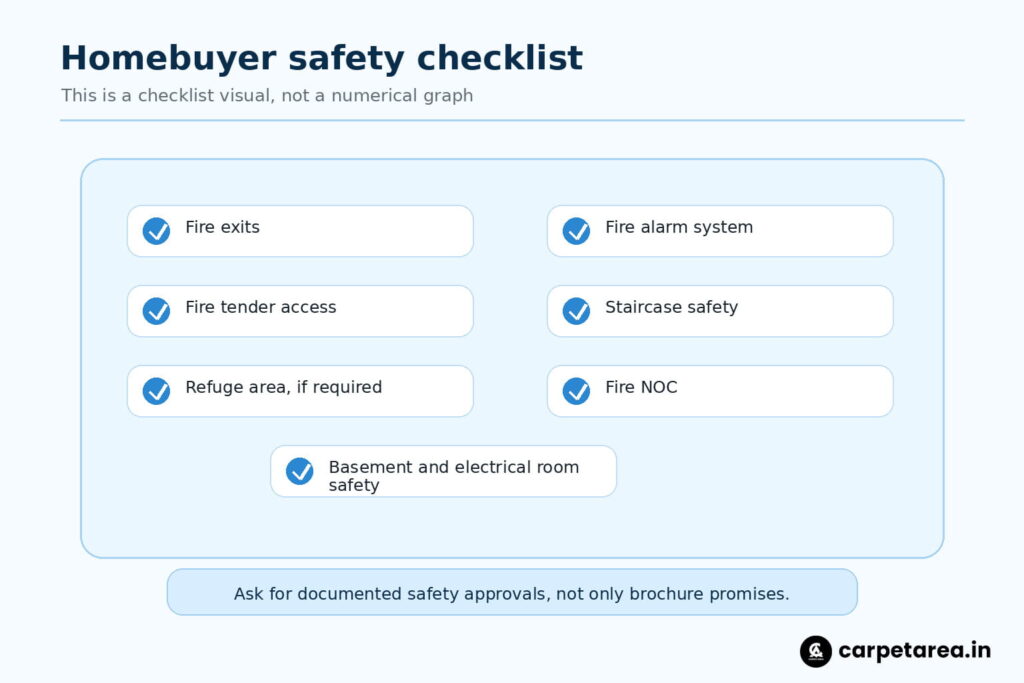
This is especially important for under-construction projects. A buyer usually focuses on price, location, possession date, amenities and payment plan. But after this policy shift, fire safety and building compliance should become part of the booking checklist. If a developer is selling a multi-storey project, buyers should ask which building standard has been followed, whether the local fire authority has approved the plan, and whether any fire safety relaxations have been taken.
For developers, the new standard creates both flexibility and responsibility. Flexibility means states and local bodies may adapt norms to local conditions. Responsibility means developers cannot hide behind minimum compliance. In a competitive market, safety can become a selling point. A project that clearly follows strong fire and life safety practices may build more trust than one that simply says all approvals are in place.
For cities, the challenge is bigger. India is urbanising quickly. More people are living in apartments, gated communities, mixed-use buildings and dense residential clusters. If local authorities now have more responsibility, they need better capacity, clearer rules, trained inspectors and regular audits. Otherwise, advisory standards may remain on paper while actual site conditions remain weak.
This debate is not only about builders. It is about public safety. A fire incident does not affect only one flat. It can affect an entire building, neighbouring structures, emergency responders and surrounding streets. That is why fire and life safety cannot be treated as a small technical item. It is a basic part of responsible urban development.
The new National Building Construction Standards 2026 may help modernise India’s construction framework, but the success of this change will depend on implementation. If states create strong local rules and enforce them properly, the new framework can work. But if advisory language leads to weaker compliance, the risk will shift directly to residents.
For homebuyers, the final message is clear. Do not buy only on brochure value. Check safety value. Ask for fire approvals. Study the project’s layout. Check emergency exits. Ask about alarms, staircases, access roads and safety equipment. In today’s market, a safe building is not just a technical requirement. It is one of the most important parts of a good real estate decision.




Leave a Reply