


India’s real estate market is not moving like a simple boom story anymore. In some housing markets, buyers are becoming selective. In some commercial markets, investors are looking more closely at returns. In many cities, land prices are high and project costs are rising. But despite these challenges, a major signal has come from the capital market: investors are still putting serious money into Indian real estate.
According to CBRE South Asia data reported by ET Realty and Business Standard, India’s real estate sector recorded $30.7 billion in equity inflows between 2024 and Q1 2026. This is an 88% increase compared with $16.3 billion during 2022 to 2023. For any sector, that is a major jump. For real estate, it is even more important because property investment usually depends on long-term confidence, policy stability, demand visibility and asset quality.
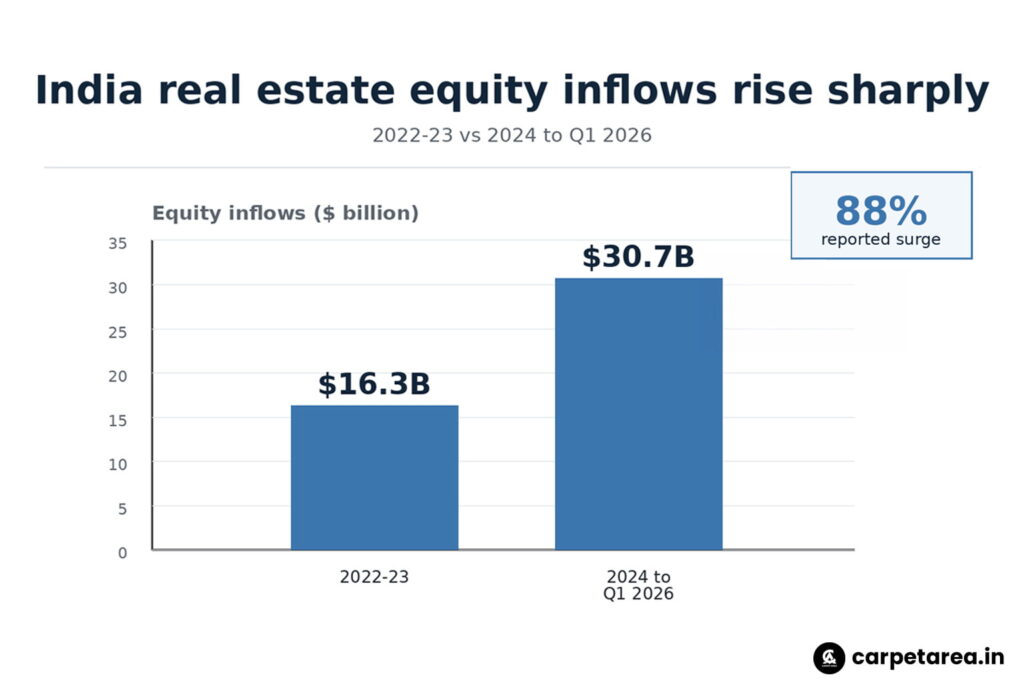
This means investors are not looking at Indian real estate only as a short-term opportunity. They are looking at it as a long-term growth market. Urbanisation, infrastructure expansion, office demand, warehousing growth, residential demand and the rise of organised developers are all making Indian real estate more attractive to serious capital.
The most important part of the report is not only the total inflow. It is the direction of the inflow. Land and development sites, along with built-up office assets, accounted for more than three-fourths of total capital inflows during the period. This shows that investors are focusing on two very different but powerful themes: future development potential and income-generating assets.
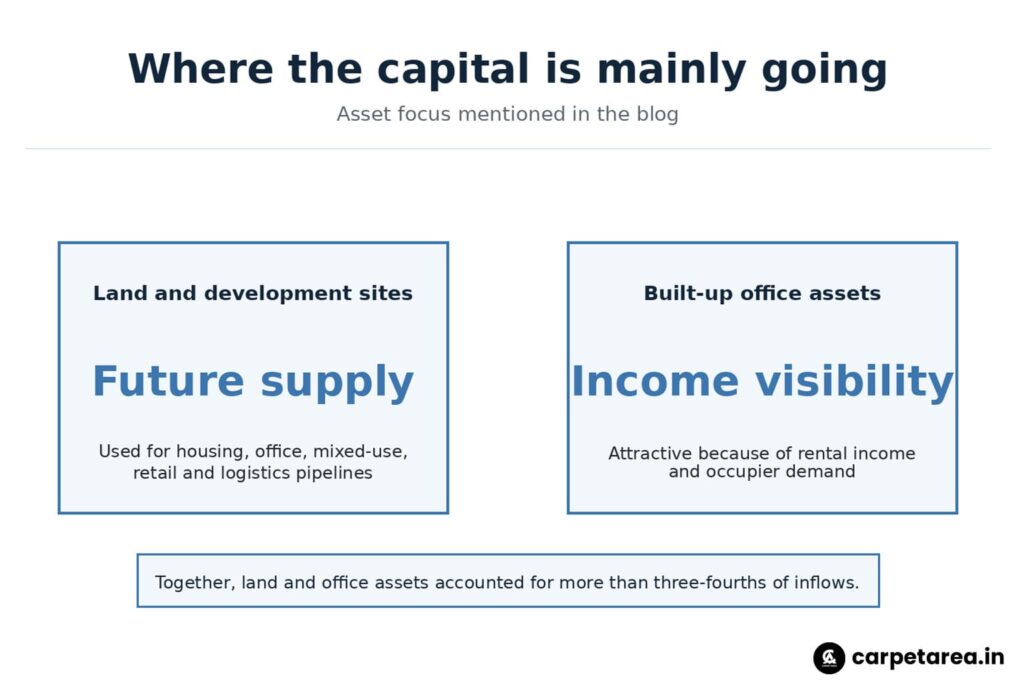
Land is attractive because it is the starting point of future supply. When investors and developers buy land, they are usually preparing for housing, office, mixed-use, retail, warehousing or data-centre development. Land investment is a sign that companies expect future demand. It also shows that developers want to build project pipelines in strong cities and growth corridors.
Office assets are attractive for a different reason. Built-up office properties can generate rental income, especially when they are leased to strong occupiers. India’s office market has remained one of the most resilient parts of real estate because of demand from global capability centres, technology firms, financial services, consulting companies and large domestic businesses. For long-term investors, stable office assets can offer rental visibility and portfolio strength.
Institutional investors also played a major role. Reports say institutional investors contributed around 30% of the total investments and more than doubled their capital deployment compared with the previous two-year period. Their focus was largely on office, retail and logistics assets. This is important because institutional money usually comes with deeper due diligence, stronger governance expectations and a preference for professionally managed assets.
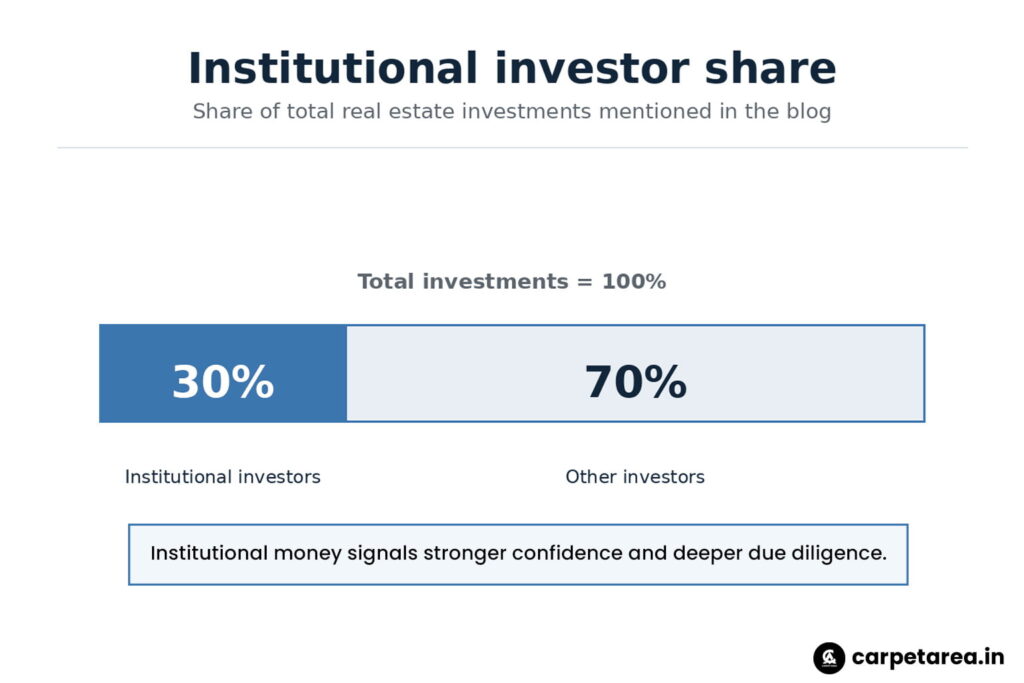
For the Indian real estate market, this is a sign of maturity. Earlier, real estate investment was often seen through the lens of local developers, individual investors and land transactions. Today, large institutional capital is looking at the sector more seriously. That can improve transparency, push better asset management and support larger projects.
The rise in equity inflows also tells us that India’s real estate story is becoming broader. It is not only about residential apartments anymore. Land, office, retail, logistics, mixed-use projects, REIT-ready assets and development platforms are all becoming part of the investment discussion. This creates a more balanced market where different asset classes can attract different types of capital.
For NRI and HRI investors, this trend is useful because institutional capital often acts as a signal. When professional investors increase exposure to real estate, it suggests that they see long-term value in the sector. But individual investors should not blindly follow headline numbers. A national-level inflow does not automatically mean every city, project or micro-market will perform well.
This is where selectivity becomes important. The same data that shows strong inflows also shows that money is not going everywhere equally. Capital is moving toward assets that have scale, location advantage, development potential, income visibility or strong developer backing. Weak projects, unclear titles, poor locations and over-priced assets may still struggle.
For homebuyers, this story has an indirect but important meaning. Strong capital inflows can support better-funded developers, more organised project execution and larger mixed-use developments. But it can also keep land prices high in strong markets. When capital chases quality land, developers may pay more for acquisition, and that cost can eventually reflect in property prices.
For commercial real estate, the signal is even clearer. Office assets continue to attract serious money because India remains a strong services economy. Logistics and retail are also gaining attention as consumption, e-commerce, supply chain modernisation and organised retail expand. This means the investment opportunity is not limited to buying flats. Commercial and income-generating assets are becoming more important in the larger real estate story.
However, investors should remain careful. A large inflow number does not remove market risks. Interest rates, global uncertainty, construction costs, regulatory delays, oversupply in certain micro-markets and weak demand in poorly connected locations can still affect returns. Real estate remains a local business, even when capital inflows are national.
The right lesson from the 88% jump is not that every property will rise in value. The better lesson is that India’s real estate market is becoming more institutional, more organised and more capital-driven. Investors are looking for assets where growth can be supported by real demand, clear titles, professional management and future development potential.
For Carpet Area readers, the takeaway is simple. India’s real estate equity inflows rising to $30.7 billion is a strong confidence signal. But the smarter story is where the money is going: land, office assets, institutional platforms and scalable growth opportunities. For buyers and investors, this means the next phase of real estate will reward careful selection, not blind excitement.
In simple words, Indian real estate still has strong investor confidence. But that confidence is becoming more disciplined. The winners will be projects, cities and asset classes where capital, demand, infrastructure and execution come together.





Leave a Reply