


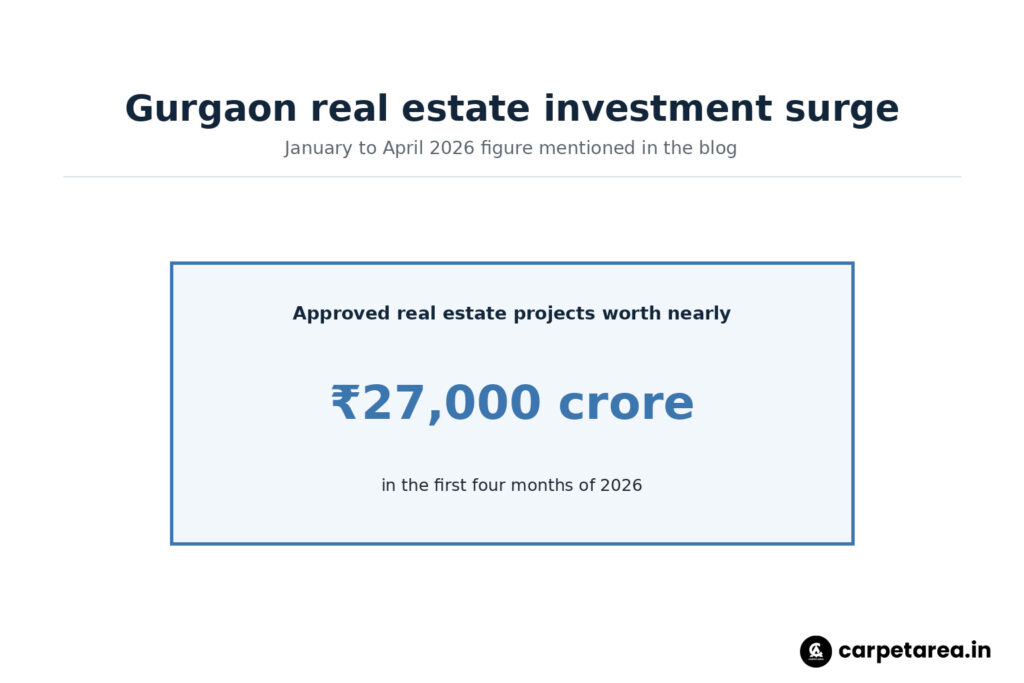
According to Gurugram RERA data reported by Indian Express, nearly ₹27,000 crore flowed into new real estate projects in Gurgaon between January and April 2026. The report notes that this momentum is visible along key corridors such as Dwarka Expressway and Golf Course Extension Road, where new residential towers continue to come up as developers commit fresh capital.
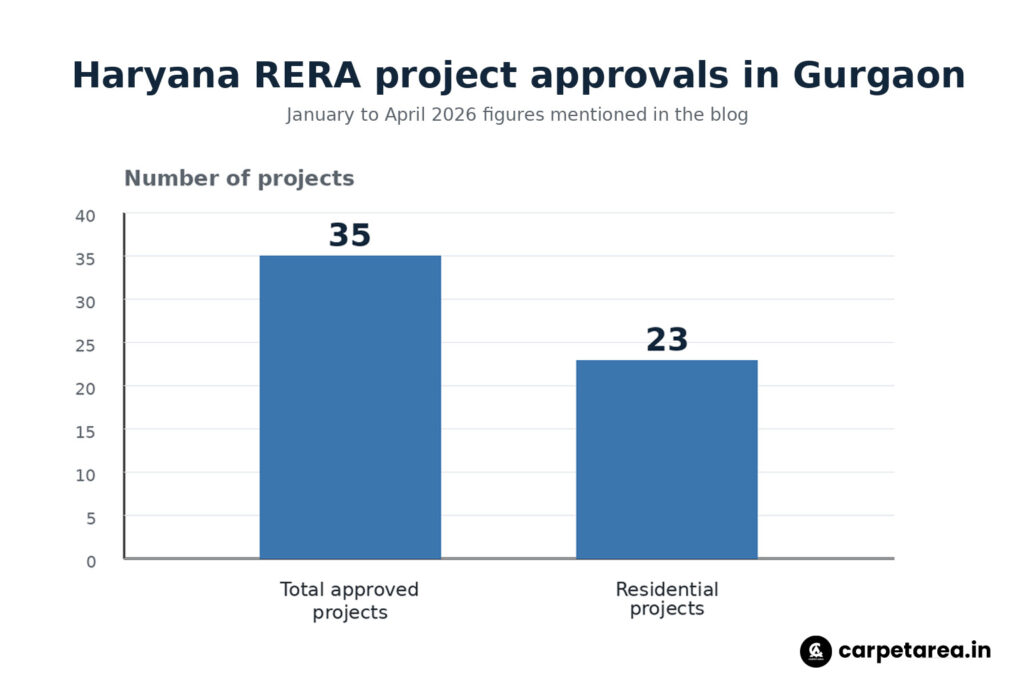
Times of India reported that Haryana RERA approved 35 real estate projects worth nearly ₹27,000 crore between January and April 2026. Out of these, 23 projects were residential, while the remaining projects were commercial. Together, these approvals are expected to add 11,513 units to the market, including 10,630 residential units and 883 commercial units.
Times of India reported that Haryana RERA approved 35 real estate projects worth nearly ₹27,000 crore between January and April 2026. Out of these, 23 projects were residential, while the remaining projects were commercial. Together, these approvals are expected to add 11,513 units to the market, including 10,630 residential units and 883 commercial units.
This is why the story matters for homebuyers and investors. Gurgaon is not only seeing price appreciation or buyer interest. It is also seeing new supply entering the formal approval pipeline. When developers bring projects to RERA, it shows that they are willing to commit land, capital, approvals and execution capacity to the market.
The first reason behind this confidence is Gurgaon’s employment base. The city has a strong corporate ecosystem, with offices, business parks, start-ups, global companies and service-sector employers. Housing demand in Gurgaon is closely linked to this commercial base. People do not buy homes here only because of future speculation. Many buyers want to live close to offices, schools, hospitals, malls and social infrastructure.
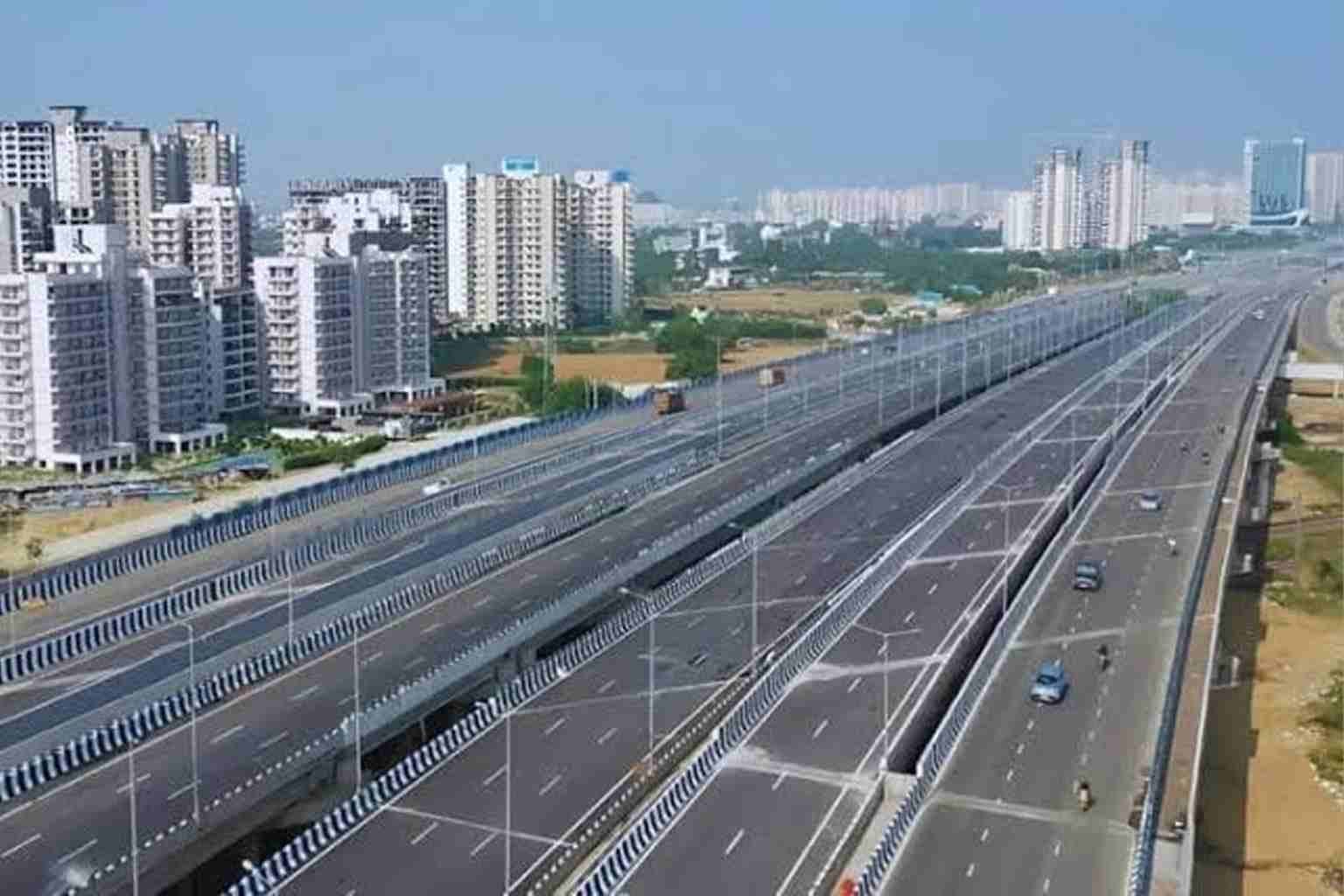
The second reason is infrastructure. Dwarka Expressway has become one of NCR’s most talked-about real estate corridors. It improves connectivity between Delhi and Gurgaon and gives developers a large corridor for residential and mixed-use expansion. Golf Course Extension Road, Southern Peripheral Road and New Gurgaon sectors have also become important because they combine better connectivity with premium and mid-income housing demand. Times of India also cited Dwarka Expressway, Southern Peripheral Road and New Gurgaon sectors among the corridors supporting market activity.
The third reason is regulatory confidence. Indian Express reported that Gurugram RERA has cleared complaints pending up to 2024, reducing backlog and streamlining dispute resolution. This matters because in real estate, trust is not created only by buildings. It is also created by timely approvals, visible regulation, complaint resolution and buyer confidence.
RERA’s role is becoming increasingly important in Gurgaon. Times of India reported that the authority has introduced reforms such as mandatory site inspections by domain experts before registration, stronger verification of documents and promoter disclosures, compulsory quarterly progress reports, and public notices before project approvals. These measures are meant to improve transparency and accountability.
For homebuyers, this is useful because a large investment number alone is not enough. What matters is whether projects are properly registered, whether disclosures are clear, whether construction is monitored and whether buyers have a route for grievance redressal. A market with strong demand but weak regulation can create risk. Gurgaon’s current story is stronger because demand and regulation appear to be moving together.
The supply numbers also show the direction of the market. With 10,630 residential units expected from the newly approved projects, Gurgaon’s housing pipeline remains active. This is especially important because earlier data had already shown that Gurugram was dominating NCR launches. If fresh approvals continue, buyers may get more project choices, but they will also need to compare locations and developers more carefully.
However, buyers should not treat this as a blind buying signal. A city-level investment surge does not mean every project will be a good purchase. Gurgaon has strong corridors, but prices have already moved sharply in many locations. Buyers must check the exact sector, road access, developer track record, RERA registration, carpet area, all-inclusive cost, maintenance charges and possession timeline.
For investors, the message is more strategic. Gurgaon’s ₹27,000 crore inflow shows that developers still believe in the city’s long-term demand. But the best investment decisions will come from micro-market study. Dwarka Expressway, Golf Course Extension Road, SPR and New Gurgaon may all be active, but each corridor has different pricing, delivery timelines, buyer profile and resale potential.
There is also a premiumisation angle. Gurgaon has seen strong demand for luxury and larger homes in recent years. But Indian Express quoted industry voices saying demand is no longer only luxury-led, with mid-income homes, plotted developments and mixed-use formats also seeing interest. This is important because a market becomes healthier when demand is spread across multiple formats, not only one high-end segment.
The risk is that rapid growth can also bring pressure. More projects mean more construction, more traffic, more civic load and more pressure on roads, water, drainage and public services. Gurgaon’s real estate story will remain strong only if infrastructure delivery keeps pace with project approvals. Otherwise, buyers may face the familiar problem of good buildings but weak urban support around them.
Still, the overall signal is clear. Gurgaon continues to attract developer capital because it offers a rare mix of employment, connectivity, premium demand, commercial growth and regulatory momentum. It is one of the few NCR markets where the link between office demand and housing demand remains visible.
In simple words, Gurgaon’s ₹27,000 crore real estate surge is not just a headline about money. It is a signal that developers still see the city as one of India’s strongest property markets. For homebuyers, it means more supply and more choices. For investors, it means Gurgaon remains a serious NCR growth story. But for both, the rule is the same: follow the data, check the project and do not buy only because the corridor is trending.

This is where selectivity becomes important. The same data that shows strong inflows also shows that money is not going everywhere equally. Capital is moving toward assets that have scale, location advantage, development potential, income visibility or strong developer backing. Weak projects, unclear titles, poor locations and over-priced assets may still struggle.
For homebuyers, this story has an indirect but important meaning. Strong capital inflows can support better-funded developers, more organised project execution and larger mixed-use developments. But it can also keep land prices high in strong markets. When capital chases quality land, developers may pay more for acquisition, and that cost can eventually reflect in property prices.
For commercial real estate, the signal is even clearer. Office assets continue to attract serious money because India remains a strong services economy. Logistics and retail are also gaining attention as consumption, e-commerce, supply chain modernisation and organised retail expand. This means the investment opportunity is not limited to buying flats. Commercial and income-generating assets are becoming more important in the larger real estate story.
However, investors should remain careful. A large inflow number does not remove market risks. Interest rates, global uncertainty, construction costs, regulatory delays, oversupply in certain micro-markets and weak demand in poorly connected locations can still affect returns. Real estate remains a local business, even when capital inflows are national.
The right lesson from the 88% jump is not that every property will rise in value. The better lesson is that India’s real estate market is becoming more institutional, more organised and more capital-driven. Investors are looking for assets where growth can be supported by real demand, clear titles, professional management and future development potential.
For Carpet Area readers, the takeaway is simple. India’s real estate equity inflows rising to $30.7 billion is a strong confidence signal. But the smarter story is where the money is going: land, office assets, institutional platforms and scalable growth opportunities. For buyers and investors, this means the next phase of real estate will reward careful selection, not blind excitement.
In simple words, Indian real estate still has strong investor confidence. But that confidence is becoming more disciplined. The winners will be projects, cities and asset classes where capital, demand, infrastructure and execution come together.

Leave a Reply