


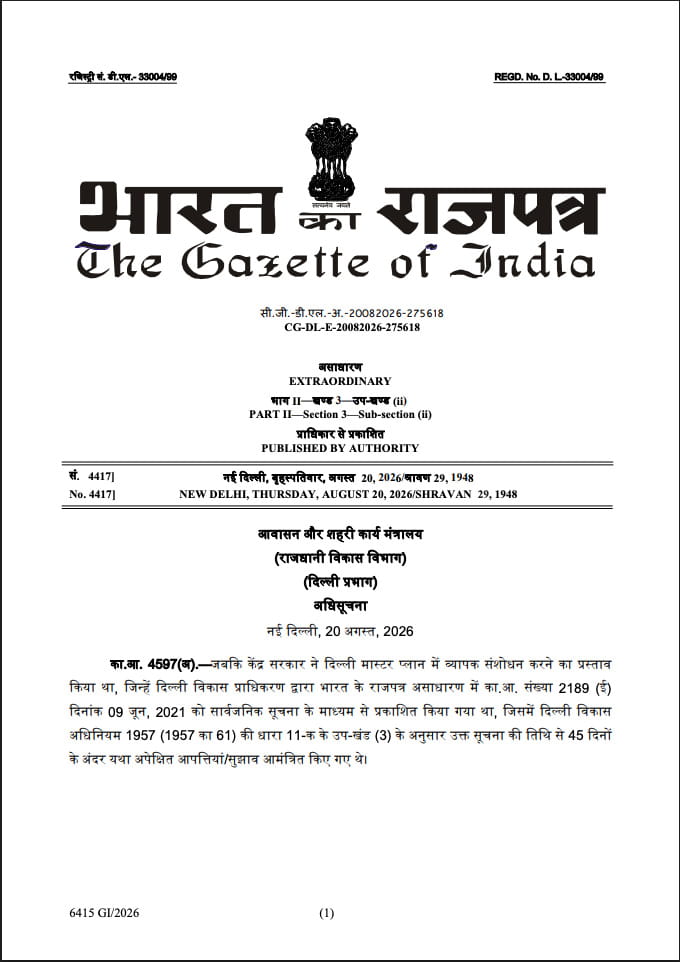
Delhi’s new planning framework has moved beyond the approval stage. The Delhi Development Authority (DDA) officially listed the Master Plan for Delhi 2047 Gazette on 20 August 2026 and now hosts both the Gazette notification and the Land Use Map 2047 on its dedicated MPD-2047 page.
That changes the most important question for property owners.
The issue is no longer simply:
“What has DDA proposed for Delhi?”
It is now:
“Which MPD-2047 provision applies to my property, and what would still need to happen before I can actually redevelop, construct, invest or sell on the basis of that provision?”
MPD-2047 envisages around 40 lakh additional affordable homes, much smaller redevelopment thresholds, large-scale Transit-Oriented Development (TOD), nearly 200 sq km of land-pooling-led expansion, a High Density Corridor along UER-II, rental housing incentives, commercial redevelopment, new industrial uses and a planning framework for Delhi’s peripheral Low-Density Areas.
But there is an equally important warning:
The Gazette changes Delhi’s planning framework. It does not automatically increase the FAR, change the land use, legalise construction or grant development permission to every property in Delhi.
That distinction is where buyers, owners and investors need to begin.
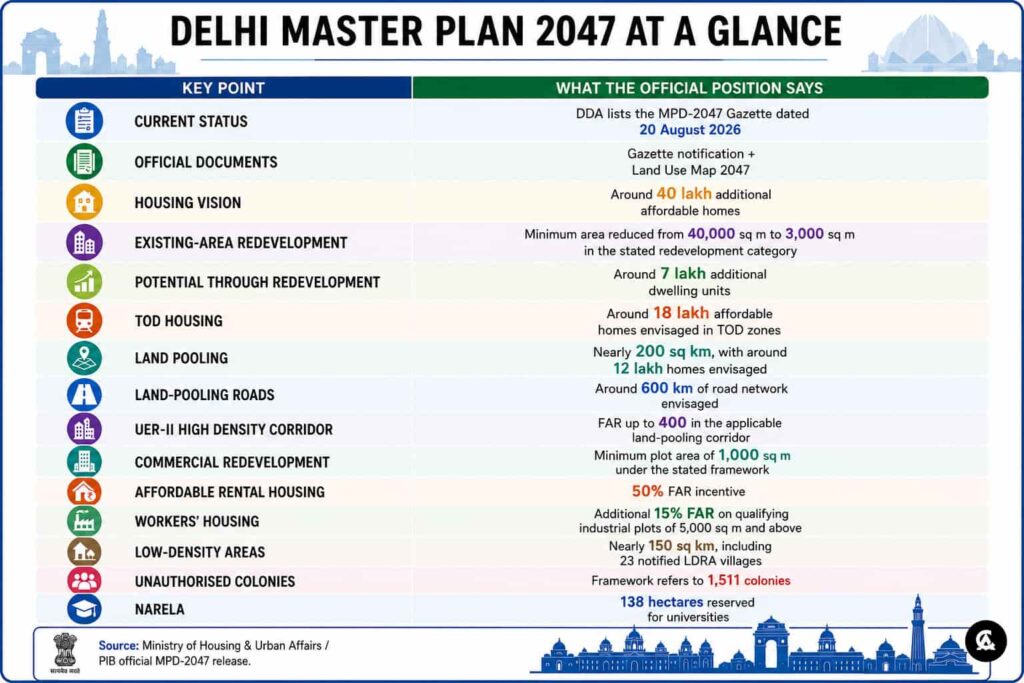
Delhi Master Plan 2047 at a glance
| Key point | What the official position says |
|---|---|
| Current status | DDA lists the MPD-2047 Gazette dated 20 August 2026 |
| Official documents | Gazette notification + Land Use Map 2047 |
| Housing vision | Around 40 lakh additional affordable homes |
| Existing-area redevelopment | Minimum area reduced from 40,000 sq m to 3,000 sq m in the stated redevelopment category |
| Potential through redevelopment | Around 7 lakh additional dwelling units |
| TOD housing | Around 18 lakh affordable homes envisaged in TOD zones |
| Land pooling | Nearly 200 sq km, with around 12 lakh homes envisaged |
| Land-pooling roads | Around 600 km of road network envisaged |
| UER-II High Density Corridor | FAR up to 400 in the applicable land-pooling corridor |
| Commercial redevelopment | Minimum plot area of 1,000 sq m under the stated framework |
| Affordable rental housing | 50% FAR incentive |
| Workers’ housing | Additional 15% FAR on qualifying industrial plots of 5,000 sq m and above |
| Low-Density Areas | Nearly 150 sq km, including 23 notified LDRA villages |
| Unauthorised colonies | Framework refers to 1,511 colonies |
| Narela | 138 hectares reserved for universities |
Source: Ministry of Housing & Urban Affairs/PIB official MPD-2047 release.
What exactly changed on 20 August 2026?
The most important change is the status of the plan.
Before the final notification stage, many MPD-2047 provisions were still being discussed as approved or proposed planning changes.
DDA now officially lists the Master Plan for Delhi 2047 Gazette with a publishing date of 20 August 2026, and its MPD-2047 page provides the Gazette and Land Use Map.
The Delhi Development Act, 1957 provides the statutory framework for preparation, approval, operation and modification of Delhi’s Master Plan. It also makes an important distinction between preparing or approving a plan and the statutory process through which it becomes operational.
For property owners, this means commentary written while MPD-2047 was still at the approval or draft stage should now be checked against the final notified framework.
Does the Gazette mean every Delhi property can now be redeveloped?
No.
This is probably the most important clarification in the entire MPD-2047 story.
A Master Plan establishes the broad planning framework for land use, development intensity, infrastructure, redevelopment and future urban growth.
It is not an automatic building sanction for an individual plot.
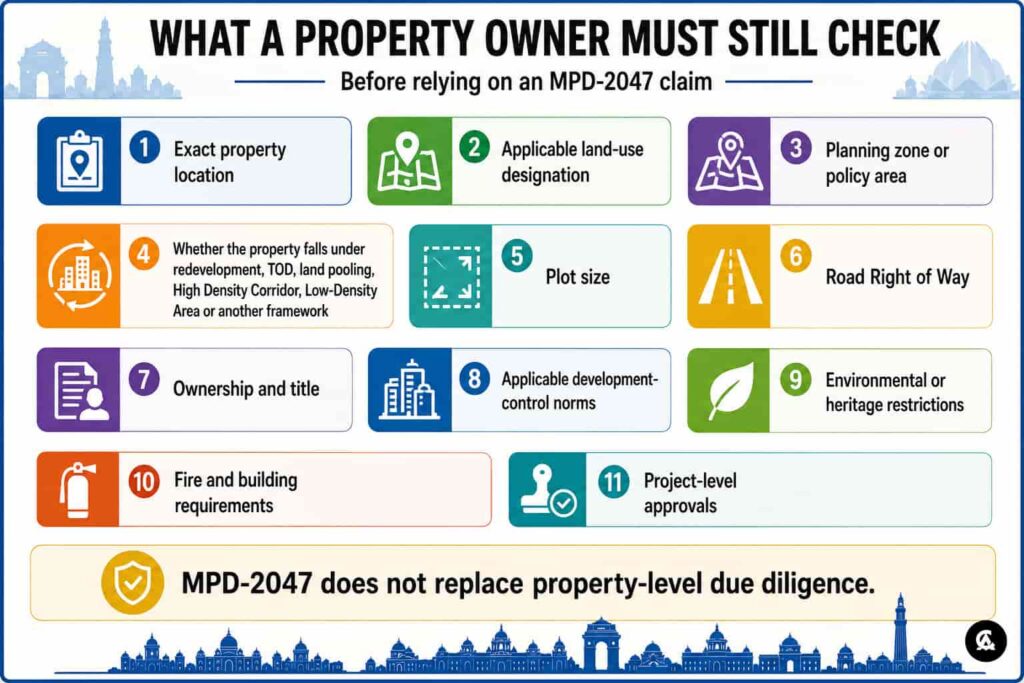
A property owner may still need to establish:
- exact property location;
- applicable land-use designation;
- planning zone or policy area;
- whether the property falls under redevelopment, TOD, land pooling, High Density Corridor, Low-Density Area or another framework;
- plot size;
- road Right of Way;
- ownership and title;
- applicable development-control norms;
- environmental or heritage restrictions;
- fire and building requirements;
- project-level approvals.
So a broker saying:
“MPD-2047 aa gaya, ab aapki property ka FAR automatically badh gaya”
is making a claim that needs property-specific verification.
The correct approach is:
MPD-2047 rule → exact location → applicable policy → eligibility conditions → project approval.
The 40 lakh homes headline needs to be understood correctly
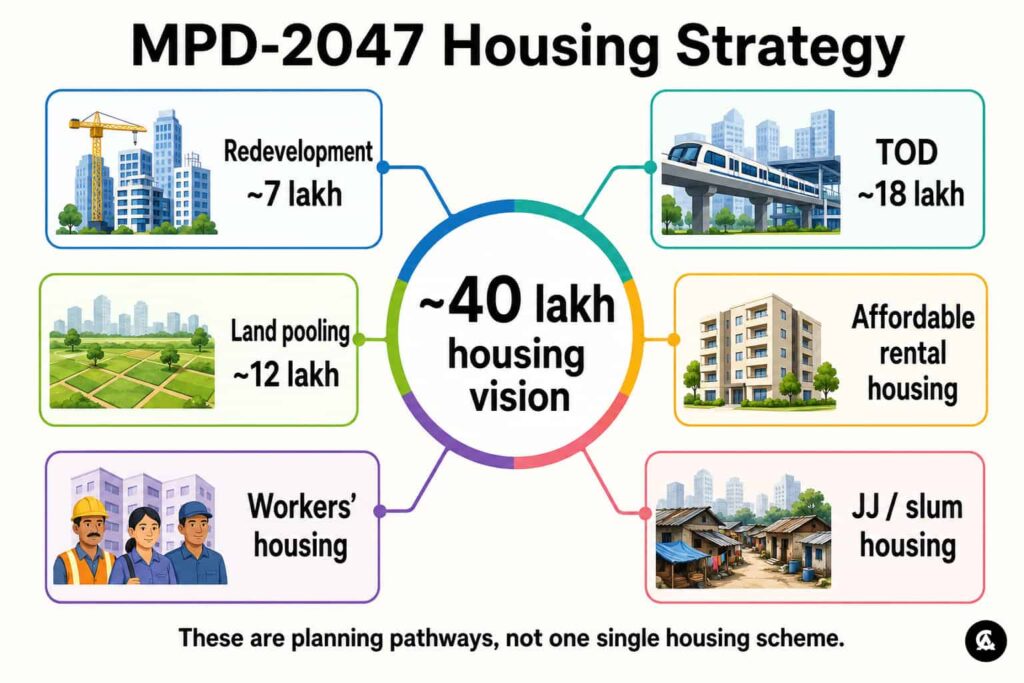
The Union Ministry of Housing & Urban Affairs says MPD-2047 envisages development of around 40 lakh new affordable housing units.
That is a very large number.
But it should not be interpreted as:
“40 lakh flats have been sanctioned and will now enter the market.”
The official plan identifies several mechanisms through which future housing capacity may be created.
These include:
Existing-area redevelopment: around 7 lakh additional dwelling units
Transit-Oriented Development: around 18 lakh affordable houses in TOD zones
Land pooling: around 12 lakh homes
along with affordable housing in High Density Corridors, rental housing, workers’ housing and housing for JJ-cluster residents.
These are planning capacities and development pathways, not an immediate possession-ready housing pipeline.
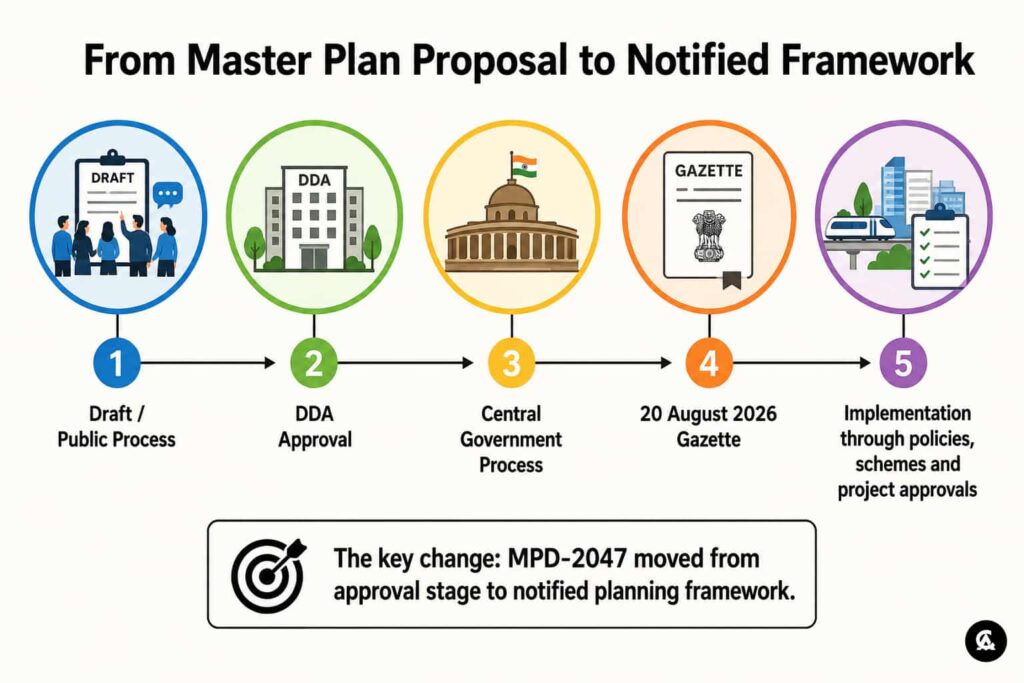
For those homes to physically reach the market, several further stages may be required:
Planning framework
↓
Area-specific scheme
↓
Infrastructure
↓
Land assembly
↓
Approvals
↓
Developer/agency participation
↓
Construction
↓
Completion
↓
Possession
This distinction matters for investors.
Future housing capacity can influence the long-term property market, but planned capacity is not the same thing as actual supply.
Why is the 3,000 sq m redevelopment threshold important?
This could be one of the most consequential provisions for owners of older housing developments.
According to the official MoHUA summary, the minimum area requirement for redevelopment of existing group housing, DDA housing and government housing has been reduced from 40,000 sq m to 3,000 sq m.
The government estimates that redevelopment of existing areas could potentially create around 7 lakh additional dwelling units.
The scale of the change is easier to understand when converted:
40,000 sq m ≈ 9.88 acres
while
3,000 sq m ≈ 0.74 acre
The threshold has therefore fallen by 92.5%.
That can make redevelopment discussions feasible for much smaller clusters than before.
But it does not mean that every 3,000 sq m housing society automatically qualifies for redevelopment.
The property would still need to satisfy the applicable MPD-2047 provisions and other planning, ownership, building and approval requirements.
For owners of ageing DDA or group housing properties, the right question is now:
“Does our site satisfy the new redevelopment framework?”
—not—
“Has redevelopment automatically been approved?”
Could higher redevelopment potential increase property values?
Possibly, but that should not be assumed.
A property may become more attractive if the new planning framework creates a realistic route to:
- additional usable area;
- replacement housing;
- better common infrastructure;
- new commercial components;
- modern amenities;
- improved parking;
- higher development efficiency.
But actual value creation depends on whether redevelopment is financially and legally executable.
An old housing society with fragmented ownership, litigation, poor access or weak redevelopment economics may not immediately benefit simply because the Master Plan has changed.
The relevant chain is:
Planning permission potential
→ resident/owner participation
→ feasible redevelopment proposal
→ statutory approvals
→ developer/financial viability
→ construction
→ completed redevelopment
Property appreciation is not guaranteed at the first step.
How important is Transit-Oriented Development under MPD-2047?
TOD is one of the main housing and density strategies in the plan.
The official release estimates around 18 lakh affordable homes in TOD zones and describes TOD as part of Delhi’s strategy to concentrate development around high-capacity public transport.
The basic idea is straightforward.
Instead of continuing to expand the city horizontally while residents travel long distances, TOD aims to create more:
homes + offices + shops + services
around mass-transit corridors.
That can potentially reduce dependence on private vehicles and improve access to jobs and services.
But homeowners should not make one common mistake:
Being close to a Metro station does not automatically mean a property receives TOD development rights.
The precise property must fall within the applicable planning framework and satisfy the relevant conditions.
Location-specific verification remains essential.
Land pooling could create 12 lakh homes — but implementation matters more than the headline
MPD-2047 envisages nearly 200 sq km of planned urban expansion through land pooling, with potential for around 12 lakh homes and approximately 600 km of road network.
A major change in the stated strategy is the infrastructure-first approach.
DDA is expected to develop roads of 30 metres and wider upfront, while different implementation methods—including Town Planning Schemes—can be used.
The government also refers to planning schemes with a minimum area of 20 hectares where development can proceed through assembly of land.
This could help address one of the historical difficulties with greenfield urban development:
housing cannot function without roads, drainage, water, sewerage, transport and social infrastructure.
But investors should still distinguish between:
land located inside a future planning area
and
land that is actually part of an implementable and approved development scheme.
That difference can be enormous.
Where has land-pooling implementation actually moved forward?
The official MPD-2047 release identifies one specific example:
Sector 8B, Zone P-II in villages Gadi Khasro and Ibrahimpur is described as the first notified sector ready for implementation.
This is important because it gives buyers and landowners something more concrete than a citywide housing target.
It also demonstrates how MPD-2047 should be followed:
Not by asking—
“When will all land-pooling land become developable?”
but by tracking—
Which sector has been notified?
Has a scheme been prepared?
Has infrastructure work started?
What approvals have been issued?
What is the actual development stage?
Those milestones are much more useful than speculative land-price predictions.
What is the UER-II High Density Corridor?
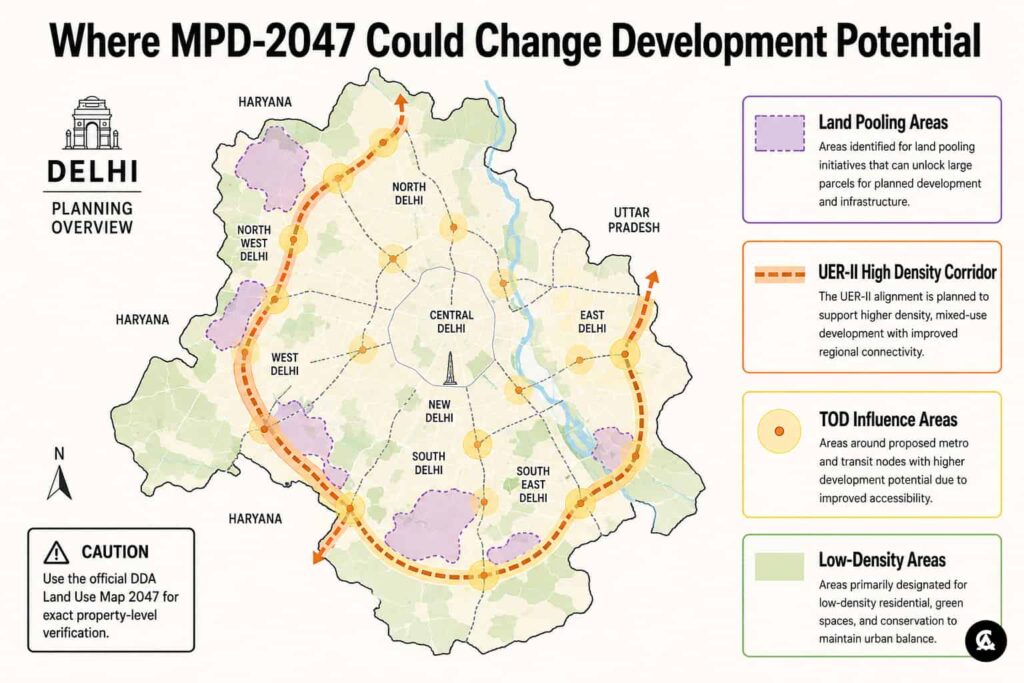
MPD-2047 introduces High Density Corridor development within the land-pooling area along UER-II, with the official summary referring to a 250-metre-wide corridor and FAR up to 400.
This matters because UER-II is not being treated only as a transport road.
In applicable areas, the planning framework also envisages higher-density development around the corridor.
Potential uses can create:
- housing;
- workplaces;
- commercial activity;
- services;
- mixed-use demand.
But buyers should be especially cautious with land advertisements around UER-II.
“Near UER-II” does not mean “eligible for FAR 400.”
A property must actually fall within the applicable High Density Corridor framework and satisfy the relevant requirements.
Affordable rental housing gets a separate incentive
One of the less-discussed provisions is the push toward rental housing.
MPD-2047 provides a 50% FAR incentive for affordable rental housing, aimed at groups including:
- students;
- working professionals;
- migrant workers;
- low-income households.
This is strategically important.
Delhi’s housing challenge is not limited to people seeking ownership.
A large population needs accommodation for:
education, employment or temporary migration.
If implemented effectively, this provision could support more professionally developed:
- student housing;
- workforce housing;
- managed rental accommodation;
- affordable urban rental projects.
Whether a significant organised rental-housing market actually emerges will depend on land economics, project approvals, rents and private-sector participation.
Industrial land also gets a workers’ housing provision
The plan provides an additional 15% FAR for workers’ housing on industrial plots of 5,000 sq m and above.
The planning logic is clear:
Jobs and housing should not always be located at opposite ends of the city.
If workers can live closer to employment centres, it could reduce commuting pressure while improving utilisation of industrial areas.
Again, this is an enabling provision.
It is not a requirement that every qualifying industrial owner will immediately develop housing.
MPD-2047 is not only a residential housing plan
Another important information gap in much of the coverage is that MPD-2047 also changes the planning framework for commercial and industrial real estate.
The official release allows redevelopment of commercial centres from a minimum plot area of 1,000 sq m, supported by incentivised FAR.
Mixed-use development is also contemplated along roads with 30 m Right of Way and above, with specified commercial use on lower floors under the stated framework.
The plan further permits or promotes uses such as:
- modern industrial parks;
- big-box retail;
- e-commerce facilities;
- warehousing;
- co-working;
- data centres.
This means the long-term impact of MPD-2047 should be analysed across:
housing + offices + retail + industrial space + logistics + rental housing
rather than residential apartments alone.
What could the commercial redevelopment rule mean?
Older commercial centres often face a basic problem:
Their land is valuable, but existing buildings may be inefficient, ageing or poorly designed for modern demand.
Reducing the minimum redevelopment area to 1,000 sq m, along with higher development incentives where applicable, can potentially improve redevelopment economics.
But the same principle applies:
Planning eligibility does not equal project approval.
Owners will still need a feasible redevelopment proposal, applicable permissions, clear ownership arrangements and sufficient financial viability.
What changes for Delhi’s Low-Density Areas?
MPD-2047 provides a planned framework for nearly 150 sq km of Low-Density Areas, covering areas along Delhi’s peripheral villages and 23 notified LDRA villages.
The official framework allows a mix of:
- residential;
- recreational;
- Public and Semi-Public (PSP);
- commercial activities,
subject to the applicable planning controls.
This is an area where buyers should exercise particularly strong caution.
A seller may advertise:
“MPD-2047 approved farmhouse land”
or
“commercial allowed under new Master Plan.”
That description by itself is not sufficient due diligence.
At minimum, a buyer would need to verify:
revenue village → khasra/location → applicable planning category → road access → environmental status → title → permitted use → approvals.
Peripheral-land investment carries much higher risk when the purchase is based mainly on future planning claims.
What does MPD-2047 say about unauthorised colonies?
The official announcement states that MPD-2047 provides for regularisation of residential buildings in 1,511 unauthorised colonies on an “as is where is” basis, without requiring layout plans under the stated framework.
The government associates this measure with greater ownership security for around 45 lakh residents.
But buyers should avoid translating this into:
“Every property in these colonies now has clean legal title.”
Planning regularisation and individual property title are not the same issue.
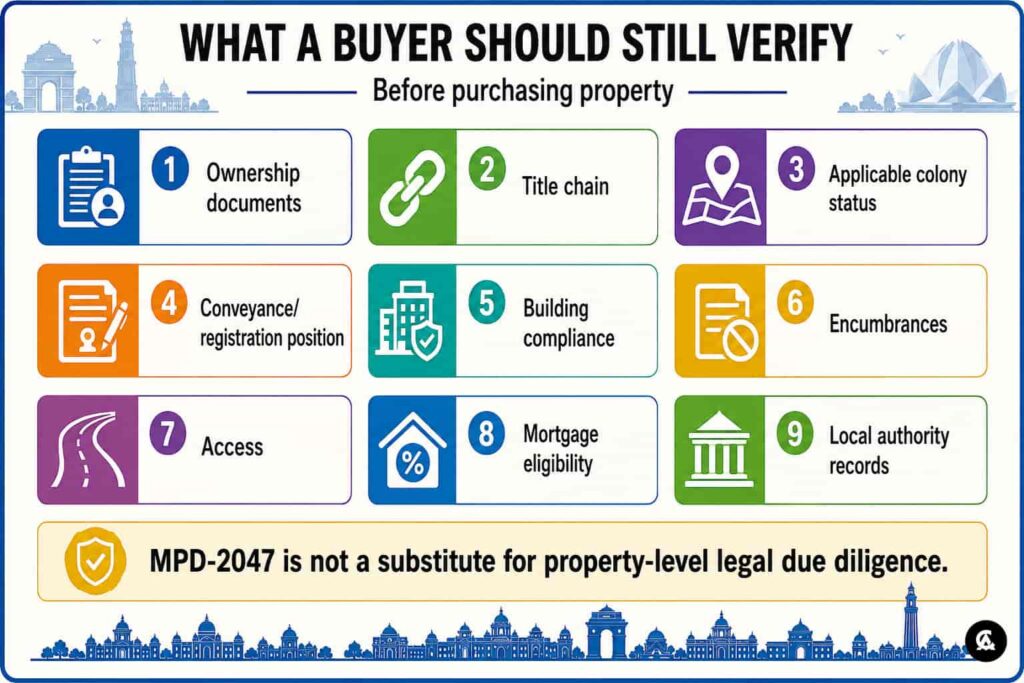
Before purchasing, a buyer may still need to verify:
- ownership documents;
- title chain;
- applicable colony status;
- conveyance/registration position;
- building compliance;
- encumbrances;
- access;
- mortgage eligibility;
- local authority records.
MPD-2047 should therefore not be used as a substitute for property-level legal due diligence.
Why is Narela important under the new plan?
Narela is being positioned as more than a housing-inventory location.
The government says 138 hectares of land have been reserved for development of universities—both public and private—with the aim of developing Narela as an education hub.
If institutions actually come up, the longer-term demand chain could be:
universities
→ students and staff
→ rental housing
→ retail/services
→ transport demand
→ improved utilisation of surrounding residential inventory
That is a potential demand driver.
It is not a guarantee of property appreciation.
Buyers should watch actual university land allotments, construction, admissions, connectivity and supporting infrastructure before assuming a price impact.
What role does MPD-2047 give Dwarka?
The plan positions Dwarka as an international/investment gateway, with emphasis on future-oriented sectors including:
- IT;
- startups;
- data centres;
- industrial parks.
For property markets, employment-generating uses generally matter because sustainable housing demand ultimately depends on people having reasons to live and work in an area.
But the relevant sequence remains:
policy → investment → business establishment → employment → occupancy/demand
The Gazette does not itself prove that every proposed investment will materialise.
The Yamuna floodplain remains a major environmental planning issue
MPD-2047 also includes environmental provisions that can directly restrict speculative development assumptions.
The official release refers to protection, conservation and ecological restoration of nearly 1,700 hectares of the Yamuna floodplain through 13 restoration projects, along with a 52 km cycle track.
This reinforces an important principle:
Not every area inside Delhi is intended for higher-density real-estate development.
Environmental restrictions can override an investor’s expectation that urban expansion automatically means greater construction rights.
Any property close to the Yamuna, drains, water bodies, forests, green areas or environmentally sensitive land needs much deeper verification.
What does reducing 133 ‘use premises’ to 45 mean?
MPD-2047 also aims to simplify the planning system itself.
The official release says the number of classified use premises is being reduced from 133 to 45, alongside greater use of a negative-list approach for residential, commercial and industrial zones.
In simple terms, the planning framework is trying to become less fragmented.
Instead of maintaining an extremely long list of individual permitted uses, the system can allow greater flexibility while clearly identifying prohibited uses.
For developers and business owners, that could potentially make planning decisions easier.
Actual project permissibility will still depend on the applicable zone and development-control conditions.
Heritage properties also get a new economic framework
The plan identifies around 1,500 heritage assets for Cultural Resource Management Plans and allows adaptive reuse for activities such as:
- hotels;
- museums;
- offices;
- libraries;
- cultural uses.
The official release also refers to a 50 TDR heritage incentive being introduced.
This could improve the economic case for conserving and reusing heritage properties rather than allowing them to deteriorate.
But heritage redevelopment will remain subject to specialised conservation and approval requirements.
What is changing in Delhi’s transport planning?
MPD-2047 connects land development more closely with transport.
The official framework refers to:
- UER-I;
- UER-II;
- UER-III;
- multimodal hubs;
- Metro;
- RRTS;
- buses;
- intermediate public transport;
- walking;
- cycling;
- a Unified Metropolitan Transport Authority;
- a unified parking framework.
The property-market implication is important.
Future housing growth is increasingly being planned around:
transport capacity rather than isolated residential colonies.
But a Master Plan reference to transport infrastructure should never be confused with:
tender awarded
or
construction started
or
project operational.
Each infrastructure project must be independently checked for its actual implementation stage.
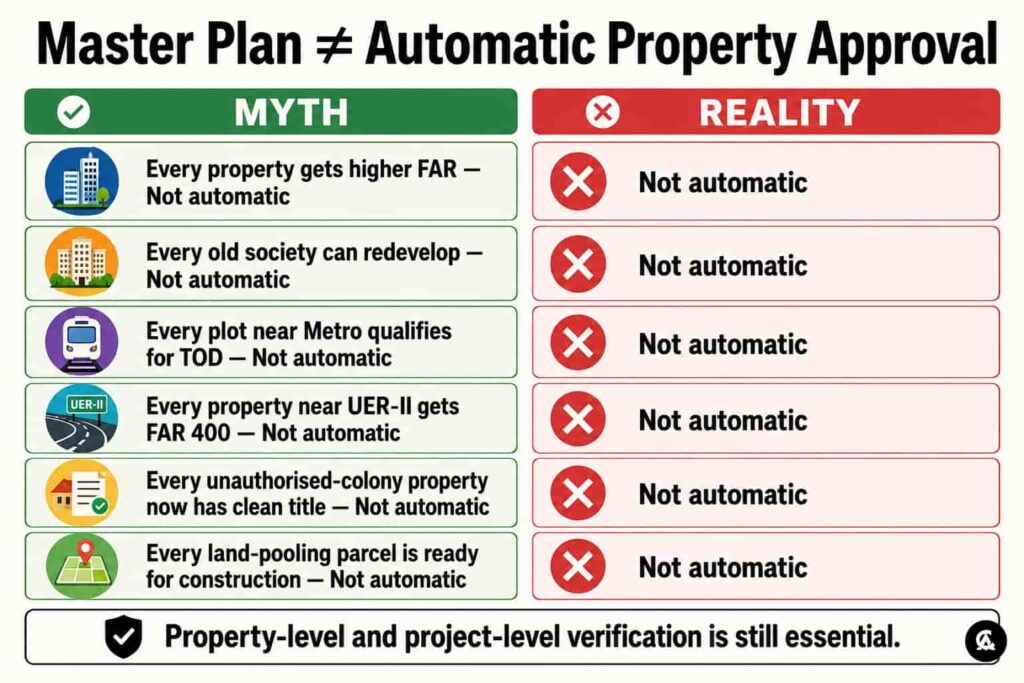
What MPD-2047 does NOT automatically mean
This is where property buyers should be particularly careful.
MPD-2047 does not automatically mean:
Every property gets higher FAR.
Every old society can immediately redevelop.
Every plot near a Metro station qualifies for TOD.
Every property beside UER-II gets FAR 400.
Every unauthorised-colony property now has clean title.
Every Low-Density Area plot can be developed commercially.
Every land-pooling parcel is ready for construction.
Every planning proposal will be implemented immediately.
Every affected property will appreciate in value.
The Master Plan creates planning possibilities and development frameworks.
Property-level rights must still be established.
What is confirmed?
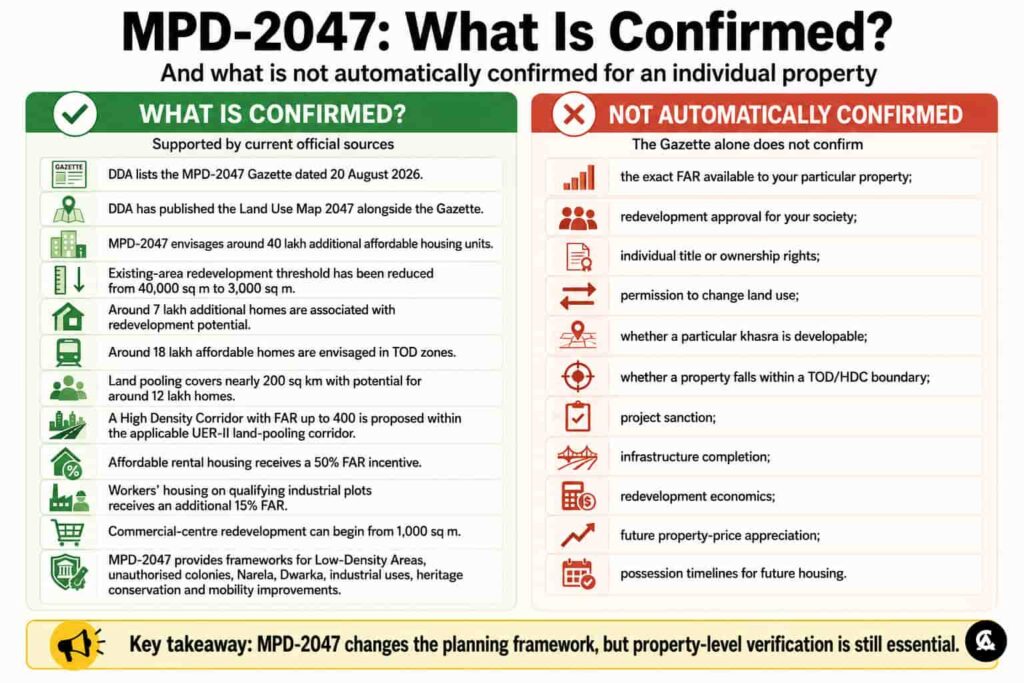
The following points are supported by current official sources:
- DDA lists the MPD-2047 Gazette dated 20 August 2026.
- DDA has published the Land Use Map 2047 alongside the Gazette.
- MPD-2047 envisages around 40 lakh additional affordable housing units.
- Existing-area redevelopment threshold in the stated category has been reduced from 40,000 sq m to 3,000 sq m.
- Around 7 lakh additional homes are associated with redevelopment potential.
- Around 18 lakh affordable homes are envisaged in TOD zones.
- Land pooling covers nearly 200 sq km of planned expansion with potential for around 12 lakh homes.
- A High Density Corridor with FAR up to 400 is proposed within the applicable UER-II land-pooling corridor.
- Affordable rental housing receives a 50% FAR incentive.
- Workers’ housing on qualifying industrial plots receives an additional 15% FAR.
- Commercial-centre redevelopment can begin from 1,000 sq m under the stated framework.
- MPD-2047 provides frameworks for Low-Density Areas, unauthorised colonies, Narela, Dwarka, industrial uses, heritage conservation and mobility improvements.
What is not automatically confirmed for an individual property?
The Gazette alone does not confirm:
- the exact FAR available to your particular property;
- redevelopment approval for your society;
- individual title or ownership rights;
- permission to change land use;
- whether a particular khasra is developable;
- whether a property falls within a TOD/HDC boundary;
- project sanction;
- infrastructure completion;
- redevelopment economics;
- future property-price appreciation;
- possession timelines for future housing.
Those answers require property-level and project-level verification.
How should a property owner check whether MPD-2047 affects their property?
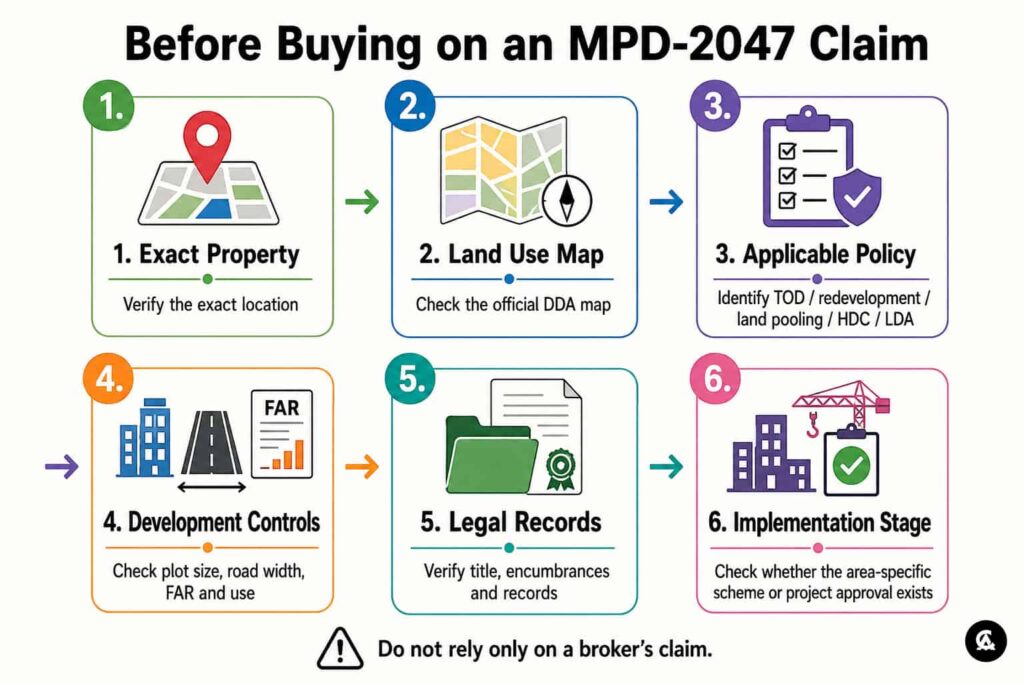
A simple six-step process can prevent many mistakes.
Step 1 — Identify the exact property
Do not rely only on a locality name.
Verify the:
plot number / address / society / revenue village / khasra, as applicable.
Step 2 — Check the official Land Use Map 2047
DDA has published the Land Use Map alongside MPD-2047.
Step 3 — Identify the applicable planning framework
Determine whether the property falls within:
- normal land-use zoning;
- redevelopment;
- TOD;
- High Density Corridor;
- Land Pooling;
- Low-Density Area;
- another applicable policy.
Step 4 — Check basic development conditions
These can include:
- plot area;
- road width;
- permissible activity;
- FAR;
- ground coverage;
- height;
- environmental limitations.
Step 5 — Check legal and property records
Planning potential cannot correct defective title.
Verify:
- ownership;
- encumbrances;
- litigation;
- revenue records;
- sanctioned building status.
Step 6 — Check the implementation stage
Ask:
Is this only permitted in the Master Plan?
or
Has the area-specific scheme been notified?
or
Has the actual project been approved?
Those are completely different stages.
The three stages every investor should understand
For investment decisions, MPD-2047 should be understood through three separate levels:
Level 1 — Master Plan permission
The citywide planning framework permits or envisages a particular type of development.
↓
Level 2 — Area-specific implementation
A TOD scheme, land-pooling sector, redevelopment project, High Density Corridor scheme or another planning mechanism becomes operational.
↓
Level 3 — Individual project approval
A specific parcel or development receives the required approvals and moves toward construction.
Most speculative property marketing happens when Level 1 is advertised as if Level 3 has already happened.
That is exactly what buyers should avoid.
Where could MPD-2047 potentially matter most for real estate?
From a property perspective, the most important areas to watch are not necessarily those with the loudest marketing.
Old group housing and DDA colonies
because smaller redevelopment thresholds could improve feasibility.
Transit-linked locations
where actual TOD implementation permits higher-density development.
UER-II and applicable High Density Corridor areas
where higher development intensity may be permitted subject to scheme conditions.
Outer Delhi land-pooling sectors
where infrastructure and scheme notifications progress.
Narela
where education-related development could generate future occupancy demand.
Dwarka
where employment-oriented investment and business activity are planned.
Older commercial centres
where smaller redevelopment thresholds could improve redevelopment economics.
Peripheral Low-Density Areas
where planning flexibility can create opportunities but also requires particularly careful due diligence.
The impact will not be uniform.
A property that receives a meaningful new development route can behave very differently from another property just one or two kilometres away that remains outside the applicable framework.
What buyers and property owners should watch next?
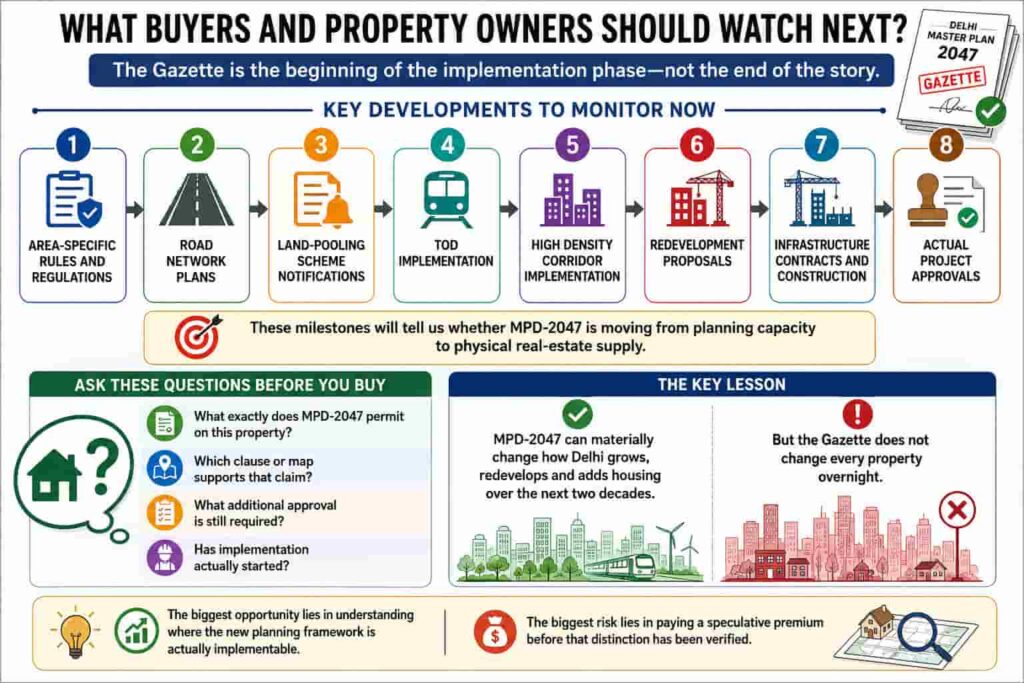
The Gazette is the beginning of the implementation phase—not the end of the story.
The most valuable developments to monitor now are:
area-specific rules and regulations
→ Road Network Plans
→ land-pooling scheme notifications
→ TOD implementation
→ High Density Corridor implementation
→ redevelopment proposals
→ infrastructure contracts and construction
→ actual project approvals
These milestones will tell us whether MPD-2047 is moving from planning capacity to physical real-estate supply.
For an owner, buyer or investor, the central lesson is simple:
Do not buy a property because somebody says “MPD-2047 has come.”
Ask instead:
What exactly does MPD-2047 permit on this property?
Which clause or map supports that claim?
What additional approval is still required?
Has implementation actually started?
MPD-2047 can materially change how Delhi grows, redevelops and adds housing over the next two decades.
But the Gazette does not change every property overnight.
The biggest opportunity lies in understanding where the new planning framework is actually implementable.
And the biggest risk lies in paying a speculative premium before that distinction has been verified.
Sources
Delhi Development Authority — Master Plan for Delhi 2047
Official DDA page hosting the MPD-2047 Gazette notification and Land Use Map 2047. DDA Master Plan for Delhi 2047
Delhi Development Authority — What’s New
Official DDA listing showing Master Plan for Delhi 2047 Gazette — Publishing Date: 20 August 2026. DDA MPD-2047 Gazette listing
Ministry of Housing & Urban Affairs / Press Information Bureau — Delhi Master Plan 2047
Official 20 August 2026 government summary covering housing, TOD, redevelopment, land pooling, UER-II, rental housing, commercial development, unauthorised colonies, Narela, Dwarka, Low-Density Areas, industry, heritage and mobility. PIB — Delhi Master Plan 2047 official release
India Code — Delhi Development Act, 1957
Statutory framework governing preparation, approval, operation and modification of Delhi’s Master Plan. Delhi Development Act, 1957


Leave a Reply