


When people hear that real estate stocks have fallen, the first question is simple: has the property market crashed?
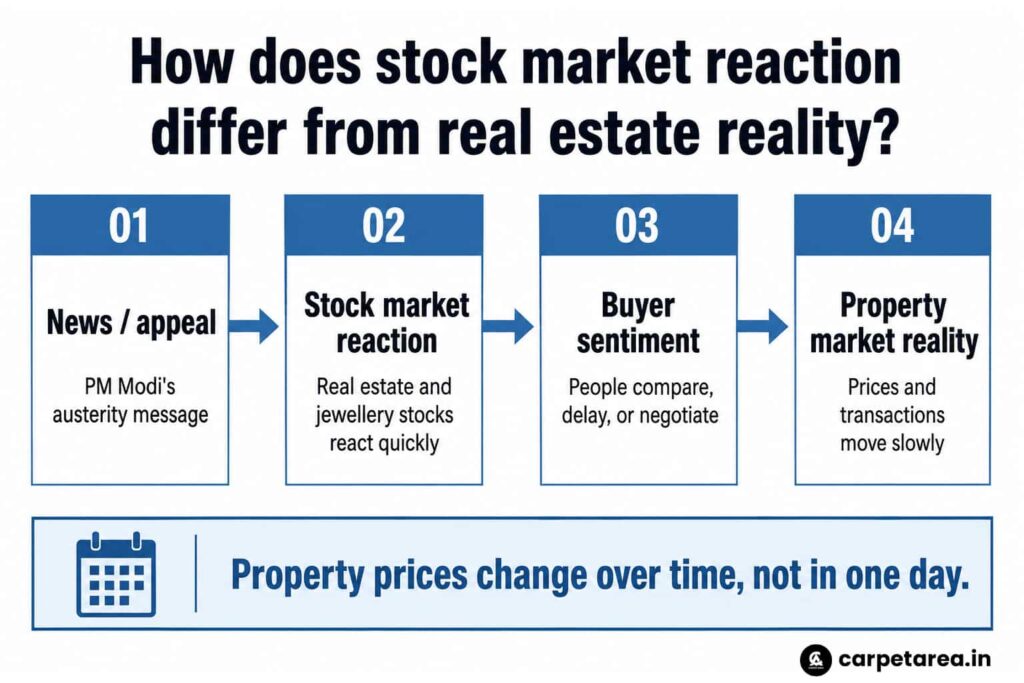
After Prime Minister Narendra Modi’s recent appeal for financial restraint, some jewellery and real estate-related stocks came under pressure. This created a quick headline moment around gold, housing, fuel use and consumer spending.
But homebuyers should understand the difference between two things.
A fall in real estate stocks is not the same as a crash in property prices.
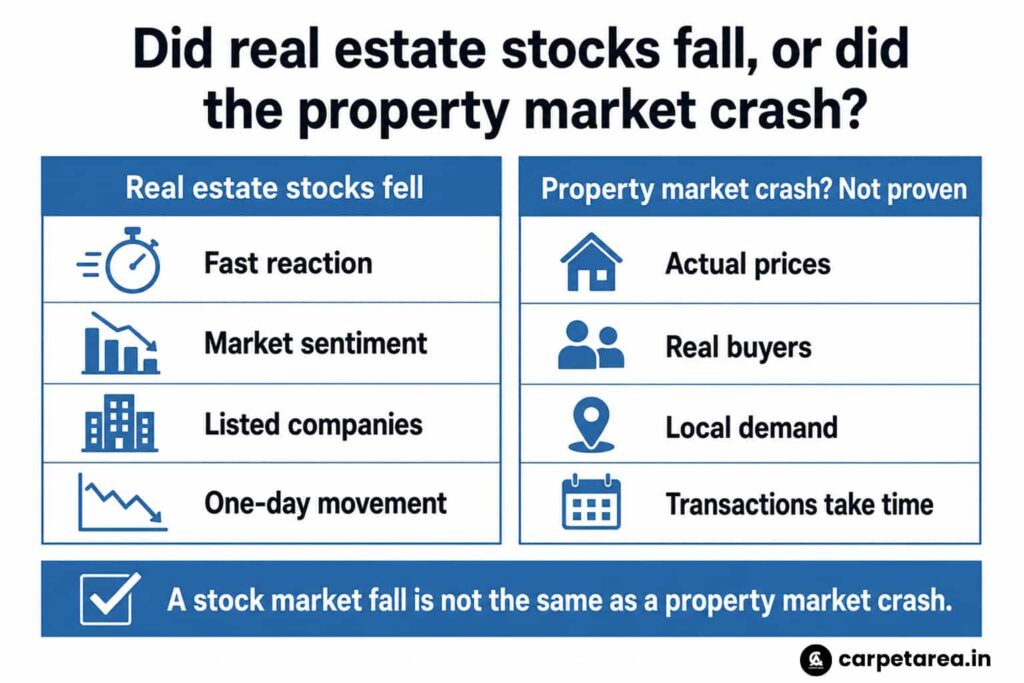
The stock market reacts quickly to news, sentiment and expectations. Property prices move slowly because they depend on local demand, supply, construction cost, home loan rates, buyer confidence and actual transactions.
So the real question is not whether Indian real estate has crashed. The better question is: can this austerity appeal make buyers more careful in the coming months?
What did PM Modi actually appeal for?
The Prime Minister’s message was not only about real estate. It was a broader appeal linked to fuel use, gold buying, foreign exchange, imports and responsible consumption.
He urged people to use petrol, diesel and gas with restraint, use public transport where possible, consider work from home where feasible, avoid unnecessary gold purchases, reduce non-essential foreign travel and support domestic choices.
The reason behind this appeal was simple: India imports a large part of its energy needs, and global uncertainty can put pressure on fuel costs and foreign exchange. When crude oil prices rise or imports become expensive, the pressure does not remain only at the government level. It can slowly reach households through fuel cost, inflation, interest-rate expectations and overall spending confidence.
That is why the market reaction was visible in sectors linked with discretionary spending, including gold, jewellery and housing-related stocks.
Why did real estate stocks fall?
Real estate stocks often react before the actual property market reacts.
If investors feel that people may delay big-ticket purchases, listed real estate companies can see selling pressure. If buyers become more cautious, markets may assume that demand for premium housing, luxury property or investment-led purchases could slow.
This is what happened after the austerity appeal. Some housing-related counters came under pressure because investors worried that buyers may postpone property decisions.
But this does not automatically mean that flat prices, plot prices or housing sales have collapsed.
A stock-market reaction is immediate. A property-market correction takes time and depends on real transactions.
Did Indian real estate crash?
No, this news does not prove that Indian real estate has crashed.
There is no evidence from this development that property prices across India have suddenly fallen. There is also no evidence that homebuyers have stopped buying homes.
What happened was more specific: real estate and jewellery stocks came under pressure after the Prime Minister’s message on financial restraint and reduced discretionary spending.
That is very different from saying that the Indian property market has crashed.
For a homebuyer, this difference is important. Panic buying and panic waiting are both risky. A buyer should not rush into a property because prices may rise, and should not blindly wait because someone says the market will crash.
The right approach is to study the local market.
What does this mean for homebuyers?
For homebuyers, the message is simple: this is a time to be more careful, not fearful.
If you are buying a home for end-use, do not make your decision only because of headlines. Check whether the location is livable, the project is legally clear, the builder is reliable and the total cost fits your income.
If you are taking a home loan, calculate the EMI properly. Do not stretch your budget just because a builder is offering a discount or a broker says prices will rise soon.
If you are buying for investment, check rental demand, resale demand, future supply and whether the price is already too high.
In a cautious market, weak projects get exposed faster. Strong locations and legally clear projects usually remain more resilient.
What should builders and investors understand?
For builders, this kind of news is a reminder that buyers are becoming more sensitive to price and affordability.
A project cannot survive only on branding, glossy brochures and urgency-based sales calls. Buyers are now asking sharper questions about carpet area, maintenance cost, possession timeline, density, construction quality and resale value.
For investors, this is also a warning. Real estate is not a quick-profit game in every market. If a property is bought at an inflated price, future returns can become weak even if the city is growing.
The better investment is not always the most hyped project. It is the one where entry price, demand, location and exit opportunity make sense.
Can austerity affect luxury housing?
Luxury and premium housing may feel the impact more than basic end-use housing because large-ticket purchases are easier to delay.
A family that needs a first home may still buy if the budget, loan and project are right. But a luxury buyer, second-home buyer or investor may wait, negotiate or compare more options if the market mood becomes cautious.
This does not mean luxury housing will stop. It means buyers may become more selective.
Projects with real value, strong locations and credible builders may still attract demand. Projects selling only on hype may face more questions.
What should buyers check now?
Before booking any property, buyers should ask these questions:
Is the price justified compared with nearby projects?
Is the builder’s delivery record strong?
Is the project RERA registered?
Are the approvals and legal documents clear?
Is the location already livable or only future-dependent?
Can the property be rented or resold easily?
Is the EMI comfortable even if expenses rise?
Is the total cost clear, including stamp duty, registration, GST, parking, maintenance and interiors?
These questions are more useful than asking whether the market has crashed.

Final view
PM Modi’s austerity appeal created a stock-market reaction in gold and housing-related counters, but it should not be confused with a real estate crash.
Indian real estate is not one single market. Mumbai, Gurugram, Noida, Pune, Hyderabad, Bengaluru and smaller cities all behave differently. Even inside one city, one micro-market may be strong while another may be overpriced.
For Carpet Area readers, the message is clear.
Do not panic because of one headline.
Do not buy because of one discount.
Do not believe that every fall in real estate stocks means property prices will crash.
Buy only when the location, legal clarity, builder credibility, price and future demand make sense.
In real estate, the smartest buyer is not the one who reacts fastest.
The smartest buyer is the one who verifies first.
Sources:-
Economic Times: Gold and housing stocks fell after PM Modi’s austerity appeal
https://m.economictimes.com/markets/stocks/news/gold-housing-plays-take-a-hit-as-modis-austerity-pitch-rattles-consumer-facing-stocks/articleshow/131036677.cms
Reuters: PM Modi urged limits on fuel use, travel and imports to save forex
https://www.reuters.com/business/energy/modi-urges-india-conserve-fuel-global-price-surges-2026-05-10/
Reuters: India’s steps to manage pressure on external balance of payments
https://www.reuters.com/world/india/what-steps-india-has-taken-stem-pressure-its-external-balance-payments-2026-06-03/
Times of India: PM Modi advised ministers to practise conservation and carpooling
https://timesofindia.indiatimes.com/india/practise-what-you-preach-by-carpooling-pm-advises-ministers/articleshow/131361471.cms





Leave a Reply