

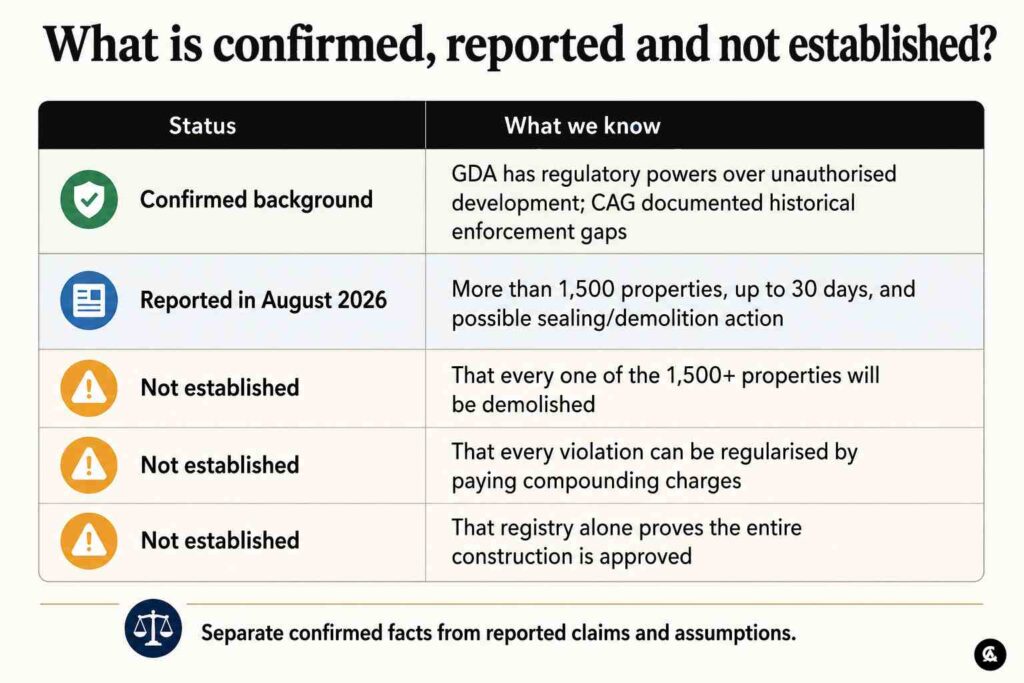
More than 1,500 properties in Ghaziabad are reportedly under renewed scrutiny by the Ghaziabad Development Authority (GDA). A report published on 27 August 2026 says owners who have not complied with earlier notices are being given up to 30 days before sealing or demolition action may follow in applicable cases. The properties mentioned include industrial units, warehouses and buildings with alleged deviations from sanctioned plans.
This does not mean that all 1,500+ properties will automatically be demolished. The outcome of an individual case depends on the exact violation, sanctioned building plan, compounding eligibility, compliance status and any pending legal proceedings.
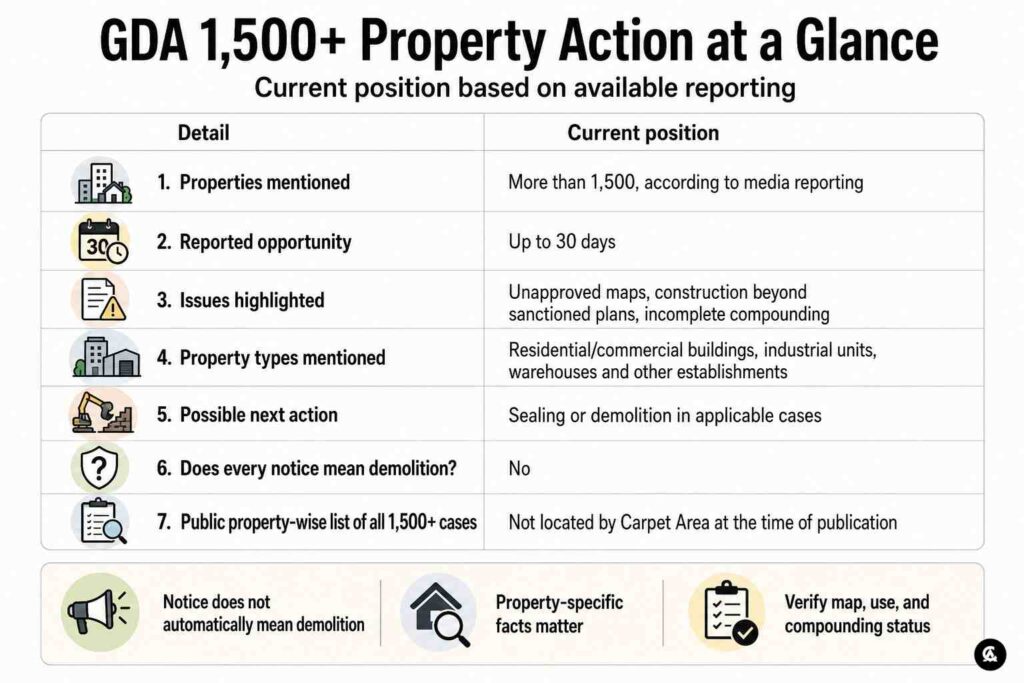
The latest report follows another development on 23 August 2026, when GDA reportedly directed its zonal officials to identify hotels, factories, warehouses and other establishments operating without approved building maps.
Which properties should be checked immediately?
A property deserves immediate verification if the owner has received a GDA notice, the actual construction differs from the sanctioned map, an additional floor or extension has been built without approval, the premises are being used differently from the approved use, or an earlier compounding process remains incomplete.
Buyers should not assume that a property is affected merely because it is located in Ghaziabad. Equally, the absence of a media mention does not establish that a building is fully compliant.
The property-specific GDA record is what matters.
The 30-day period should not automatically be counted from 27 August
The reported 30-day opportunity should not be interpreted as a universal deadline beginning on the date of the news report.
If a property owner has received an official notice, the relevant notice date, response period and compliance deadline written in that document should be checked. The media report provides the broader enforcement development; it does not replace an individual GDA order.
What can and cannot be compounded?
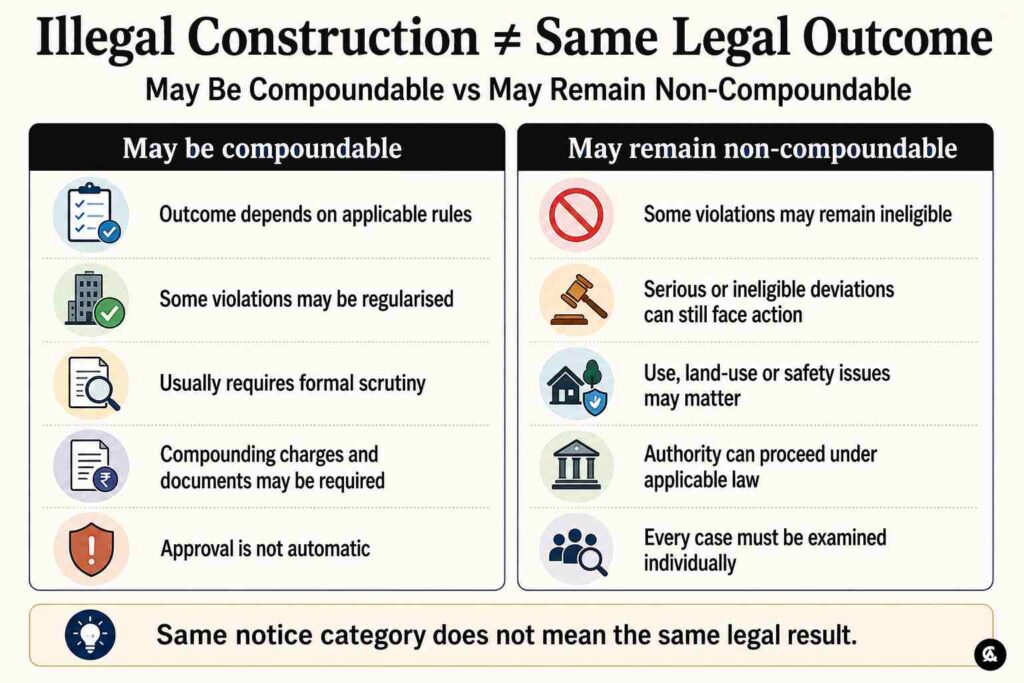
Compounding does not mean that any illegal construction can be made legal simply by paying a fee.
The Uttar Pradesh Building Construction and Development Byelaws 2025 contain the current framework for compounding. Chapter 16 supersedes the earlier 2009 compounding rules and provides for regularisation of eligible deviations within prescribed conditions. It also makes clear that non-compoundable construction cannot simply continue and may have to be removed.
Certain violations can therefore have very different legal outcomes. A limited building deviation that falls within permitted compounding rules is not the same as a land-use conflict, construction affecting public land, or another violation that the applicable rules do not permit to be compounded.
A payment receipt alone is not proof that the entire building has been approved. Owners should check the final sanctioned or compounded plan and the conditions attached to that approval.
Illegal colony and illegal construction are different issues
An unauthorised colony can involve problems with the broader layout, development or land status.
Unauthorised construction can also occur inside an otherwise approved locality—for example, when the plot is legitimate but additional floors, extensions or other construction have been carried out beyond the sanctioned plan.
The GDA public portal separately provides facilities for map sanction, completion-certificate checking, individual-property records, group-housing/layout plans and information on unauthorised colonies.
That means an approved locality does not automatically prove that every structure inside it is approved.
How can a buyer check a Ghaziabad property?
Before making a major payment, a buyer should compare three things:
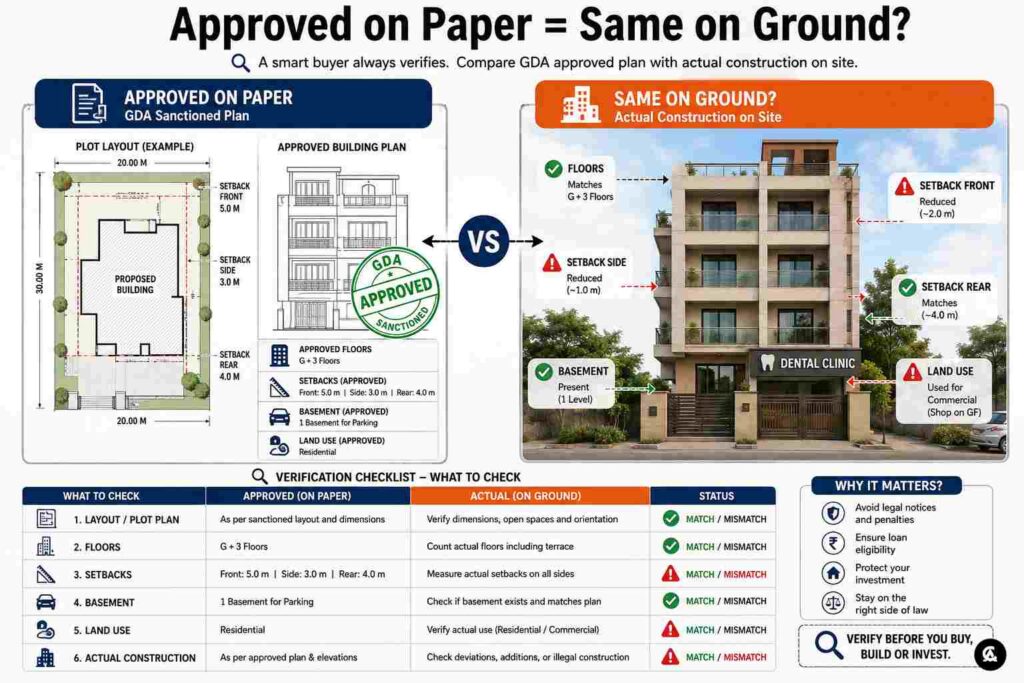
what the ownership documents say → what GDA has approved → what actually exists on the ground.
The GDA portal provides public sections relating to sanctioned plans and completion certificates, but where records are unavailable or unclear, the buyer should verify the property directly with the concerned authority office using the exact plot/property details.
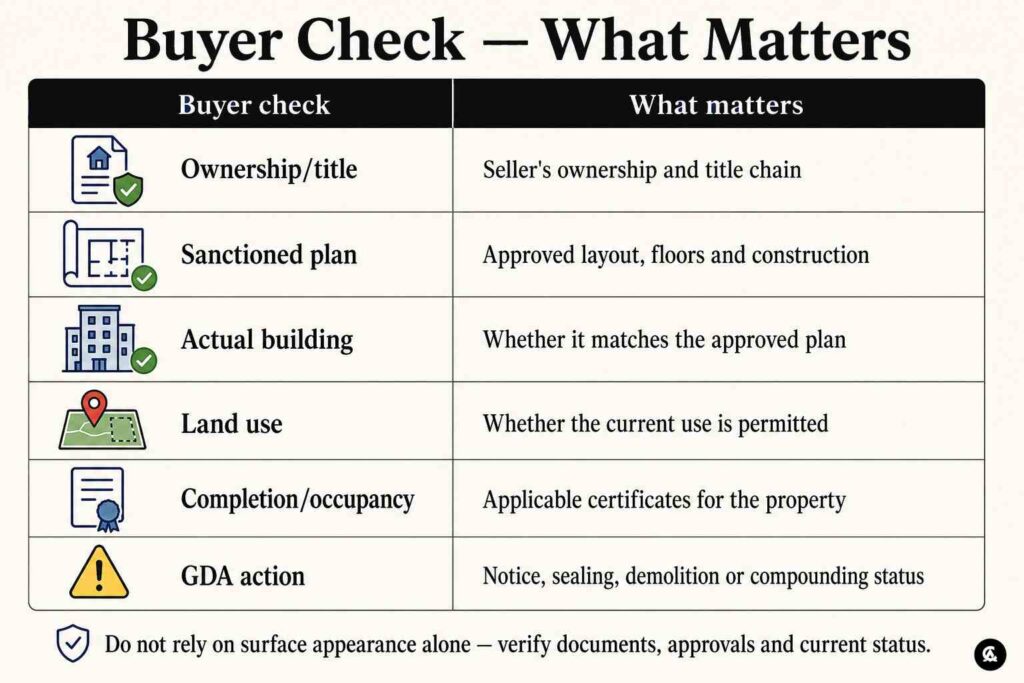
A registered sale deed is important for ownership, but it does not by itself prove that every floor, extension, basement or change of use is approved by GDA.
What if you already bought the property?
An existing buyer who later discovers an unauthorised portion should first establish what was originally sanctioned, what was actually sold, what construction exists today and whether GDA has issued any notice or order.
The next question is whether the deviation is legally compoundable. If a sealing or demolition order, title dispute or significant unauthorised construction is involved, case-specific technical or legal advice may be necessary.
An unresolved approval problem can also complicate resale, legal due diligence, valuation or home-loan processing, depending on the property and lender.
Why does the CAG audit matter?
The latest action comes against a significant historical backdrop.
The Comptroller and Auditor General of India (CAG) tabled its Performance Audit of GDA on 20 February 2026. The audit said unauthorised-construction cases recorded by GDA increased from 5,395 to 9,416 between 2017 and 2022, and described enforcement as weak.
In 1,703 cases test-checked by the audit, CAG found 52 demolitions, 100 sealing actions, 334 compounding cases and 354 cases involving notices or other action, while 863 cases were pending in court. The audit also noted instances where notices or sealing/demolition orders had been issued without further action.
These historical cases should not be confused with the 1,500+ properties reported in August 2026. They simply show that unauthorised construction and enforcement delays were already documented issues within GDA’s jurisdiction.
The next meaningful developments will be property-specific compliance decisions, completed compounding cases, sealing orders, demolition proceedings, court interventions and any official GDA property-wise or zone-wise disclosure.
At the time of publication, a consolidated public GDA list matching all of the reported 1,500+ properties was not found on the Authority’s public portal. Buyers should therefore avoid relying on WhatsApp lists, broker claims or neighbourhood rumours.
The safest property check remains simple:
sanctioned map → physical inspection → actual construction → GDA status → purchase decision
What Ghaziabad property buyers should take away?
The latest GDA illegal construction action in Ghaziabad is important, but it should lead to verification rather than panic.
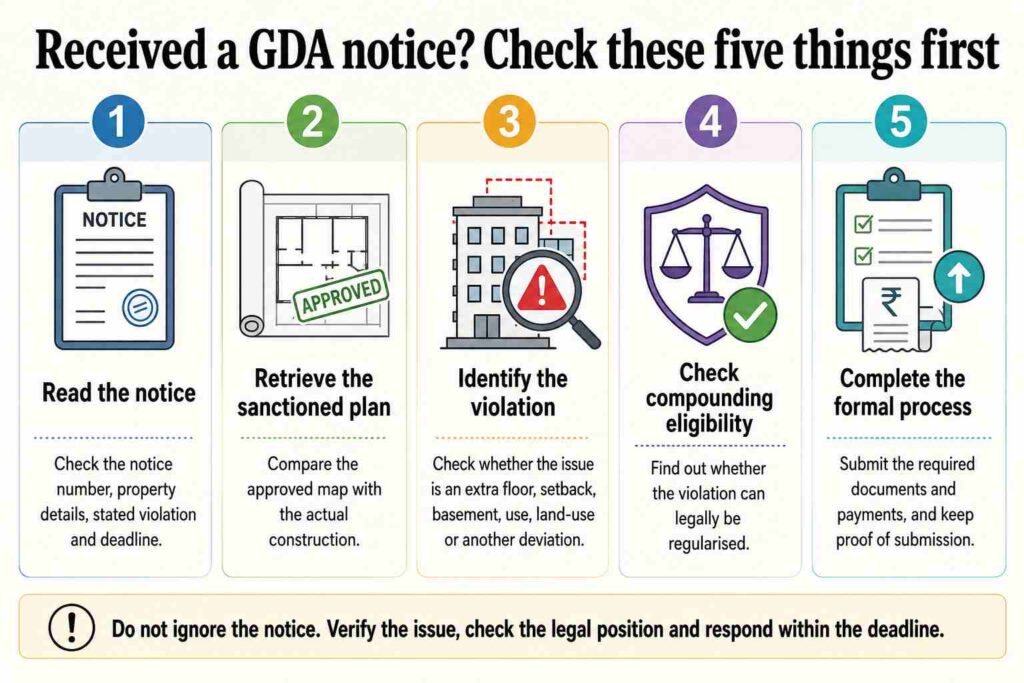
If you already have a GDA notice, read the exact notice and deadline, compare the sanctioned map with the actual property and determine whether the violation can legally be compounded.
If you are buying, do not rely only on a registry or seller’s assurance.
Verify ownership, verify the sanctioned plan, inspect the construction and check the current GDA status before paying.
Sources:-
- Navbharat Times — GDA 1,500+ notices, 30-day window
This is the main fresh source for the 1,500+ properties and up to 30 days claim. - Live Hindustan — GDA action against establishments without approved maps
This supports the broader enforcement drive involving hotels, factories, warehouses and other establishments. - Uttar Pradesh Building Construction and Development Byelaws 2025 — Official PDF
This is the key official source for compounding, non-compoundable construction and enforcement provisions. - UP Model Building Construction and Development Byelaws 2025 — Official document
Useful as the broader official building and zoning framework for Uttar Pradesh development authorities. - CAG — Performance Audit of Ghaziabad Development Authority
This is the strongest official background source for historical weaknesses in GDA’s handling of unauthorised construction and enforcement. - Ghaziabad Development Authority — Approved Group Housing / Public Plan Records
Useful for directing buyers toward official GDA property-plan verification resources



Leave a Reply