


Why is everyone suddenly talking about a Hyderabad real estate crash?
Hyderabad real estate has been one of India’s most talked-about property markets. For the last few years, areas like Gachibowli, Kokapet, Narsingi, Tellapur, Kollur, Financial District and Puppalaguda have attracted homebuyers, investors and builders because of IT growth, infrastructure expectations and premium housing demand.
But now, one viral claim has created fear:
“Hyderabad has nearly 1 lakh unsold or vacant flats, and the real estate market may crash.”
Imagine a buyer visiting a project in Kokapet. The sales team says, “Sir, inventory is limited. Prices may increase soon.” The same evening, the buyer sees a social media post saying, “Hyderabad real estate crash has started. 1 lakh flats are empty.”
Now the buyer is stuck between two pressures.
One side is builder FOMO.
The other side is social media panic.
The real question is simple: is Hyderabad real estate actually crashing, or is the viral claim being exaggerated?

What is the viral 1 lakh flats claim?
The viral claim says that Hyderabad and Greater Hyderabad have nearly 1 lakh unsold or vacant flats, and because of this, property prices may fall sharply.
The concern is not completely baseless. A local report, citing industry estimates, said that more than 80,000 flats may be unsold across Greater Hyderabad projects, with a combined value exceeding ₹1 lakh crore. But this is an industry estimate reported by a local outlet, not an official government count of vacant flats.
The biggest problem is that social media is mixing two different terms:
Unsold flats and vacant flats.
They may sound similar, but in real estate, they do not mean the same thing.
Unsold flats vs vacant flats: Why this difference matters
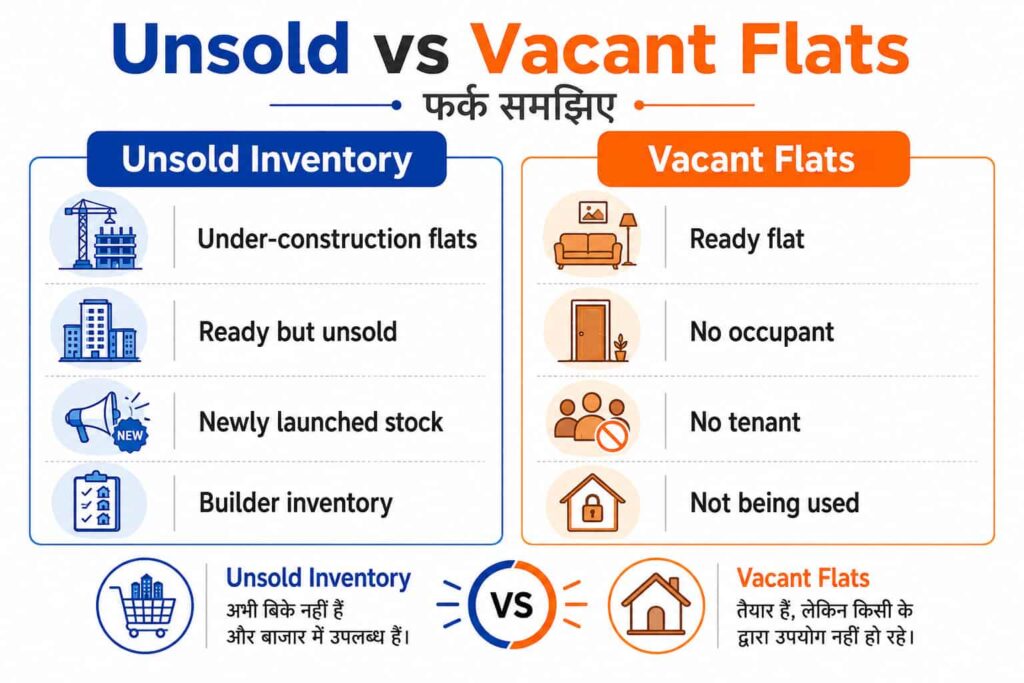
An unsold flat is a unit that has not been sold yet. It may be under construction, ready but unsold, newly launched, held by the builder, or held by an investor.
A vacant flat is different. It usually means a ready flat where nobody is living, no tenant is staying, and the unit is not being used.
So, if Hyderabad has high unsold inventory, it does not automatically mean that 1 lakh ready flats are lying empty.
That is the biggest confusion in the viral claim.
Unsold inventory shows market pressure.
Vacant flats need separate verification.
Is Hyderabad real estate slowing down?
Yes, some slowdown signals are visible.
According to Knight Frank-linked reporting, Hyderabad residential registrations fell 13% year-on-year in June 2026 to 5,560 units. The report also said that some activity had moved forward to May before guidance value revisions, which partly explains the June moderation.
But the half-year picture does not show a complete crash.
For January to June 2026, Hyderabad residential registrations increased 5% year-on-year to 37,992 units, while registered property value increased 6% year-on-year to ₹26,400 crore.
This means the market is not dead.
A better description is:
Hyderabad real estate is uneven, selective and under pressure in some pockets — but a full market crash is not officially proven.
What does housing sales data show?
Knight Frank-linked reporting said Hyderabad recorded 19,249 housing sales in H1 2026, showing a 1% year-on-year increase. The same report said Hyderabad’s unsold inventory increased 3% year-on-year to 56,095 units.
This data tells us two things at the same time.
Demand has not disappeared.
Inventory pressure is rising.
That is why calling Hyderabad a pure boom market would be wrong. But calling it a confirmed crash market would also be premature.
Claim vs reality
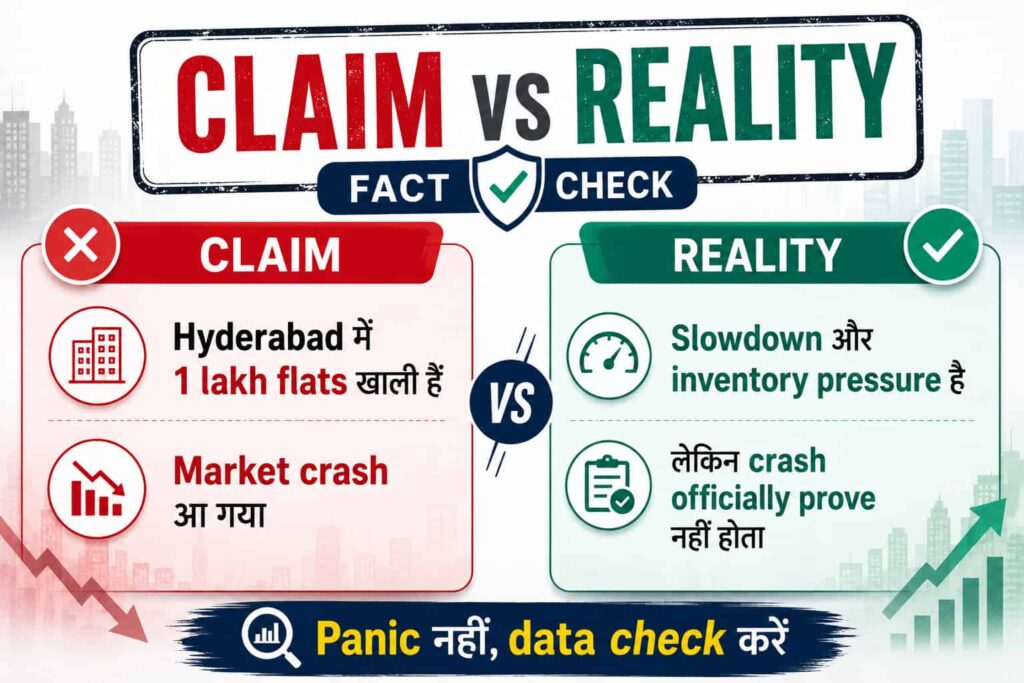
The viral claim says:
“Hyderabad has 1 lakh empty flats and the market has crashed.”
The more balanced reality is:
“Hyderabad has inventory pressure and some slowdown signals, but a full crash is not officially proven.”
This is why buyers should not panic after watching viral videos. At the same time, they should not blindly trust builder urgency.
The right approach is to check project-level facts.
Why can prices come under pressure?
Hyderabad prices increased sharply in many premium micro-markets. In several locations, buyers started seeing apartments in the ₹1 crore to ₹2 crore range. After adding registration, parking, club charges, interiors, maintenance deposits and other costs, the final cost can become much higher than the advertised base price.
When prices rise faster than buyer affordability, three things can happen.
End-users delay decisions.
Investors struggle to exit.
Builders are left with unsold inventory.
This does not always mean a crash. It may mean slower absorption, better negotiation, flexible payment plans, project-level discounts or price correction in overpriced pockets.
Builder urgency vs buyer fear
Builders may say:
“Only a few units are left.”
“Prices will increase soon.”
“Next phase will be costlier.”
“This is the last chance.”
Social media may say:
“Market will crash.”
“1 lakh flats are empty.”
“Do not buy now.”
“Builders are stuck.”
A smart buyer should not follow either extreme blindly.
Not every builder claim is true.
Not every viral warning is fake.
Not every project will crash.
Not every project is worth buying.
The buyer must move from emotion to verification.
A simple buyer story: How Rahul should think
Let us take a practical example.
Rahul works in Hyderabad’s IT sector. He is looking for a flat near Kokapet, Gachibowli or Financial District. He shortlists a ₹1.4 crore apartment.
The project looks good. The sample flat is attractive. The clubhouse looks premium. The sales team creates urgency.
But Rahul has also heard the viral claim that Hyderabad has 1 lakh unsold flats.
Instead of panicking, Rahul asks three questions.
How much actual inventory is left in this project?
If many units are still unsold, there may be room for negotiation. A buyer should ask the sales team for available inventory, floor-wise options and written price breakup.
Are ready-to-move flats available nearby?
If similar ready homes are available at a better price, paying a heavy premium for an under-construction flat may not make sense.
What is the rental demand and resale exit?
If the expected rent is weak compared to the EMI, and resale demand is not strong, the investment may become risky.
This is how Rahul avoids both builder pressure and social media fear.
Hyderabad flat buyer checklist before booking
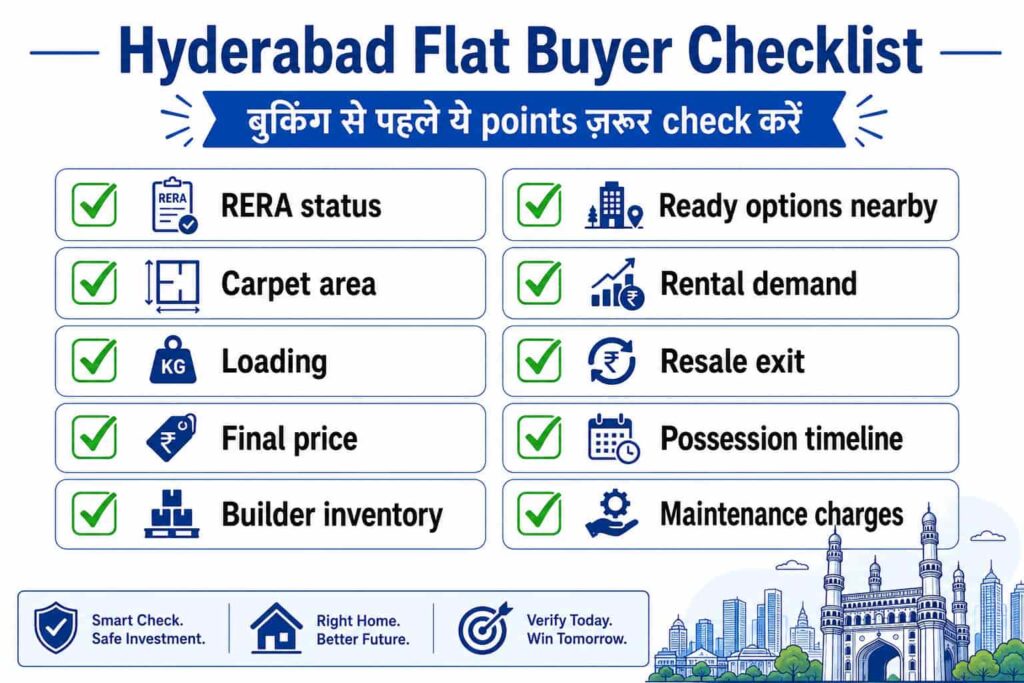
Before booking a flat in Hyderabad, buyers should check the basics carefully.
RERA status, carpet area, loading, final price, builder inventory, ready options nearby, rental demand, resale exit, possession timeline and maintenance charges should be verified before paying the booking amount.
What should end-users do?
If you are buying a flat for your own family use, do not make the decision only because of viral crash claims.
Check whether the location works for your daily life. See if the office commute is practical. Check schools, hospitals, public transport, road connectivity and daily needs.
Also check whether the final all-inclusive price is fair and whether the EMI is comfortable compared to your income.
If the location is right, the price is justified, the project is legally clear and the home genuinely suits your family, then avoiding a good property only because of viral fear may also be a mistake.
What should investors be careful about?
Investors need to be more careful than end-users.
If you are buying only for appreciation, you must study competing supply in the same area. Look at rental yield, resale demand, builder transfer rules, possession risk and nearby resale prices.
Also check whether the infrastructure story is already visible or only promised.
If you buy an under-construction flat at a premium price without a clear exit plan, the risk increases.
Which projects may face pressure?
Not every Hyderabad project should be judged the same way.
Pressure may be higher in projects where the price is too aggressive, possession is far away, many similar projects are available nearby, rental demand is weak, carpet area is low, loading is high, builder track record is average or resale buyers are limited.
Projects with strong location, clear title, good developer, reasonable pricing, practical layout and end-user demand may remain stable.
Should buyers wait?
There is no single answer.
If you are an investor looking for short-term gains, waiting, comparing and negotiating may be better.
If you are an end-user and your family need is real, then market timing should not be the only factor.
For an end-user, the most important points are:
Location
Price
Builder reputation
Usable layout
EMI comfort
Legal clarity
Possession certainty
The best deal in real estate is not always the cheapest deal. It is the deal where risk is low, usage is clear and exit is possible.
Hyderabad real estate market signals
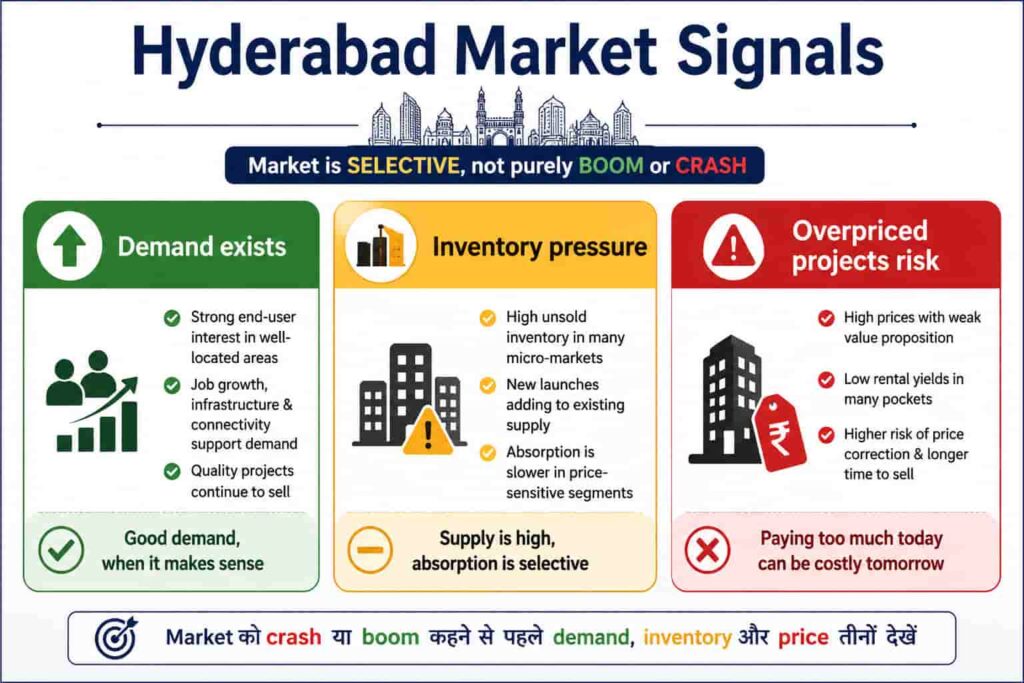
The Hyderabad market should not be described only as a boom or only as a crash.
The signals are mixed.
Demand still exists.
Inventory pressure is visible.
Overpriced projects may face risk.
Final verdict
The viral Hyderabad real estate claim has created fear, but it does not show the full picture.
The “1 lakh vacant flats” claim is not clearly proven as an official fact.
Unsold inventory pressure may be real.
Some segments may be slowing down.
Some overpriced projects may face negotiation pressure.
But calling the entire Hyderabad market a collapse is too early.
The right approach for buyers is simple:
Do not panic.
Do not buy in FOMO.
Check the data.
Compare projects.
Negotiate the final price.
Verify RERA and legal details.
Understand your own budget.
Hyderabad real estate is not finished.
But the time for blindly paying any premium price is also over.
The market has become selective.
Good projects may continue to perform. Overpriced projects may come under pressure.
Sources:-
- Hyderabad Mail — 80,000+ unsold flats / ₹1 lakh crore value claim
Source: Hyderabad Mail report on unsold inventory in Greater Hyderabad. - Siasat — Hyderabad registrations down 13% in June 2026; H1 2026 registrations up 5%
Source: Siasat report citing Knight Frank India. - ETRealty — Hyderabad housing sales up 1% to 19,249 units; unsold inventory up 3%
Source: ETRealty report citing Knight Frank India.



Leave a Reply