

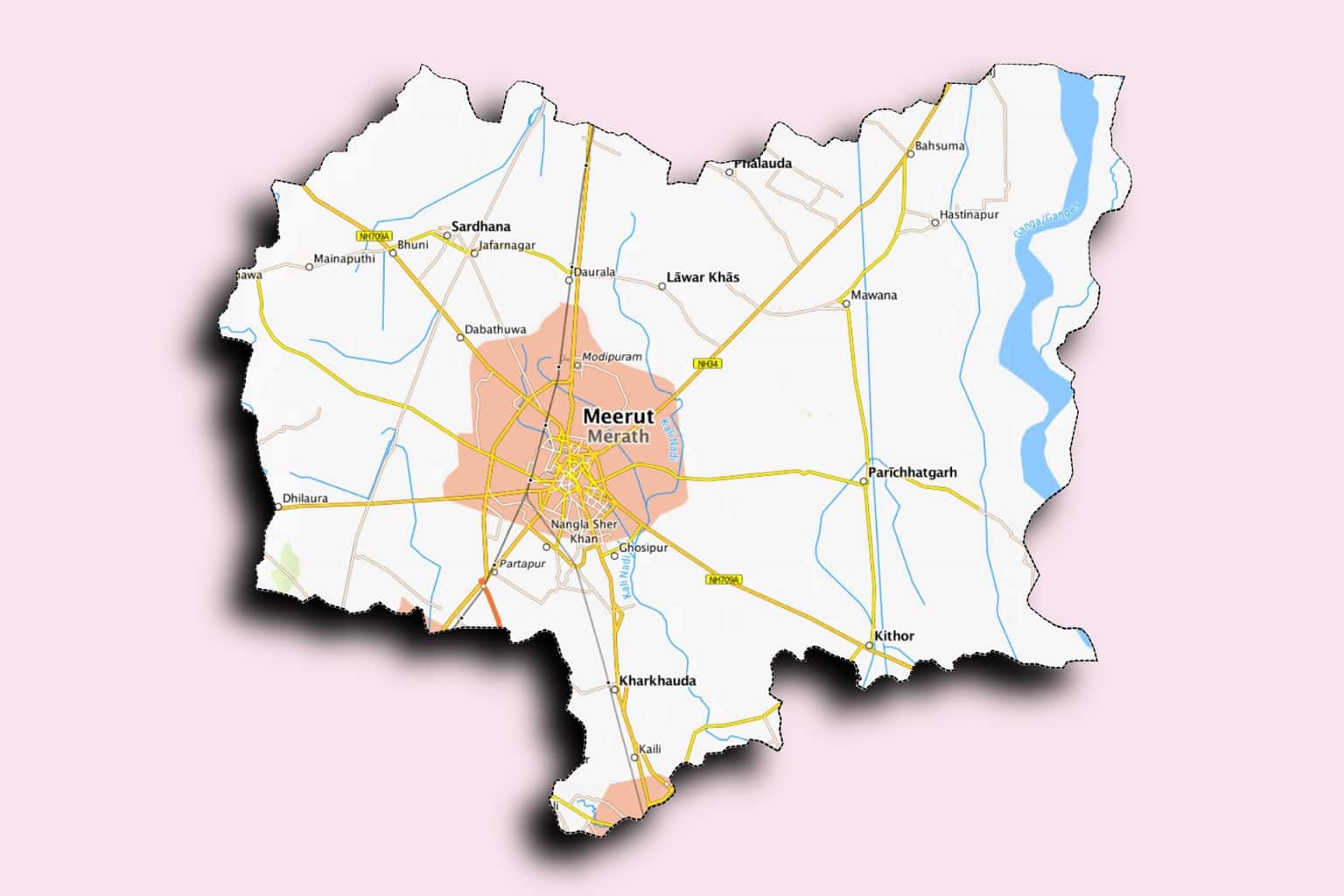
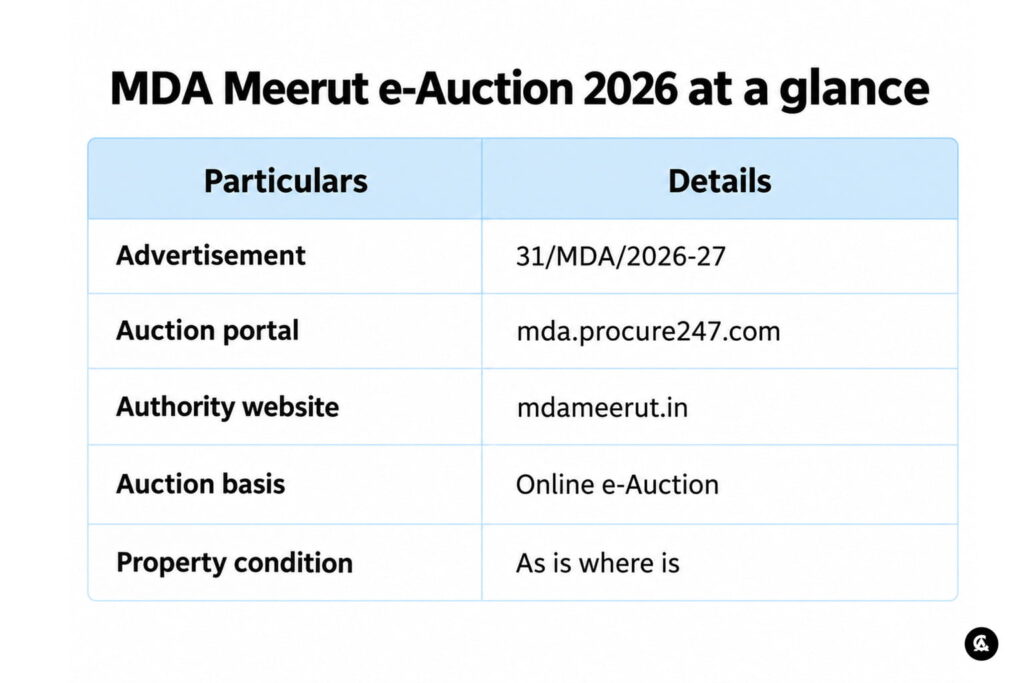
Meerut Development Authority (MDA) conducted a large e-auction in September 2026 covering residential properties as well as commercial and other non-residential sites across several MDA schemes in Meerut.

The official Advt. No. 31/MDA/2026-27 advertised 67 residential properties and 134 non-residential properties. The detailed booklet, however, contains much more than a simple plot list: it sets out property-specific reserve rates, reserve costs, EMD, bidding rules, payment options, interest, early-payment rebate, possession conditions, cancellation provisions and numerous official layout plans.
Because the scheduled auctions were held on 12 and 13 September 2026, this is no longer an open registration opportunity. The value of the official booklet now lies in understanding what was offered, how the auction worked and what successful bidders are required to do next.
Residential and non-residential auctions had separate schedules
The booklet provides separate bidding schedules for residential and non-residential properties.
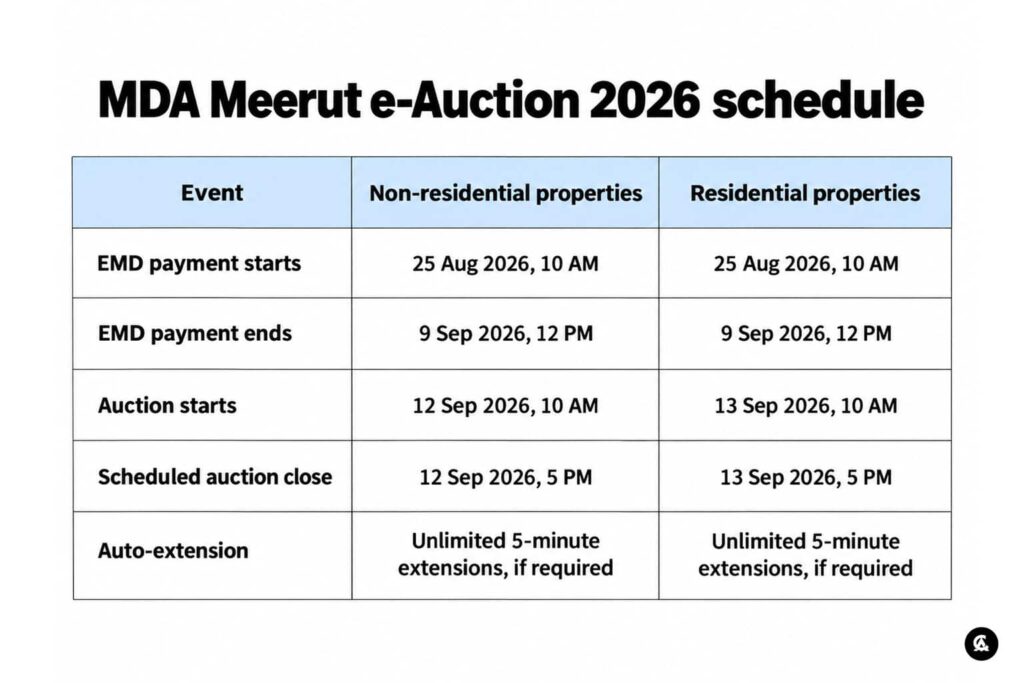
The booklet prints “20026” in the auction-end year at one place; the surrounding schedule clearly identifies the auction as the 2026 programme.
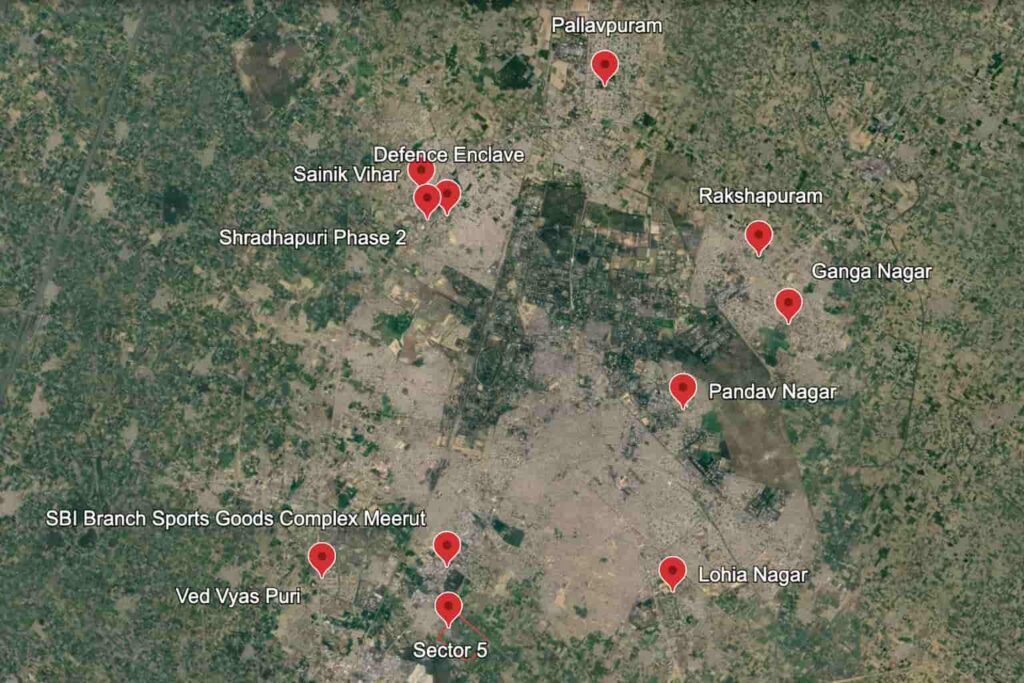
Where were the residential properties located?
The headline advertisement identifies residential properties across the following MDA schemes.
The detailed residential inventory includes MIG and HIG properties, houses and plots rather than one uniform property type.
Examples from the 67 residential properties
The table below shows representative entries from the official residential schedule. These are reserve values, not necessarily final auction prices.
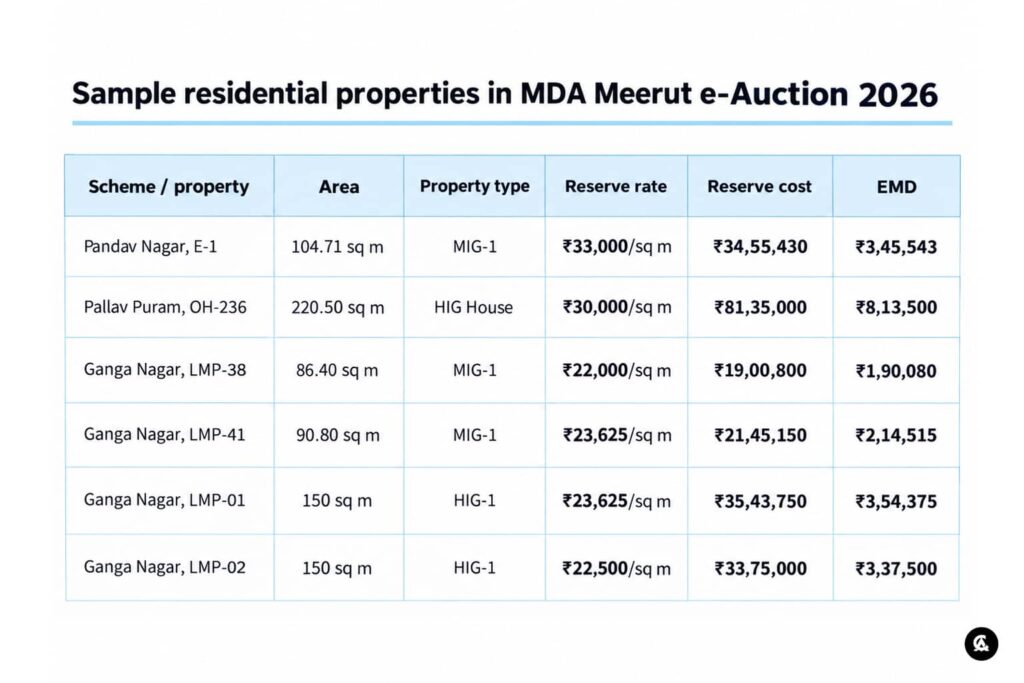
The reserve cost shown in the schedule is the starting reference for the auction. It should not be interpreted as a guaranteed final purchase price.
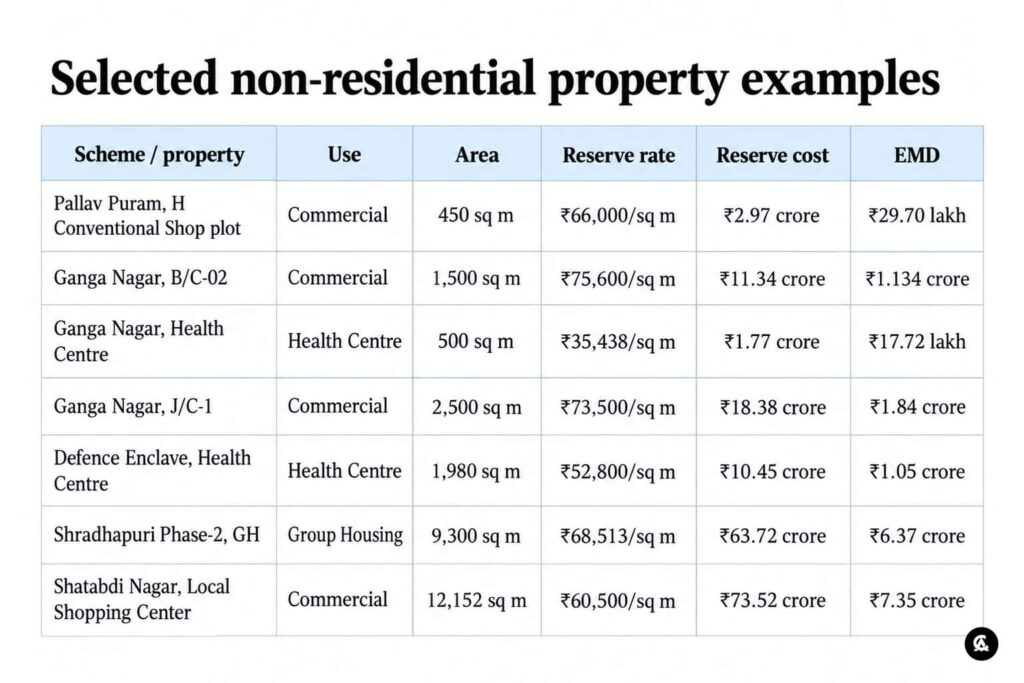
Non-residential does not mean only commercial plots
One of the most important features of this MDA auction is the diversity of the non-residential inventory.
The official booklet includes ordinary commercial sites as well as properties intended for specific uses.
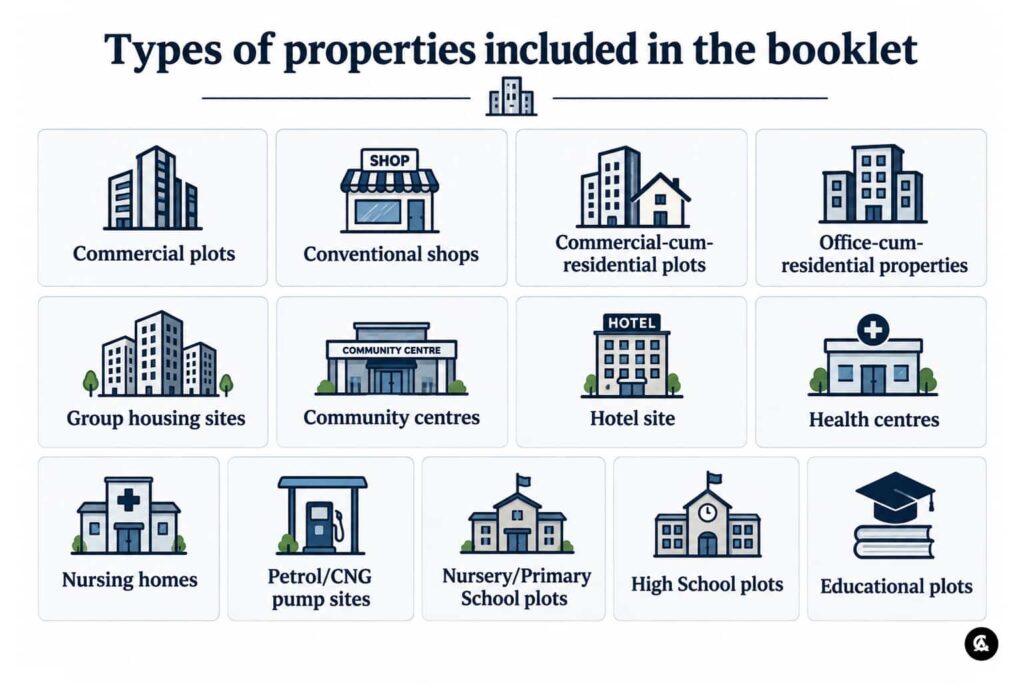
This distinction matters because eligibility and subsequent use conditions can differ significantly between an ordinary commercial property and an institutional or medical-use plot.
Selected commercial and institutional property examples
The range in size and value is substantial.
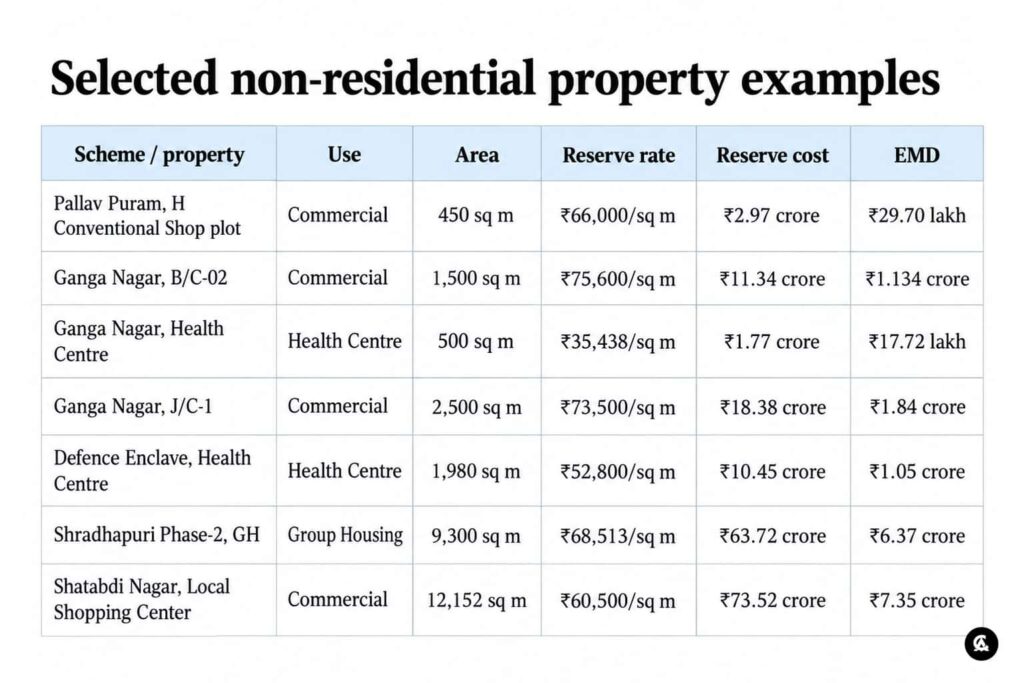
These examples also show why buyers should compare the individual property row, rather than assuming a common reserve rate across an entire MDA scheme.
Reserve price is not the final auction price
The booklet provides a reserve rate, reserve cost, EMD and a property-specific minimum rate of bidding.
Once the e-auction starts, bidders compete above the prescribed threshold. A bid entered during the auction cannot simply be reduced or withdrawn.
Even the highest bid does not automatically result in final allotment. After the auction, the bids are evaluated by the auction committee, and acceptance or rejection of the highest bid remains subject to the competent MDA authority under the booklet’s conditions.
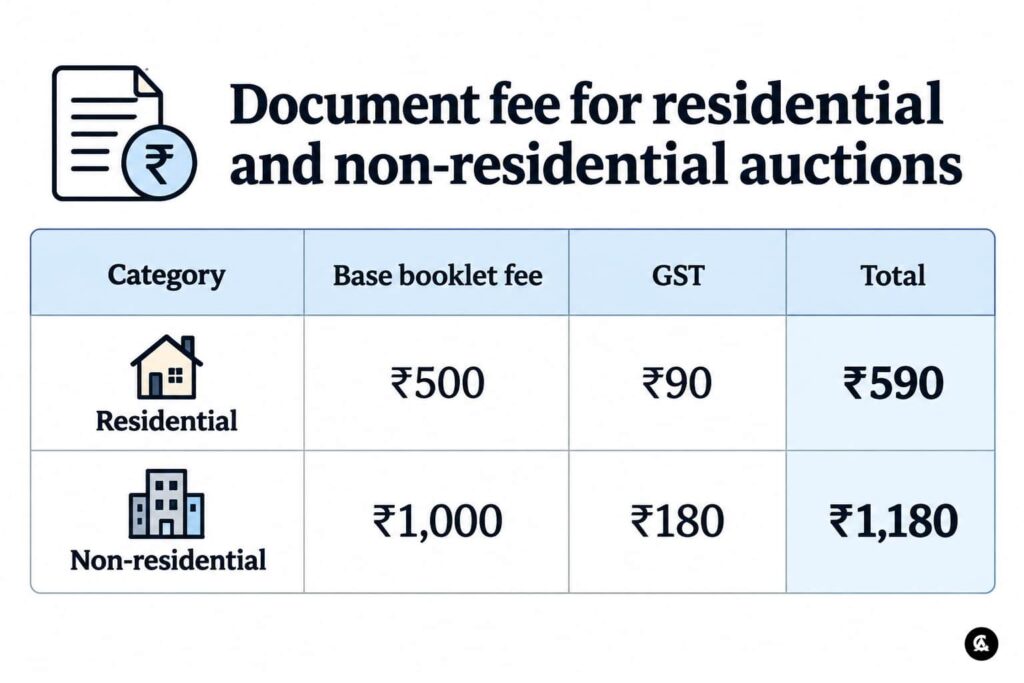
EMD had to be paid from the applicant’s own account
The non-residential auction conditions specifically require the applicant, firm or company to remit the EMD from its own account.
For an unsuccessful applicant, the EMD is to be returned to the same account. The booklet also warns that MDA will not be responsible for complications arising where the EMD was paid from somebody else’s account.
This is an important procedural condition because EMD is not simply a payment reference; it is also linked to the bidder’s identity and refund process.
Who could participate in the non-residential auction?
Eligibility depends on the property type.
For ordinary non-residential properties, the booklet allows different kinds of applicants.
Applicant type mentioned in the booklet
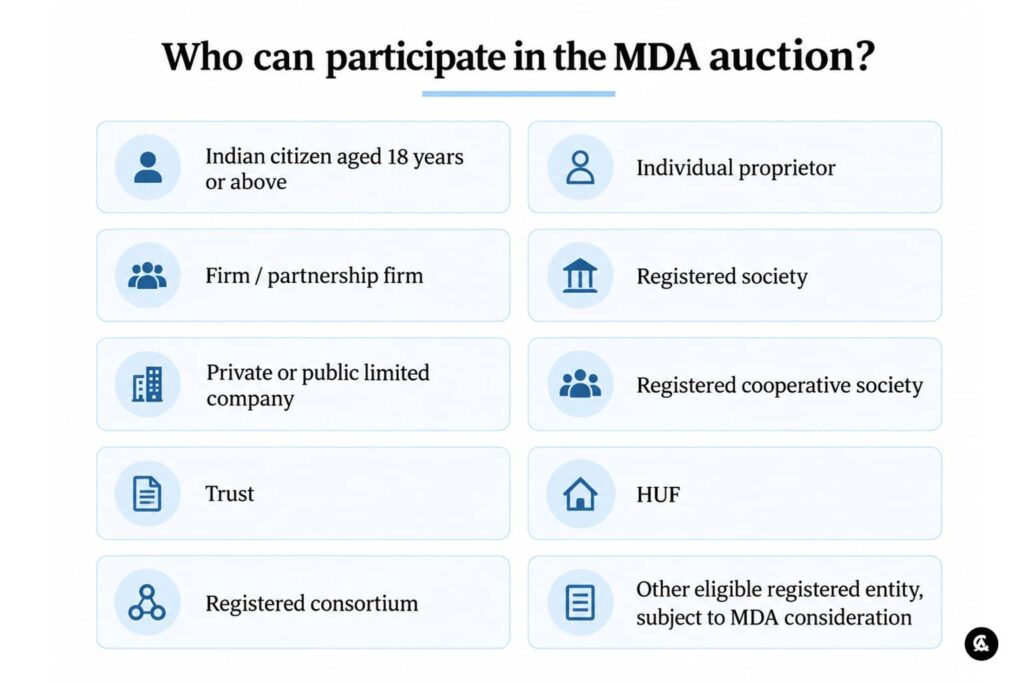
Joint participation is also permitted for relevant properties. However, applicants bidding jointly are required to select the appropriate joint-holder option during registration and enter the names of all joint applicants correctly.
The booklet makes it clear that a person omitted during registration cannot simply be added as a successful joint applicant after the auction.
Payment schedule for successful non-residential bidders
The detailed non-residential terms provide a structured payment option after allotment.
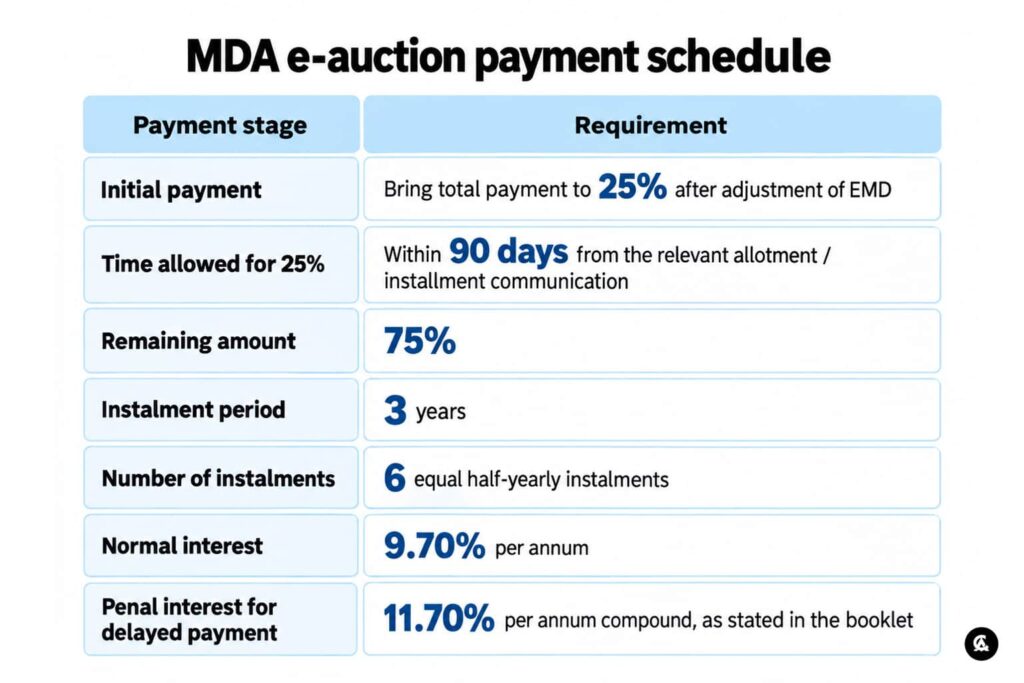
The first half-yearly instalment becomes due six months after the due date of the allotment amount, followed by the remaining instalments at six-month intervals.
These terms are from the non-residential section of the official booklet and should not automatically be applied to a residential property without checking the residential conditions applicable to that particular allotment.
Early full-payment rebate can materially reduce the basic price
The non-residential terms also provide a rebate where the balance is paid early.
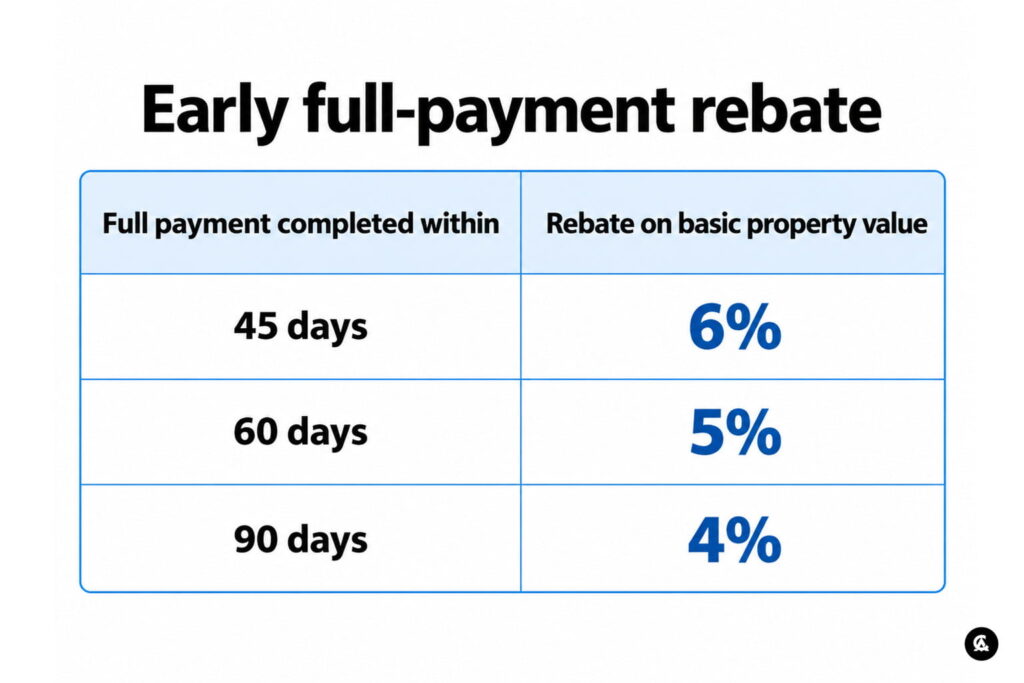
The booklet states that this rebate applies to the basic property value. It does not extend to the applicable freehold or lease-rent component.
Winning bid may not be the complete acquisition cost
A bidder should not calculate the budget only as:
Auction rate × area.
Depending upon the property and location, the booklet refers to several other possible liabilities.
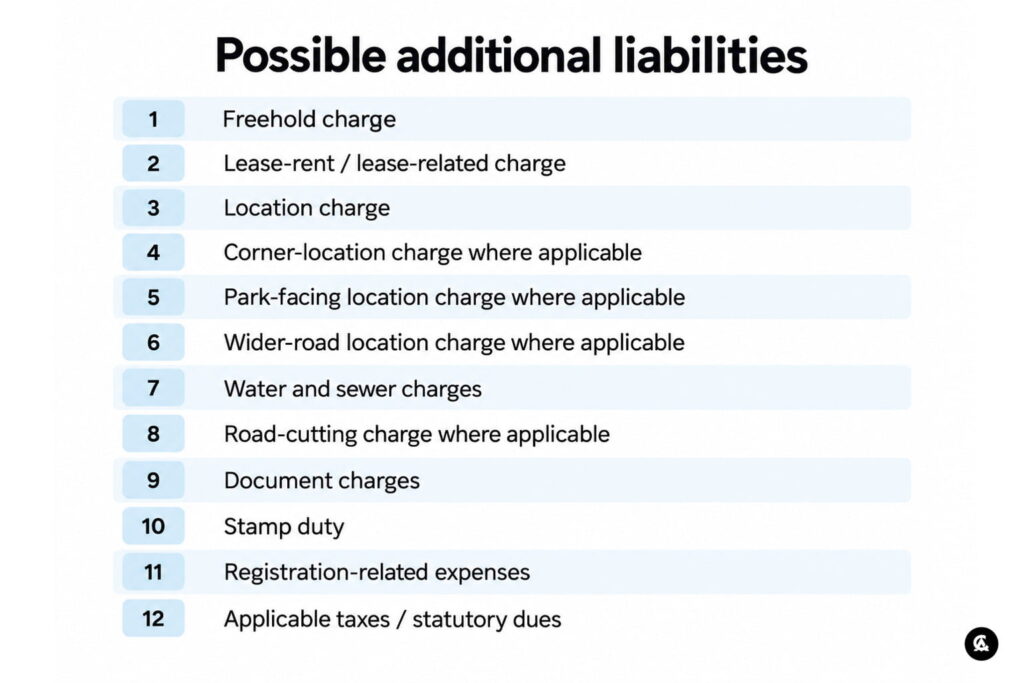
The non-residential conditions state that freehold and leasehold properties are treated differently and that location-related charges may apply depending on the final site position.
TDS may also become relevant
For qualifying non-residential transactions where the value, including the relevant components specified in the booklet, reaches the prescribed ₹50 lakh threshold, the conditions refer to 1% TDS under Section 194-IA.
The allottee is required to deposit the applicable tax and provide the required proof to MDA before the amount can be accounted for against the property.
Possession is not automatic after winning
The successful bidder has to complete the applicable payment and documentation requirements before possession can be handed over.
Depending on the property and payment route, the booklet refers to payment of the required property amount along with freehold/lease components, applicable location charges, water/sewer charges, road-cutting charges and documentation requirements.
For instalment purchasers of ordinary non-residential properties, possession can be linked to payment of the prescribed initial amount and execution/registration of the appropriate agreement.
Final plot area can be different from the advertised area
The area published in the e-auction table is not necessarily the final measurement for all purposes.
The official conditions provide for adjustment where the final site plan or verification shows that the allotted property area has increased or decreased.
The booklet also contains a specific mechanism for cases where the final area is more than 10% higher than the advertised standard area.
That means the final financial liability can change if the actual site area changes.
Properties are offered on an “as is where is” basis
The booklet repeatedly uses the “जहाँ है, जैसा है” — “as is where is” principle.
This makes the official layout plans included later in the PDF particularly important. They identify plot positions, adjoining roads, parks, institutional sites, commercial pockets and surrounding planning details for many of the properties.
A bidder should therefore rely on the property-specific schedule and layout plan together rather than evaluating a property solely from its serial number or reserve value.
Construction and use must follow the allotted purpose
The property must be used for the purpose for which it was allotted.
Before construction, the required building plan approval from MDA is necessary, and development parameters such as setbacks, ground coverage, FAR and building height are governed by the applicable building rules.
For educational and other special-use plots, additional conditions apply to the institution and its operation.
Payment default can lead to cancellation
The auction should not be viewed as a low-commitment process in which the bidder can win first and decide later.
Under the non-residential conditions, failure to deposit the required allotment amount within the prescribed period can lead to cancellation and forfeiture of EMD.
Further default in instalments can also trigger cancellation, deductions from amounts already deposited and resumption of the property under the relevant conditions.
Highest bidder’s EMD is retained until MDA decides the bid
After the auction, the EMD of bidders other than the highest bidder is to be refunded according to the prescribed process.
The highest bidder’s EMD remains deposited until the competent authority decides whether the highest bid will be accepted or rejected.
This is another reason why “highest bid” and “successful final allotment” should not be treated as identical stages.
MDA can withdraw, postpone or cancel a property from auction
The booklet reserves authority to remove, postpone or cancel a property from the e-auction under the stated conditions.
Therefore, the property schedule downloaded before bidding should always be read along with any subsequent amendment or change issued on the auction portal.
There is an important 134 vs 138 inventory discrepancy
The advertisement on the first page clearly states:
| Category | Advertised count |
|---|---|
| Residential | 67 |
| Non-residential | 134 |
However, the detailed non-residential property schedule later in the same PDF continues up to serial number 138.
The final entries include additional properties under Pallav Puram, Raksha Puram and Ganga Nagar.
For that reason, 134 should be described as the advertised headline count, while the detailed booklet itself should be consulted property-by-property rather than assuming that its complete schedule contains exactly 134 rows.
This is one of the most important details in the 96-page document because relying only on the advertisement can produce a different inventory count from the detailed schedule.
What buyers should understand from this MDA auction?
The MDA Meerut e-Auction 2026 was not simply a sale of inexpensive government plots.
It combined ordinary residential properties with commercial and institutional land across multiple MDA schemes. Every property carried its own area, reserve rate, reserve cost, EMD and minimum bidding requirement, while the final financial commitment could also include freehold or lease-related amounts, location charges, statutory payments and registration expenses.
The reserve price was only the starting reference. Final allotment depended on the bidding outcome and acceptance by MDA, and successful bidders remain subject to the payment, possession, use and cancellation conditions contained in the official booklet.
Since the scheduled bidding has already concluded, the next useful development to track is the official auction result: successful properties, accepted bids, unsold inventory and the difference between reserve value and accepted auction price.



Leave a Reply