

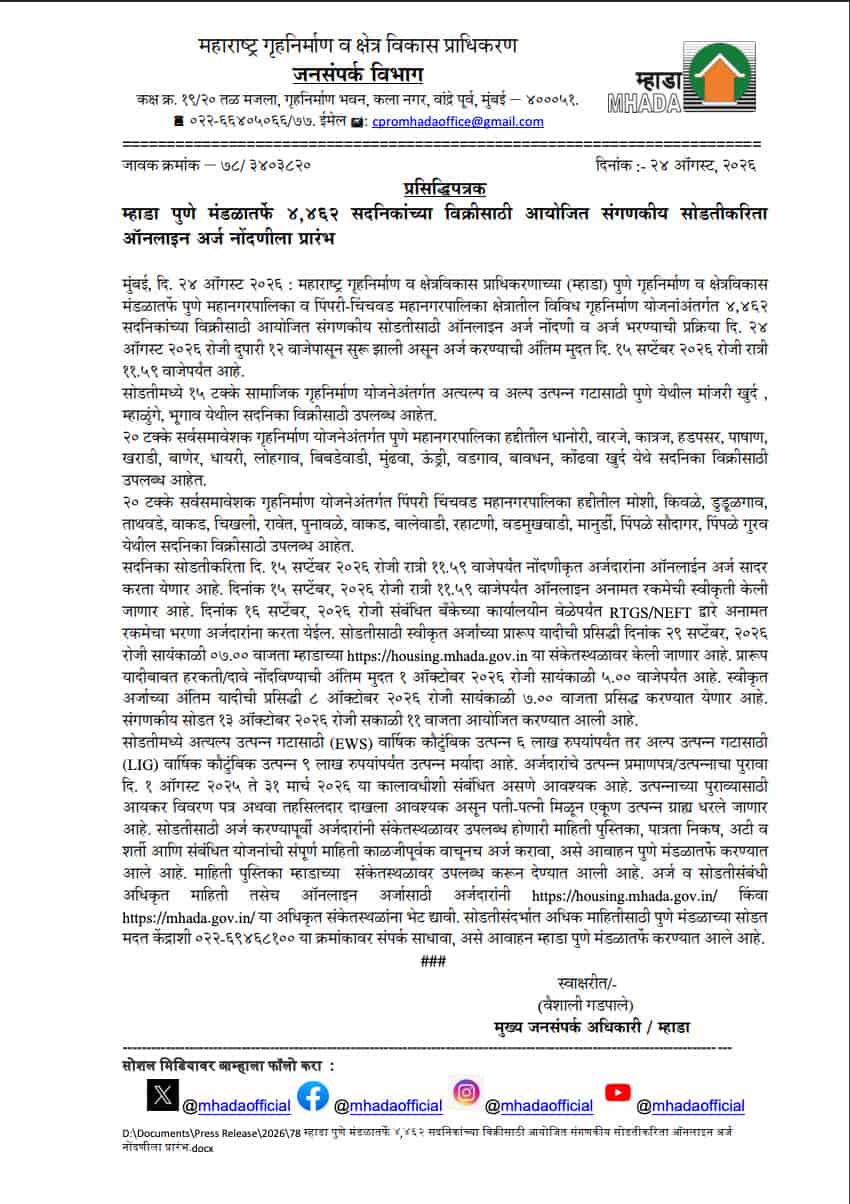
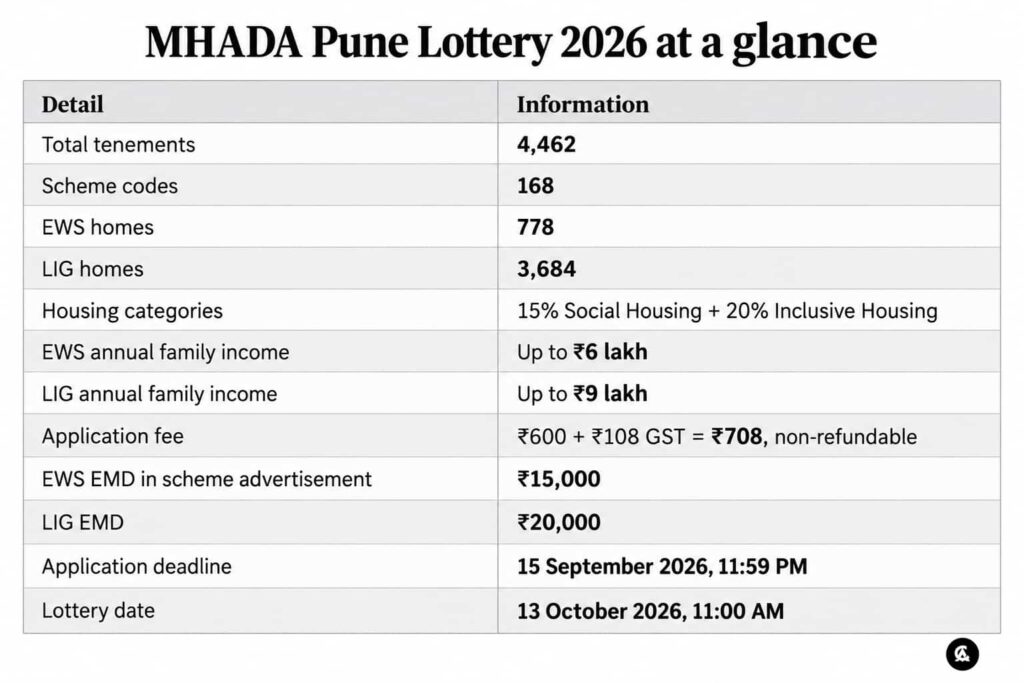
The MHADA Pune Board September 2026 lottery covers 4,462 tenements across 168 scheme codes under the 15% Social Housing Scheme and 20% Inclusive Housing Scheme. The inventory includes 1RK, 1BHK, 1.5BHK, 2BHK and 2.5BHK homes across Pune and Pimpri-Chinchwad region projects.
Adding the scheme-wise inventory in the official booklet gives 778 EWS homes and 3,684 LIG homes. The detailed advertisement separately provides the project name, estimated price, built-up area, carpet area, number of flats, reservation breakup and MahaRERA registration details for individual schemes.
Where are these 4,462 flats?
The lottery is not a single housing project. It combines a large number of projects under two housing mechanisms.
The 15% Social Housing Scheme includes major inventories at Manjari Khurd, Mhalunge and Bhugaon. The 20% Inclusive Housing inventory extends across locations such as Dhanori, Hadapsar, Warje, Katraj, Pashan, Baner, Kharadi, Bavdhan, Mundhwa, Dhayari, Undri, Lohegaon, Moshi, Tathawade, Wakad, Ravet, Punawale, Chikhali, Kiwale, Dudulgaon, Mamurdi, Pimple Saudagar, Rahatani and several other locations listed scheme by scheme in the advertisement.
Some of the biggest single project clusters are Sarita Niketan with 476 homes, Avian Valley Solaire with 404 homes, Shanti Niketan with 393 homes, and Life Republic Sector R35/35th Avenue Harmony Residency with 218 homes.
Major projects, prices and carpet areas
The prices published in the advertisement are estimated prices, not necessarily the final sale price. The detailed booklet specifically states that the displayed price is tentative and may be finalised or revised by the competent MHADA authorities.
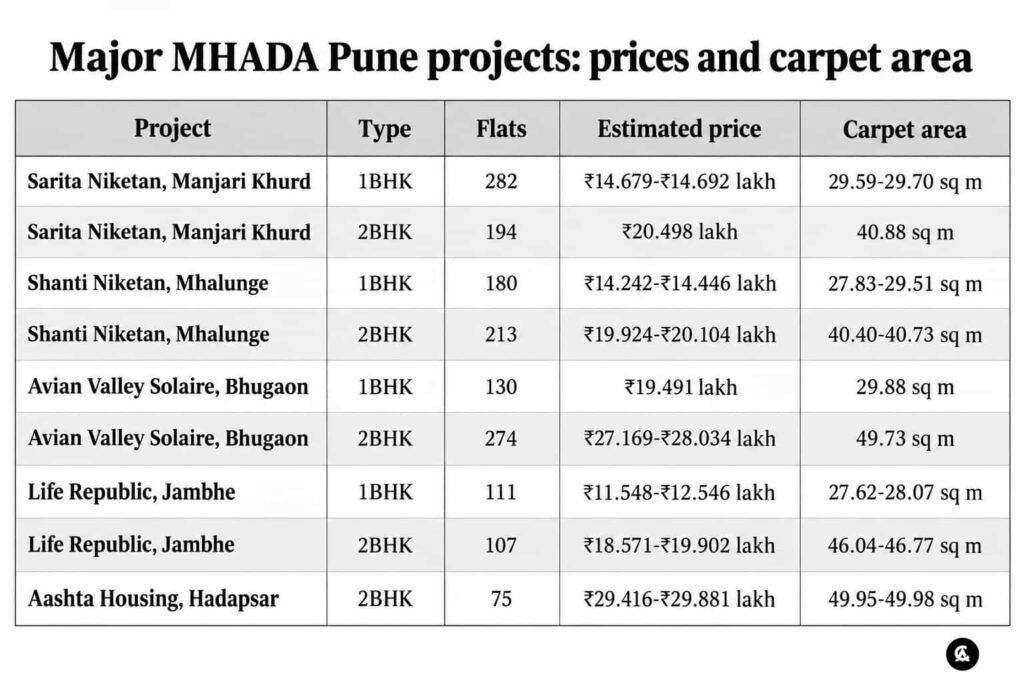
The advertisement gives both built-up area and carpet area for the individual entries. For example, Sarita Niketan 1BHK has a built-up area of 44.11-44.15 sq m, while its carpet area is 29.59-29.70 sq m. Avian Valley Solaire 2BHK has a built-up area of 86.40-89.15 sq m and a carpet area of 49.73 sq m.
MahaRERA and OC information
The advertisement contains a MahaRERA registration column for individual schemes.
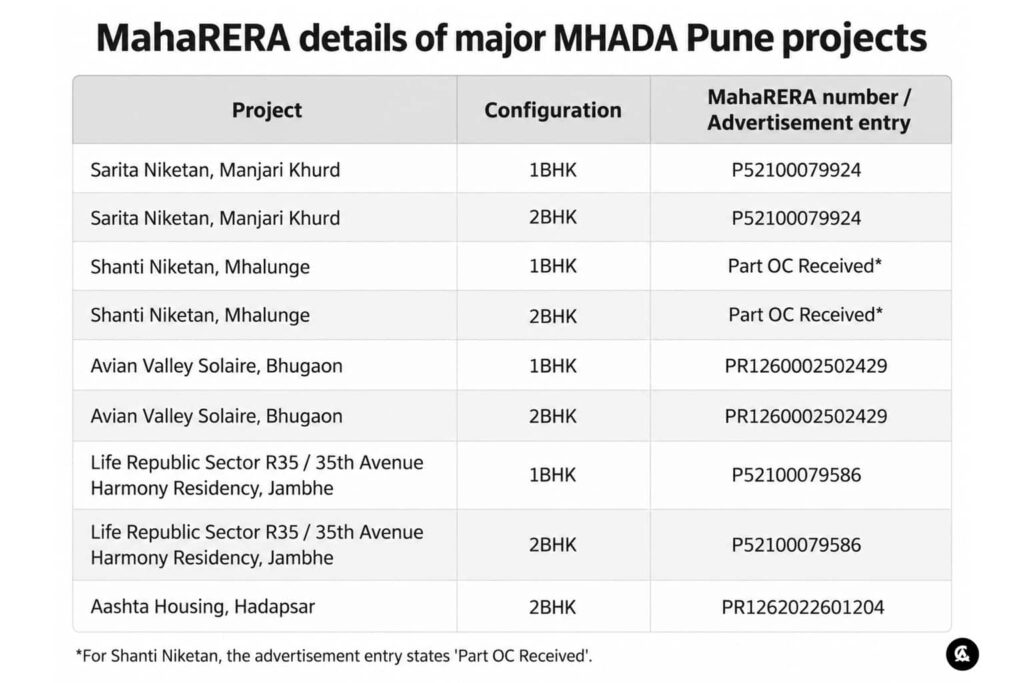
The same advertisement also carries “OC Received” or “Part OC Received” remarks against certain entries. These remarks are not given uniformly for all 4,462 homes, so the three documents do not assign one common possession or OC status to the entire lottery.
The advertisement provides project names but does not contain a separate developer/promoter-name column for every scheme.
Who falls under EWS and LIG?
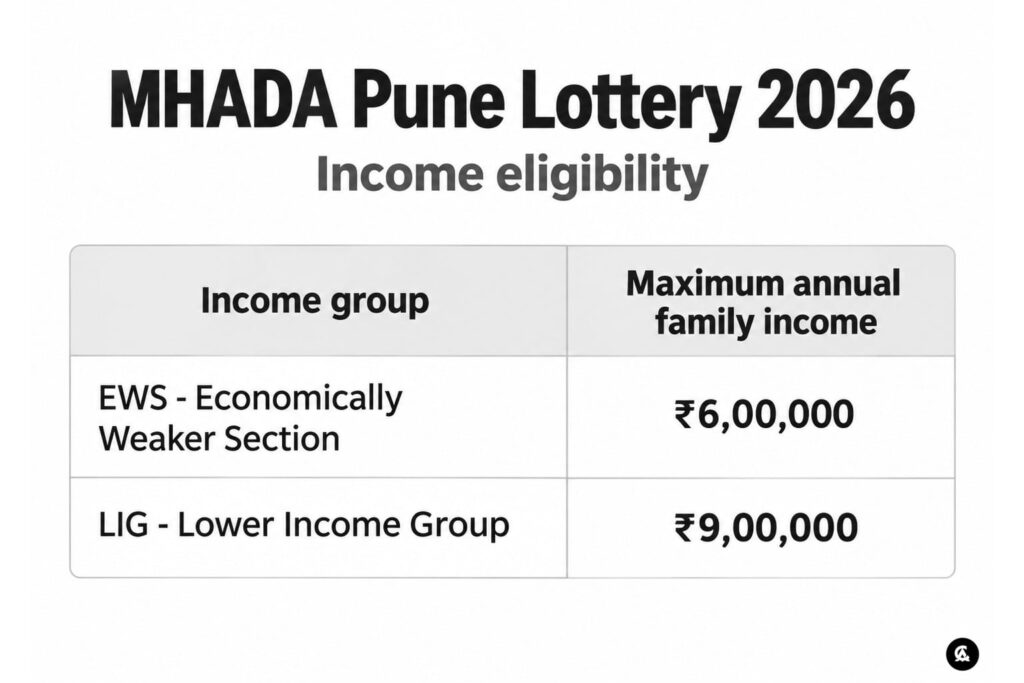
Family income means the combined income of the applicant and spouse. The detailed booklet and scheme advertisement specify the income-proof period as 1 April 2025 to 31 March 2026, with an Income Tax Return or Tehsildar income certificate accepted as the prescribed income proof.
Basic eligibility and Maharashtra domicile rule
The applicant must be at least 18 years old on the date of application.
The domicile clause requires at least 15 years of continuous residence in Maharashtra during the preceding continuous 20-year period counted from the advertisement. The booklet requires a competent-authority-issued Maharashtra domicile certificate with a barcode. The domicile condition is relaxed for the specified Central Government employee (CG) category.
There is also a specific property-ownership restriction under Regulation 9(A). An applicant is not eligible for a tenement in a municipal area if the applicant, spouse or minor children own a house, flat or residential plot in that municipal area, or hold a MHADA house, flat or residential plot there on the specified hire-purchase, outright-sale or rental basis.
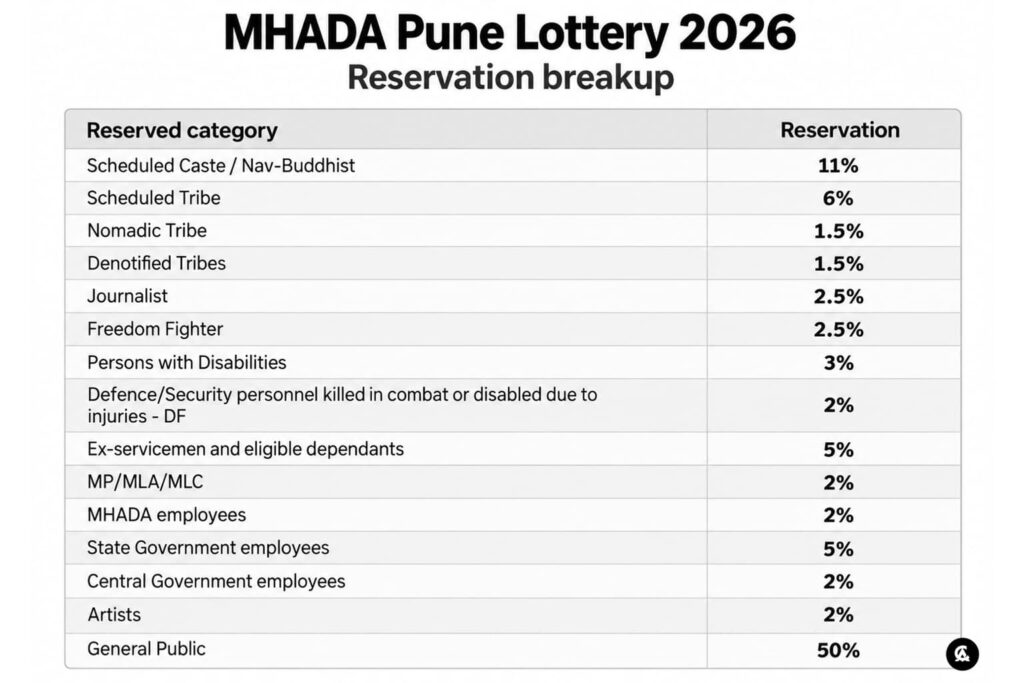
The separate 2% Government discretionary reservation is under a court stay, and the booklet states that flats under this category have been converted to the General Public category.
For the Ex-servicemen category, eligible dependants are defined as the spouse, sons, unmarried daughters, mother and father. The booklet also states that ex-servicemen from other states cannot claim this reservation category.
For the State Government category, eligible permanent employees must generally have completed at least five years of service. The MHADA employee category also carries a five-year permanent-service condition. The Central Government category covers the specified employees residing in government accommodation who are due to retire at normal retirement age within three years, as well as already retired employees under the stated conditions; voluntary retirees are excluded from this concession.
How payment works after allotment?
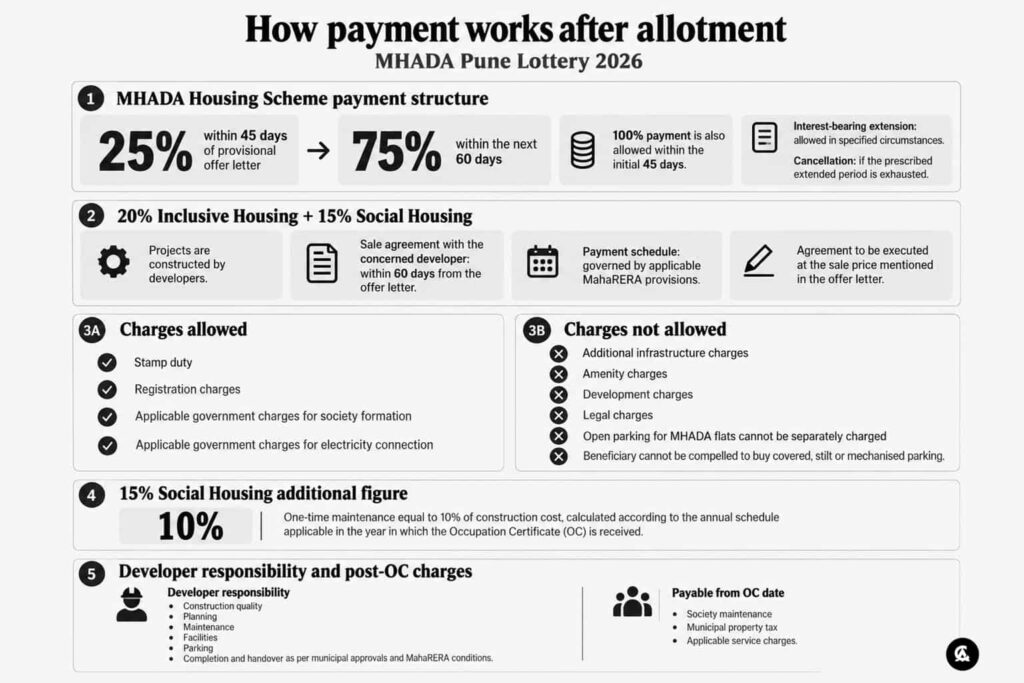
For flats falling under the MHADA Housing Scheme payment structure, the booklet provides for 25% of the total sale price within 45 days of the provisional offer letter, followed by the remaining 75% within the next 60 days. It also permits 100% payment within the initial 45-day period. The booklet provides interest-bearing extensions in specified circumstances and cancellation if the prescribed extended period is exhausted.
The rules are different for flats under the 20% Inclusive Housing and 15% Social Housing schemes, because these projects are constructed by developers. The booklet makes the developer responsible for construction quality, planning, maintenance, facilities and parking. A successful allottee is required to execute the sale agreement with the concerned developer within 60 days from the offer letter, while the payment schedule is governed by the applicable MahaRERA provisions.
The agreement is to be executed at the sale price mentioned in the offer letter. Apart from stamp duty, registration charges and applicable government charges relating to society formation and electricity connection, the booklet says additional infrastructure, amenity, development or legal charges cannot be demanded. Open parking reserved for MHADA flats cannot be separately charged, and the beneficiary cannot be compelled to purchase covered, stilt or mechanised parking.
For 15% Social Housing, the booklet additionally provides for one-time maintenance equal to 10% of the construction cost calculated according to the annual schedule applicable in the year in which the Occupation Certificate is received.
Completion and handing over of flats under these developer-built schemes is the concerned private developer’s responsibility according to municipal approvals and MahaRERA conditions. Where an OC has been received, society maintenance, municipal property tax and applicable service charges become payable from the OC date as specified in the booklet.
Two differences inside the published documents
There are two numerical inconsistencies within the three documents that form part of the lottery material.
First, the scheme-wise advertisement and the 168-scheme inventory table show EWS EMD as ₹15,000 and LIG EMD as ₹20,000. However, the generic EMD table on page 11 of the detailed booklet states ₹10,000 for EWS and ₹20,000 for LIG. The application fee remains ₹708 in both places.
Second, the detailed booklet and the three-page scheme advertisement specify the income-proof period as 1 April 2025 to 31 March 2026, while the MHADA press release uses 1 August 2025 to 31 March 2026. This is a difference between the published lottery documents themselves; the blog does not substitute either period with information from any outside source.
Sources
MHADA Pune Final Information Booklet – September 2026


Leave a Reply