

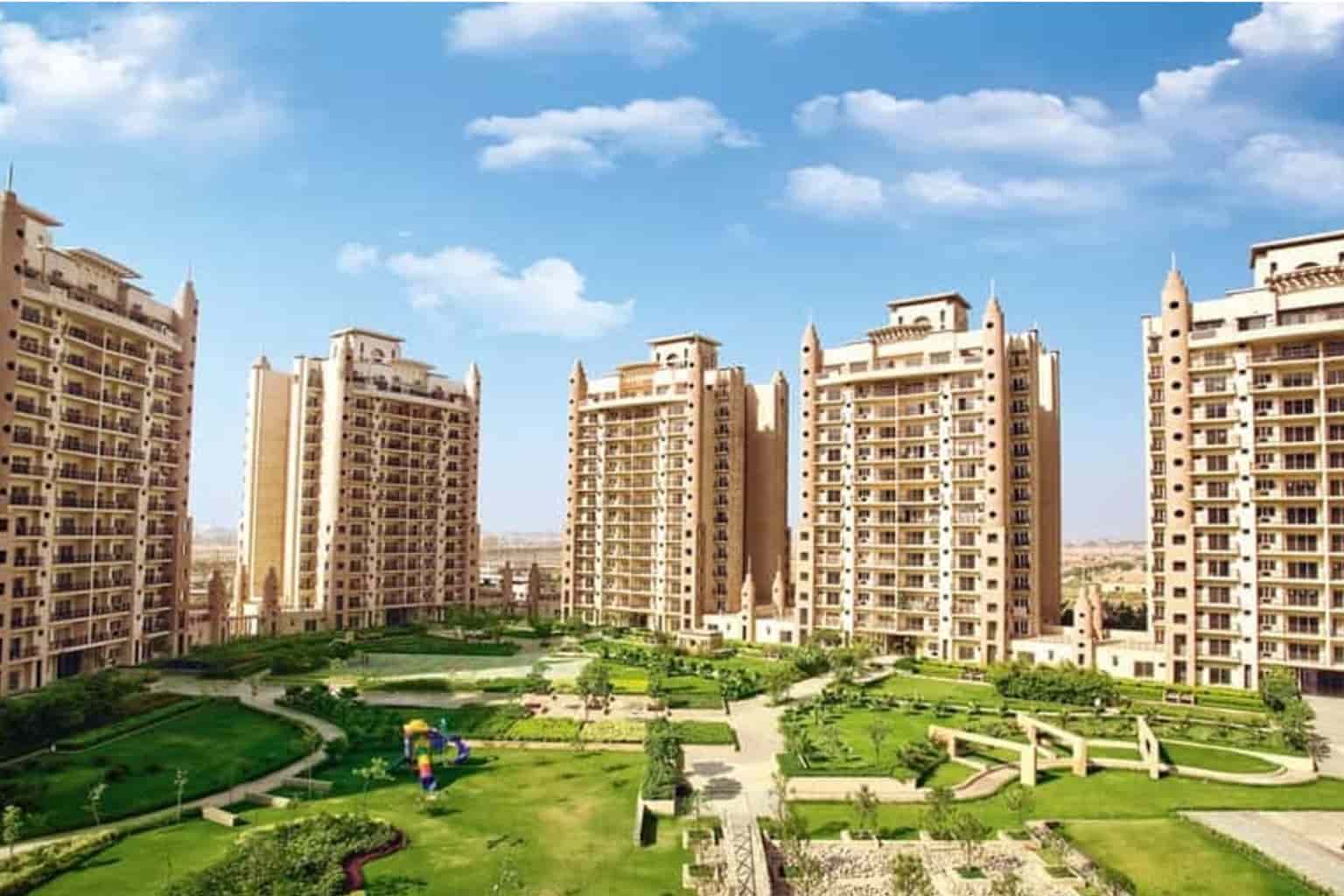
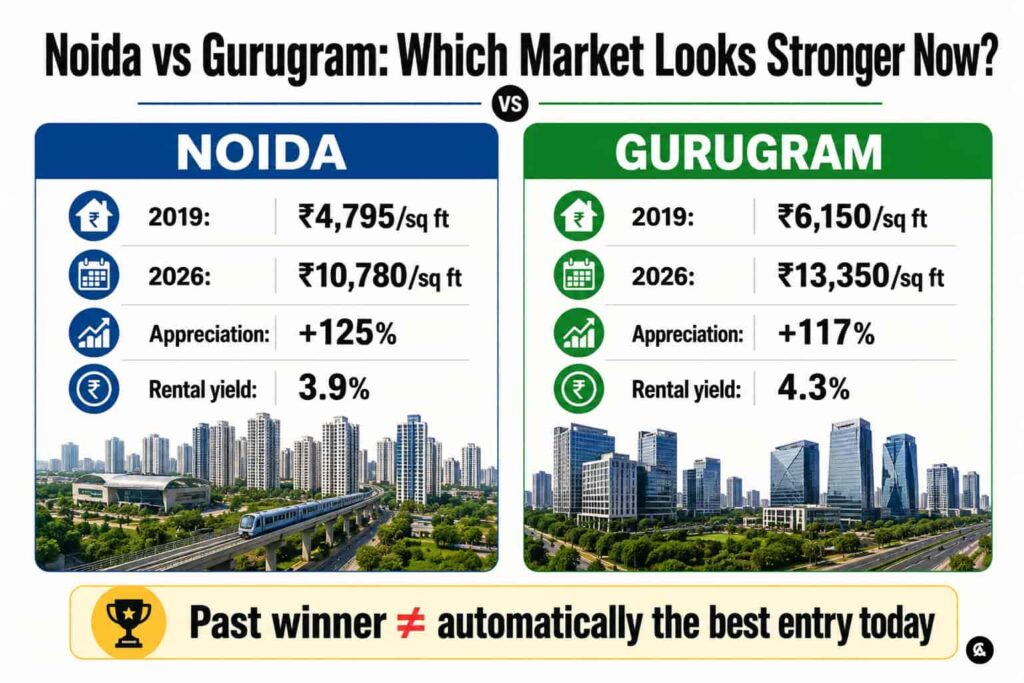
Noida property prices have risen about 125% between 2019 and Q2 2026, according to ANAROCK Research & Advisory data reported across multiple publications. Average residential values increased from approximately ₹4,795 per sq ft to ₹10,780 per sq ft. Gurugram followed closely with a 117% increase, from ₹6,150 to ₹13,350 per sq ft.
The bigger question for a homebuyer or investor is no longer whether Noida delivered strong returns in the past. It is whether buying after a 125% price rise still makes financial sense—or whether much of the future growth is already reflected in today’s prices.

Noida property prices 2026 at a glance
| Indicator | Noida | Gurugram |
|---|---|---|
| Average residential price in 2019 | ₹4,795/sq ft | ₹6,150/sq ft |
| Average residential price in Q2 2026 | ₹10,780/sq ft | ₹13,350/sq ft |
| Capital appreciation | 125% | 117% |
| Rental yield in 2019 | 3.2% | 3.5% |
| Rental yield in Q2 2026 | 3.9% | 4.3% |
| Rental yield improvement | +70 bps | +80 bps |
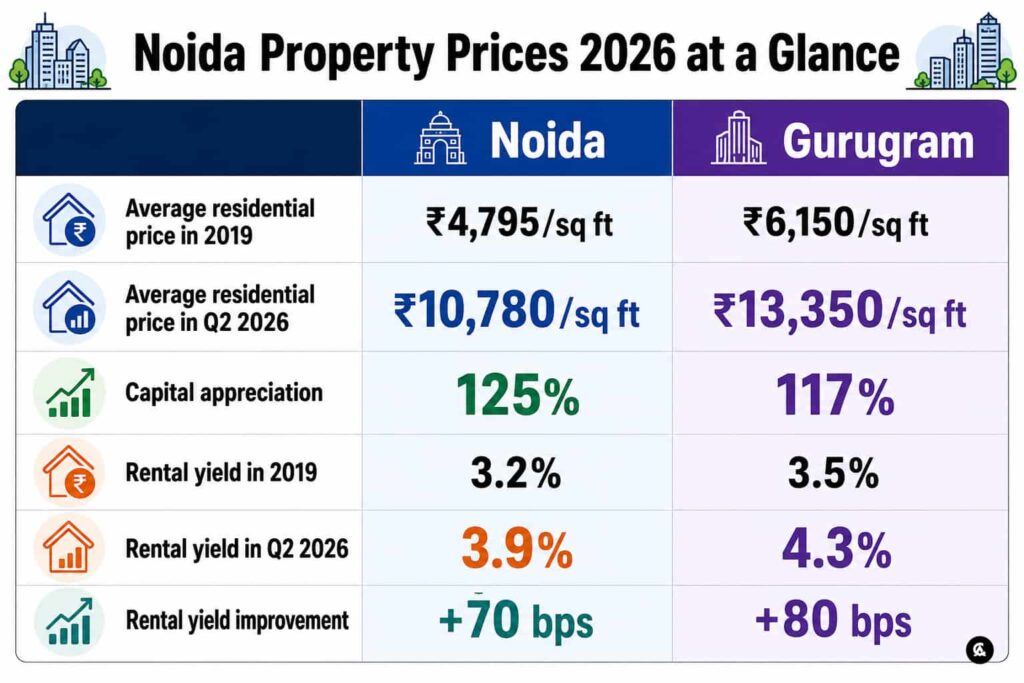
The figures are market averages from ANAROCK Research & Advisory’s analysis of major residential markets. They should not be interpreted as the appreciation achieved by every project, sector or individual property in Noida or Gurugram.
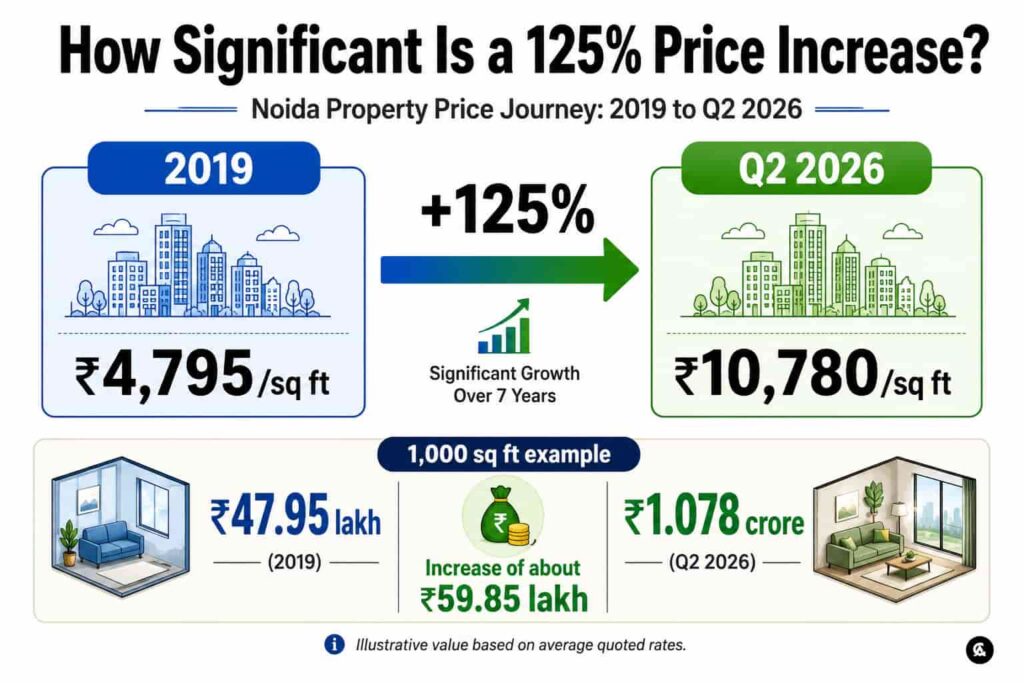
How significant is a 125% property price increase?
Using the reported market averages, the scale of the increase becomes easier to understand.
A hypothetical 1,000 sq ft property priced at ₹4,795 per sq ft would represent a base value of approximately:
2019: ₹47.95 lakh
At ₹10,780 per sq ft:
Q2 2026: ₹1.078 crore
That is an increase of almost ₹59.85 lakh before considering stamp duty, registration, GST where applicable, parking, PLC, club charges or other transaction costs.
This is only an illustration based on average quoted rates. Actual apartment prices depend on location, project, configuration, construction stage, floor, developer and transaction terms.
Did every property in Noida appreciate by 125%?
No.
The 125% figure is an average market-level movement, not a guaranteed return for every homeowner.
ANAROCK’s official NCR Q2 2026 market report itself shows substantial differences between individual NCR micro-markets.
For example:
| NCR micro-market | Q2 2026 average quoted rate |
| Sector 150, Noida | ₹14,780/sq ft |
| Greater Noida West | ₹10,150/sq ft |
| Dwarka Expressway | ₹14,180/sq ft |
| New Gurugram | ₹13,450/sq ft |
| Raj Nagar Extension | ₹6,950/sq ft |
| NH-24, Ghaziabad | ₹7,220/sq ft |
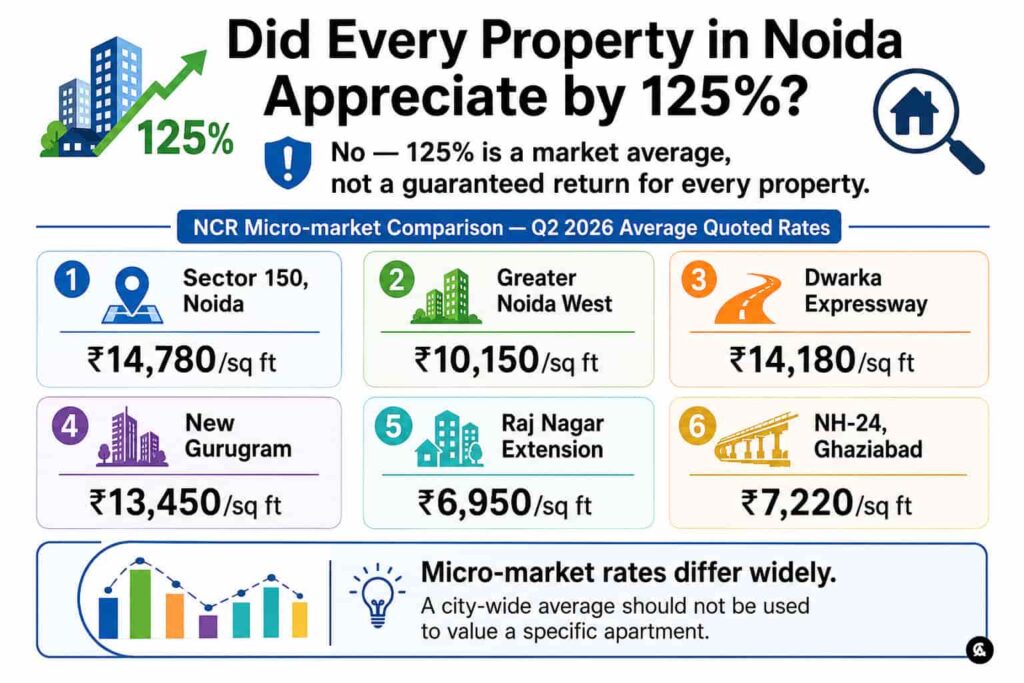
ANAROCK specifies that these are average quoted base prices on super built-up area, reinforcing why buyers should not use one city-wide number to value a specific property.
A well-located completed property next to established infrastructure may behave very differently from an under-construction project several kilometres away.
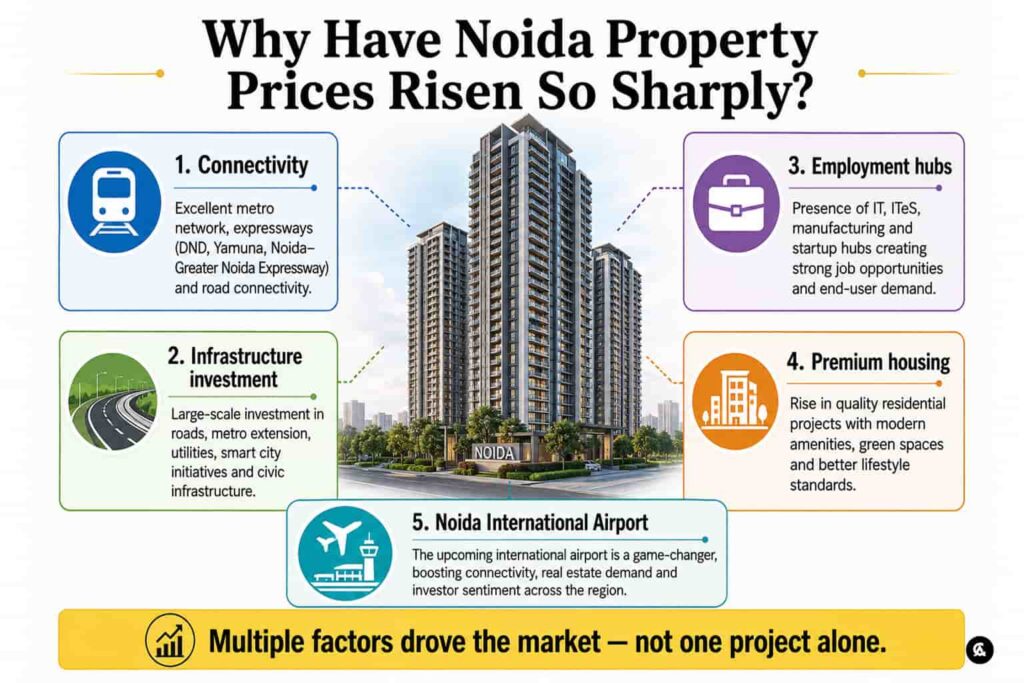
Why have Noida property prices risen so sharply?
The appreciation cannot be attributed to a single project or infrastructure announcement.
ANAROCK’s analysis points towards a combination of infrastructure investment, improved connectivity, employment creation and sustained housing demand, with premium housing supply also contributing to the change in market positioning.
Several structural changes have helped reshape Noida’s residential market:
Better regional connectivity: Noida and Greater Noida are connected through expressways, arterial roads and the Metro network.
Premium housing supply: Newer projects increasingly target buyers seeking larger homes, better amenities and higher specifications.
Employment ecosystem: Office, IT, services, industrial and emerging commercial activity continues to create housing demand across the wider Noida-Greater Noida region.
Infrastructure expectations: Large projects can influence long-term perception and investment interest even before they become fully operational.
Noida International Airport: The airport began commercial operations on 15 June 2026, with IndiGo operating the first commercial flight. Phase 1 has been designed for an annual passenger capacity of 12 million.
However, it would be misleading to say that Noida International Airport caused the entire 125% property-price increase. Most of the 2019–2026 appreciation occurred while the airport was still under development.
The airport is better viewed as one component of the region’s evolving infrastructure story, not as an explanation for all historical gains.
Why is the increase in rental yield particularly interesting?
The capital-price increase is only half the story.
ANAROCK’s data shows that Noida’s rental yield increased from 3.2% in 2019 to 3.9% in Q2 2026, even while average residential values rose 125%.
Gurugram’s yield increased from 3.5% to 4.3% while property values appreciated 117%.
This is notable because rapidly increasing capital values can often push rental yields lower if rents fail to keep pace.
Here, rents have apparently risen sufficiently for average yields to improve alongside capital values.
But investors should keep one distinction clear:
Rental yield is not the same as net investment return.
A gross rental yield does not automatically account for:
- Vacancy periods
- Maintenance
- Property tax
- Brokerage
- Repairs
- Furnishing
- Society charges
- Financing costs
A property advertised as yielding around 4% can therefore produce a lower net return after expenses.
Noida vs Gurugram: Which market looks stronger now?
Noida has generated the larger percentage increase since 2019, but Gurugram continues to command a higher average residential price.
Noida: ₹10,780/sq ft
Gurugram: ₹13,350/sq ft
Gurugram also has the higher reported rental yield at 4.3% versus Noida’s 3.9%.
Gurugram’s housing market benefits from its deep corporate and employment ecosystem, while major transport infrastructure has strengthened connectivity.
The Haryana section of the Dwarka Expressway, measuring 19 km, was inaugurated in March 2024. The eight-lane section cost approximately ₹4,100 crore and connects towards the Delhi-Haryana border, Basai and Kherki Daula, with connectivity towards IGI Airport.
The comparison therefore should not simply be:
“Which city appreciated more?”
A buyer should compare:
Entry price + rental demand + employment proximity + future competing supply + infrastructure + project quality + exit liquidity
That determines whether a specific purchase makes sense today.
Is it too late to buy property in Noida in 2026?
A 125% historical rise does not automatically mean Noida is overpriced, but it does mean buyers should expect much stronger justification before paying today’s prices.
Past appreciation should never be the main reason for buying.
The answer depends heavily on what type of buyer you are.
For an end-user
A self-use buyer with a long holding period should prioritise:
- Daily connectivity
- School and healthcare access
- Project quality
- Developer track record
- Completion status
- Monthly EMI affordability
- Family requirements
If the property meets those requirements and the finances are comfortable, waiting indefinitely for a market crash may not be a sound strategy.

For an investor
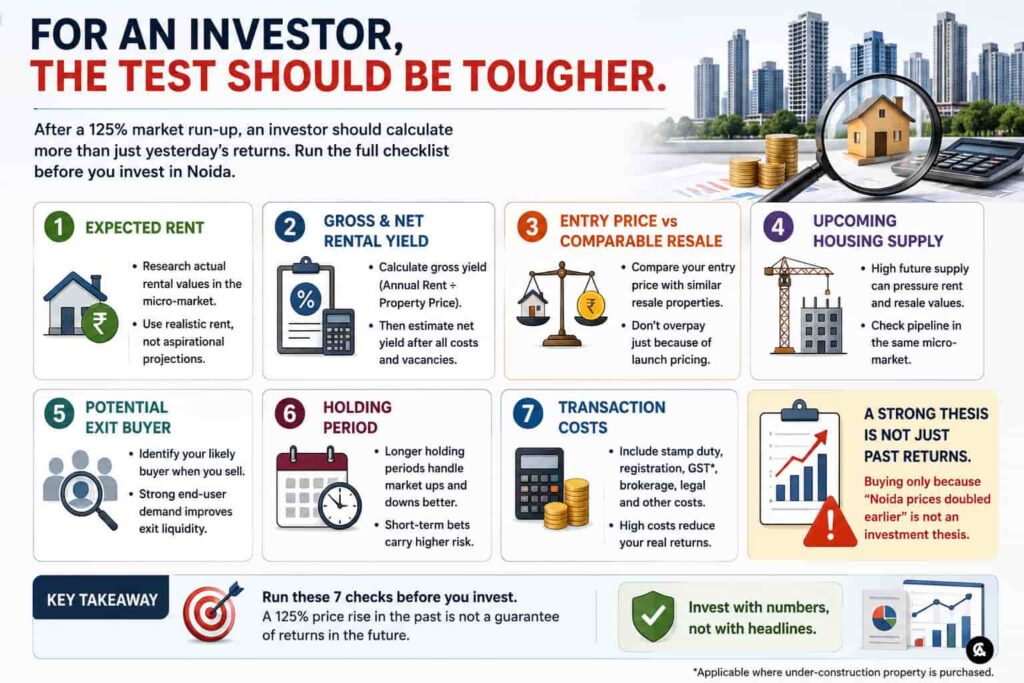
The test should be tougher.
After a 125% market run-up, an investor should calculate:
Expected rent
Gross and net rental yield
Entry price against comparable resale properties
Upcoming housing supply
Potential exit buyer
Holding period
Transaction costs
Buying only because “Noida prices doubled earlier” is not an investment thesis.
What price should a Noida buyer actually compare?
Do not compare only developer brochures.
For the same micro-market, collect at least three numbers:
1. Developer’s quoted rate
2. Final negotiated all-inclusive price
3. Recent resale asking and transaction levels
A project may advertise ₹14,000 per sq ft but effectively sell for less after:
- PLC waiver
- Floor-rise waiver
- Parking benefit
- Club-charge waiver
- Payment-plan incentive
- Booking discount
- Brokerage adjustment
The effective acquisition price matters more than the headline rate.
A buyer entering after a long appreciation cycle should negotiate on total acquisition cost, not merely ask whether the builder has reduced the base price.

Could Noida property prices correct after such a strong rise?
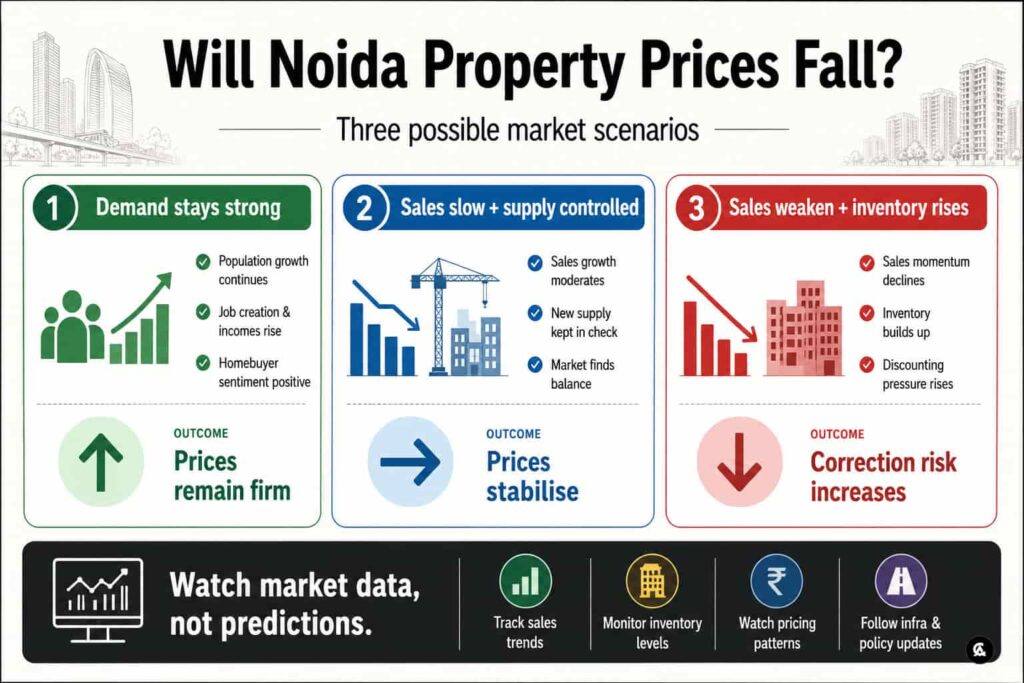
Yes, property prices can correct, stagnate or remain range-bound. A 125% historical increase does not eliminate that possibility.
But one should distinguish between a market correction and a property crash.
ANAROCK’s Q2 2026 NCR snapshot still recorded:
13,350 housing sales
11,200 new launches
89,100 available units
₹9,810/sq ft average NCR quoted base price
Sales were down 12% quarter-on-quarter and launches declined 30%, while available inventory fell 2% sequentially.
These figures show moderation, but they do not by themselves establish a broad property crash.
Buyers looking for a meaningful correction should watch for several signals occurring together:
- Sales weakening for several quarters
- Unsold inventory rising
- Developers increasing discounts
- Resale sellers accepting lower offers
- Large new supply entering the same micro-market
- Rental growth slowing materially
- Infrastructure or employment assumptions failing to materialise
A correction may also appear first through discounts and incentives, rather than a dramatic reduction in the advertised price per sq ft.
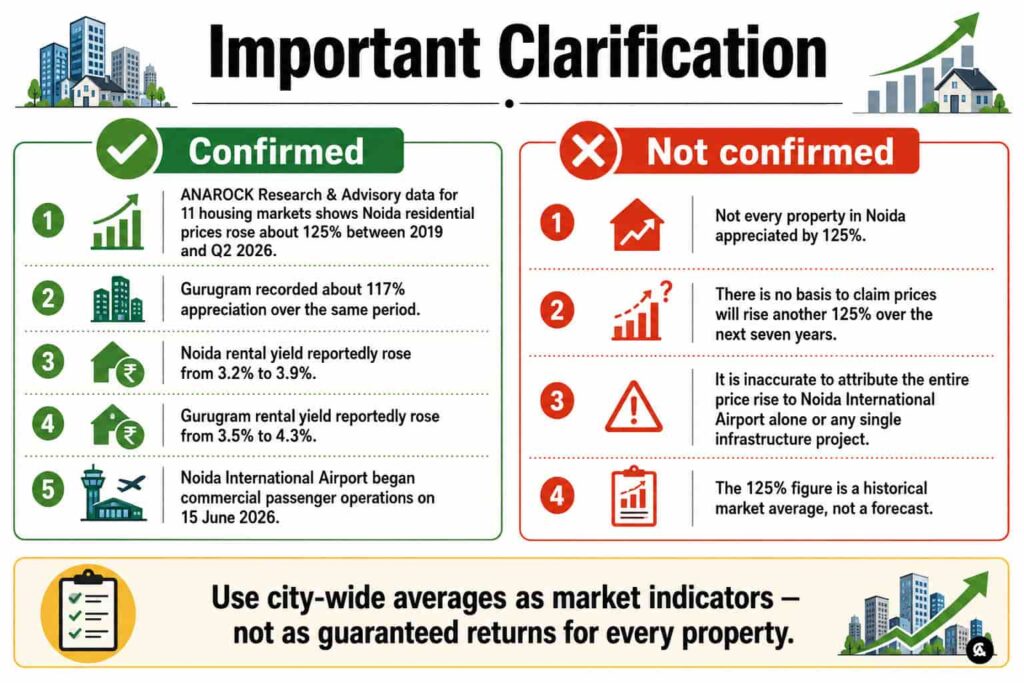
Important clarification
Confirmed
ANAROCK Research & Advisory data reported for 11 housing markets puts Noida’s average residential price increase at approximately 125% between 2019 and Q2 2026, while Gurugram recorded about 117% appreciation.
Noida’s reported rental yield increased from 3.2% to 3.9%, while Gurugram’s moved from 3.5% to 4.3% over the same period.
Noida International Airport began commercial passenger operations on 15 June 2026.
Not confirmed
It is not correct to assume that every property in Noida appreciated by 125%.
There is no basis to claim that prices will rise another 125% over the next seven years.
It would also be inaccurate to attribute the entire historical appreciation to Noida International Airport or any single infrastructure project.
The 125% figure is a historical market average—not a forecast.
7 checks before buying in Noida after the 125% price rise
Before purchasing, verify:
1. Micro-market price: Compare the sector rather than the entire city.
2. Effective purchase price: Include all charges and subtract genuine waivers.
3. Resale market: Check what existing owners are asking and actually accepting.
4. Rental demand: Calculate realistic rent rather than relying on projected rental brochures.
5. Future supply: Too many competing units can affect both rents and resale liquidity.
6. Developer execution: Delivery record matters more as ticket sizes increase.
7. Personal holding period: Real estate becomes more difficult to justify when the planned exit is too short.

What homebuyers should know
Noida has unquestionably undergone a major residential-market repricing since 2019. The reported average has moved from ₹4,795 to ₹10,780 per sq ft, placing it among India’s strongest-performing major housing markets over the period.
But past appreciation and future investment potential are two different questions.
For buyers entering in 2026, the opportunity is no longer simply “buy Noida because prices are rising.” The decision now depends on the specific sector, project, acquisition price, rental potential, competing supply and holding period.
A strong market can still contain overpriced properties.
And a market that has already risen 125% can still contain value—provided the buyer purchases the right property at the right effective price.
Sources:-
ANAROCK — National Capital Region Residential Market Viewpoints, Q2 2026 — NCR sales, launches, available inventory, average quoted price and micro-market pricing.
ANAROCK Research & Advisory data reported by The Economic Times — 2019 vs Q2 2026 residential capital values and rental yields across 11 housing markets.
Business Today — ANAROCK housing appreciation and rental-yield analysis — Noida, Gurugram and major-city comparison.
Noida International Airport — Official announcement dated 15 June 2026 — commencement of commercial flight operations.
Press Information Bureau, Government of India — Dwarka Expressway Haryana Section — official project length, cost and connectivity details.




Leave a Reply