


India’s senior living and retirement home sector is receiving renewed regulatory attention. In a Rajya Sabha written reply on July 24, 2026, the Central Government highlighted the Model Guidelines for Development and Regulation of Retirement Homes and clarified that retirement-home projects are also covered under the Real Estate (Regulation and Development) Act, 2016 (RERA).
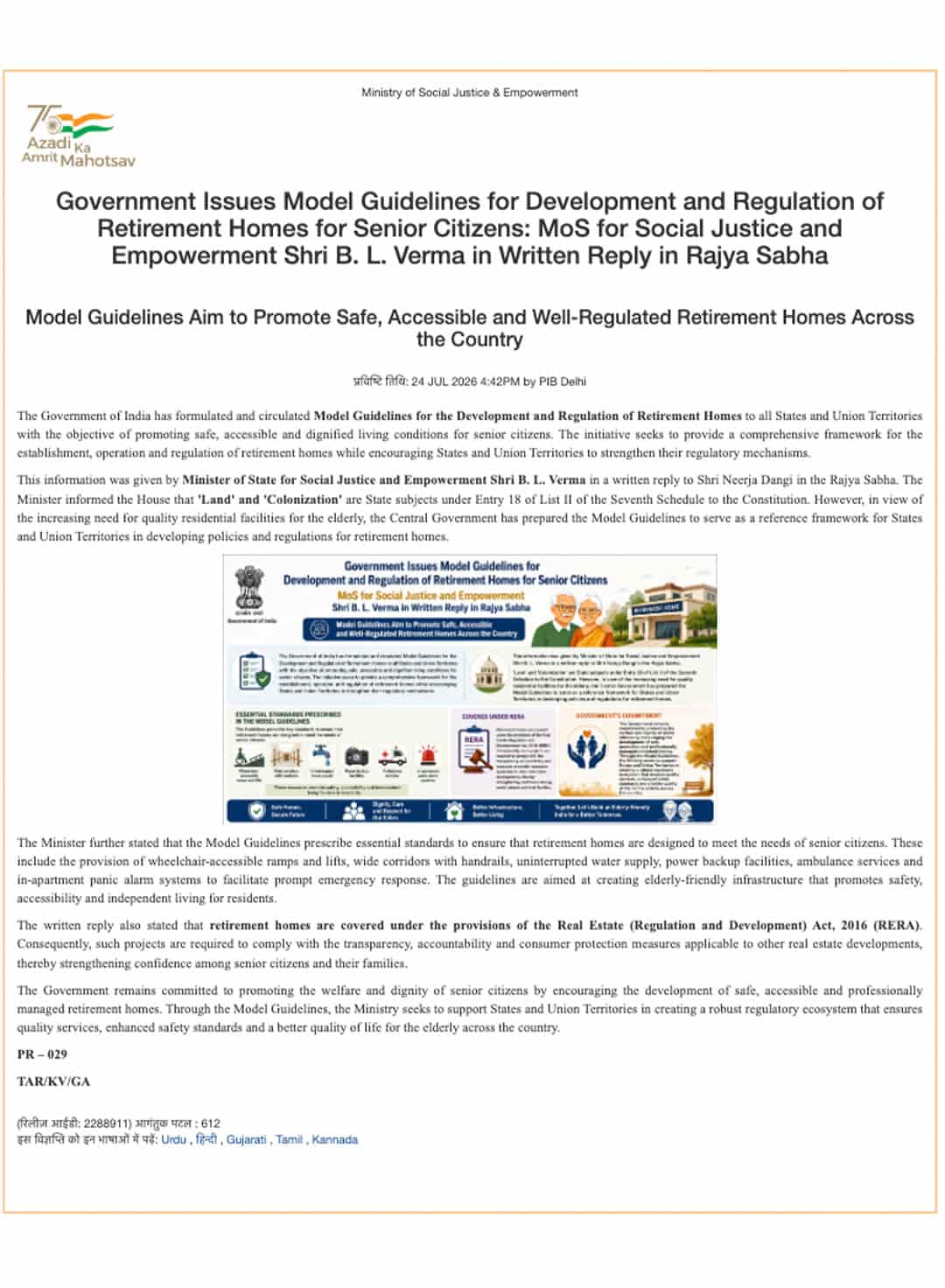
However, buyers should understand one important point: these are not completely new Retirement Home Rules introduced in 2026. The Model Guidelines were originally issued by the Ministry of Housing and Urban Affairs on March 6, 2019. The 2026 development is significant because the Government has again brought the regulatory framework into focus and reiterated its application to retirement homes.
What did the Government say in 2026?
The Ministry of Social Justice and Empowerment informed the Rajya Sabha that the Model Guidelines have been circulated to States and Union Territories to provide a framework for the establishment, operation and regulation of retirement homes.
The Government also pointed out that land and colonisation are State subjects. Therefore, States and UTs have an important role in developing and strengthening their own regulatory mechanisms based on the Model Guidelines.
This means there is no single new central Retirement Home Act 2026 replacing existing State regulations.
Instead, the Model Guidelines provide a reference framework for making senior housing safer, accessible and more accountable.
Are retirement homes covered under RERA?
Yes.
This is one of the most important points confirmed by the Government in its July 2026 Rajya Sabha reply.
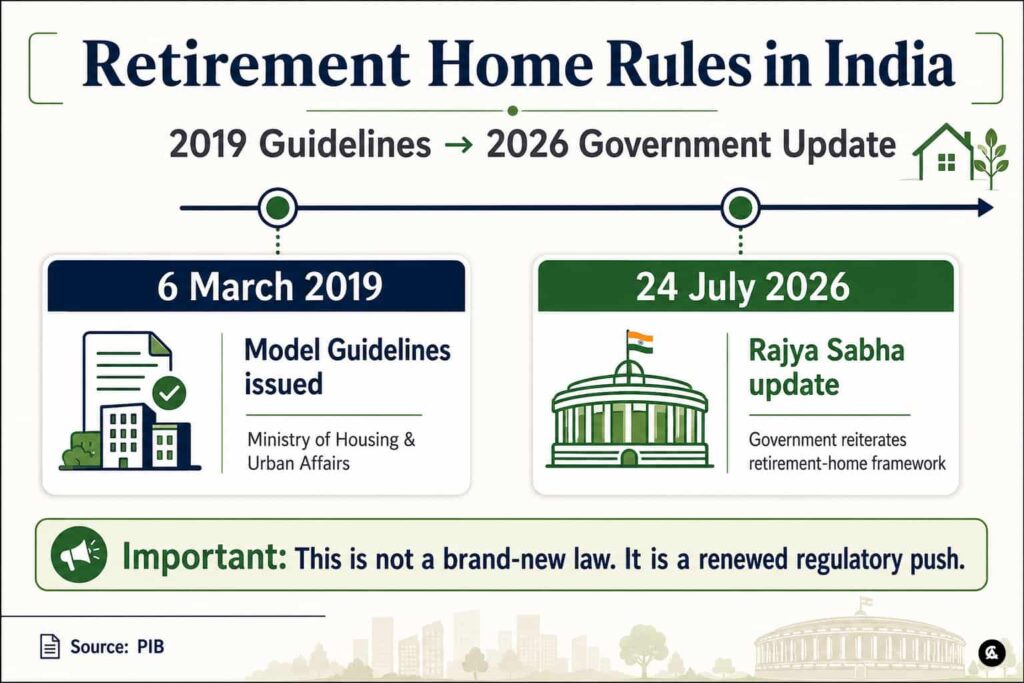
Retirement homes are covered under the provisions of the Real Estate (Regulation and Development) Act, 2016, where applicable. Such projects must follow the transparency, accountability and consumer-protection requirements applicable to real-estate developments.
The original 2019 guidelines go further and state that retirement-home apartments can be sold only after registration with the respective State or Union Territory Real Estate Regulatory Authority, where RERA registration is applicable.
For buyers, this means a retirement home should not be evaluated only on healthcare services, food or lifestyle amenities. Its real-estate compliance must also be checked carefully.
Before booking, buyers should verify:
- RERA registration and project details
- Promoter or developer information
- Approved plans and project specifications
- Possession commitments
- Agreements and payment conditions
- Details of the senior-living operator
What safety features should a retirement home provide?
Retirement homes are fundamentally different from conventional residential projects because their design must address the needs of older residents.
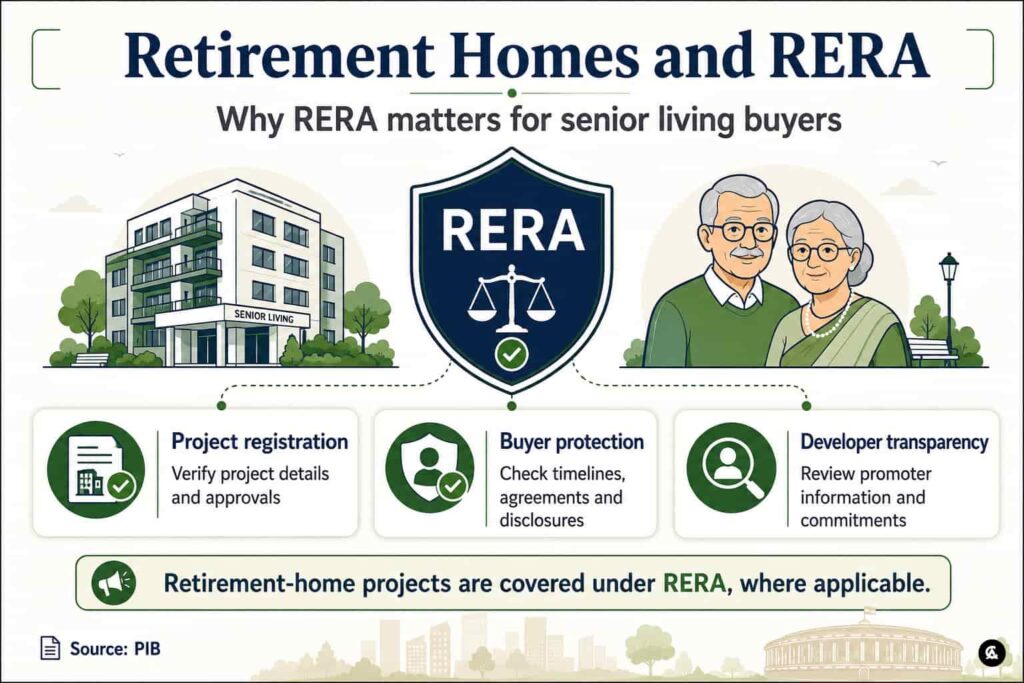
The Government’s 2026 update specifically highlighted infrastructure such as:
- Wheelchair-accessible ramps
- Accessible lifts
- Wide corridors
- Handrails
- Uninterrupted water supply
- Power backup
- Ambulance services
- Panic alarms inside apartments
The original guidelines also include measures such as anti-skid flooring in bathrooms and stairs, barrier-free movement, elderly-friendly door handles, appropriate furniture and gas-leak detection systems in kitchens.
These features should therefore be treated as core senior-living infrastructure rather than premium add-ons.
What medical and emergency support is expected?
The 2019 Model Guidelines also provide for basic medical, safety and security arrangements.
These include:
- 24×7 on-site ambulance service
- Emergency tie-up with a nearby hospital
- Pharmacy access
- Medical emergency room
- Regular medical check-ups
- Emergency alarm systems
- Trained security staff
- CCTV in common areas
- Police verification of personnel working in the retirement home
This does not automatically mean every retirement home is a hospital or provides intensive medical care.
Buyers should separately verify what level of healthcare, nursing, assisted care or emergency response is actually included in the service agreement.
Who can live in a retirement home?
Under the Model Guidelines, a retirement-home resident is a person who is 60 years of age or above.
Interestingly, the guidelines allow another person to purchase an apartment, but the unit is intended to be used by a senior citizen.
This distinction can be particularly relevant where children purchase a senior-living property for their parents.
Developer vs senior living operator: Understand the difference
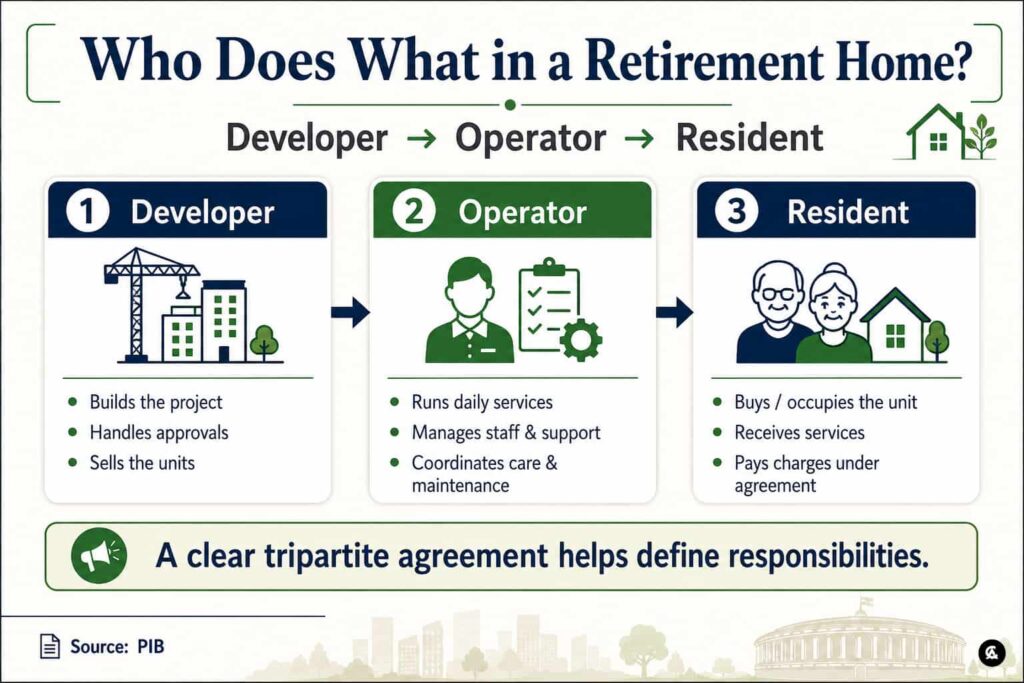
A retirement-home project may involve two different entities:
Developer: Builds and sells the real-estate project.
Retirement Home Operator or Service Provider: Manages services required after residents move in.
The developer may operate the retirement home itself or appoint a specialised operator.
The Model Guidelines provide for disclosure of the service provider’s technical capabilities and envisage a tripartite agreement between the developer, retirement-home operator/service provider and allottee.
This is particularly important because the long-term experience of a senior-living resident depends heavily on the operator—not just the quality of construction.
What about maintenance charges and security deposits?
Retirement homes may have higher recurring costs than conventional apartments because services such as security, housekeeping, emergency support and community facilities require continuous management.
The Model Guidelines provide for two separate mechanisms:
Interest Free Maintenance Security Deposit (IFMS): A refundable maintenance security deposit paid by the allottee.
Maintenance Charges: Charges that may be paid as a lump sum or through monthly, quarterly or annual instalments based on mutually agreed terms.
The guidelines state that the IFMS should be refundable within a maximum of three months from the date of the refund application.
Before buying, residents should therefore ask for a clear breakup of:
- Monthly maintenance charges
- Healthcare charges
- Food and dining charges
- Housekeeping
- Nursing or caregiving
- Emergency services
- Annual escalation
- Refund conditions
- IFMS/security deposit
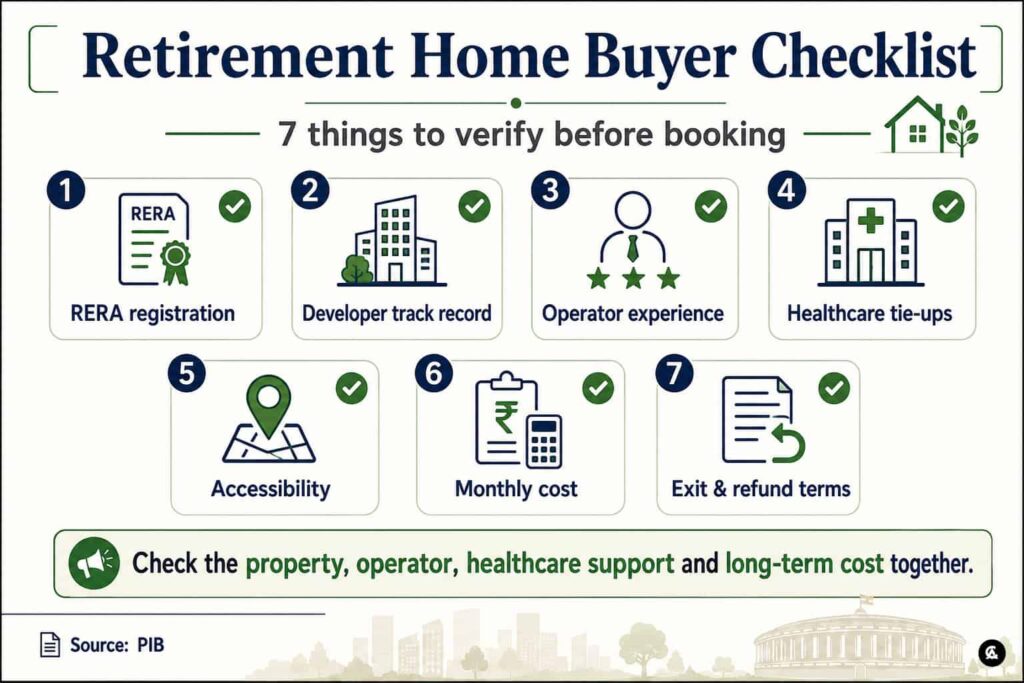
7 things buyers should check before buying a retirement home
Before paying a booking amount, senior citizens and their families should check:
1. RERA registration
Verify whether the project is registered with the relevant State RERA where registration is required.
2. Developer track record
Check previous projects, delivery history and pending complaints.
3. Operator experience
Find out who will actually manage the senior-living community after possession.
4. Healthcare infrastructure
Verify hospital tie-ups, ambulance availability and emergency-response arrangements.
5. Accessibility
Check ramps, lifts, handrails, bathrooms, corridors and common areas physically.
6. Total recurring cost
Do not look only at the property price. Calculate maintenance, meals, healthcare, housekeeping and assisted-care costs.
7. Exit and refund terms
Understand what happens if the resident wants to leave, sell the property or discontinue services.
What does the 2026 update mean for India’s senior living market?
The July 2026 Government statement does not create a completely new retirement-home law. However, it reinforces an important regulatory message: senior living is not merely a hospitality or care service—it is also a regulated real-estate category when structured as a real-estate project covered by RERA.
For developers and operators, this increases the importance of transparency, accessibility, safety and clearly defined responsibilities.
For buyers, it means choosing a retirement home should involve much more than comparing apartment size and amenities.
The developer, RERA status, senior-living operator, healthcare system, recurring costs and exit conditions should all be evaluated together.
The Government’s July 24, 2026 Rajya Sabha update has again put Retirement Home Guidelines in India into focus.
The underlying Model Guidelines date back to 2019, so this should not be confused with a new Retirement Home Act or completely new rules introduced in 2026.
But the official clarification is still important: retirement homes are expected to provide senior-friendly infrastructure, safety and emergency facilities, while applicable projects also come under RERA’s transparency and consumer-protection framework.
For families considering senior living, the most important rule is simple:
Do not evaluate only the home. Evaluate the property, developer, operator, healthcare support and long-term cost together.
Sources:-
- PIB — Ministry of Social Justice & Empowerment, 24 July 2026:
Government Issues Model Guidelines for Development and Regulation of Retirement Homes for Senior Citizens
This is the fresh 2026 official update based on the written reply by MoS B. L. Verma in the Rajya Sabha. It also confirms that retirement homes are covered under RERA where applicable. - PIB — Ministry of Housing & Urban Affairs, 6 March 2019:
Original Model Guidelines for Development and Regulation of Retirement Homes
This is the original government release explaining elderly-friendly infrastructure, healthcare requirements, RERA registration, IFMS, maintenance charges, operator responsibilities and tripartite agreements.



Leave a Reply