

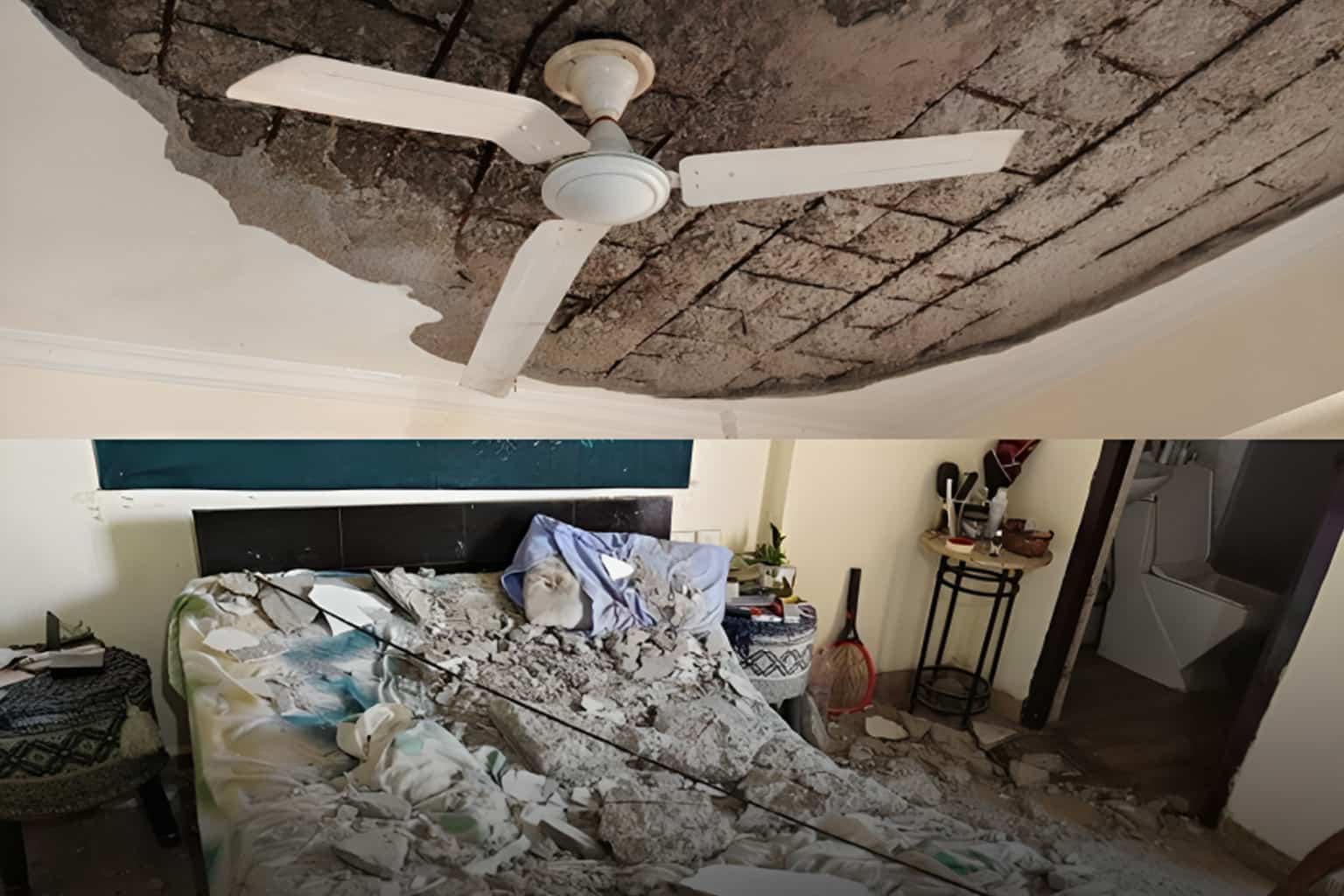
A frightening incident at Gardenia Gateway Society in Noida Sector 75 has restarted an important debate around construction quality, apartment maintenance and structural safety in high-rise housing.
A large section of the ceiling inside a bedroom reportedly fell directly onto the bed moments after the occupant had stepped out of the room. No one was injured, but photographs and clips showing concrete-like chunks, plaster and dust spread across the bed quickly circulated online. Residents subsequently demanded a wider structural inspection of the residential complex rather than a simple surface repair.
The visuals are alarming, but one question must be answered carefully:
Was this only a plaster failure, or does it indicate a deeper problem inside the reinforced-concrete slab?
That answer cannot be obtained from a viral clip alone. It requires an inspection by a qualified structural engineer.
What happened at Gardenia Gateway Society?
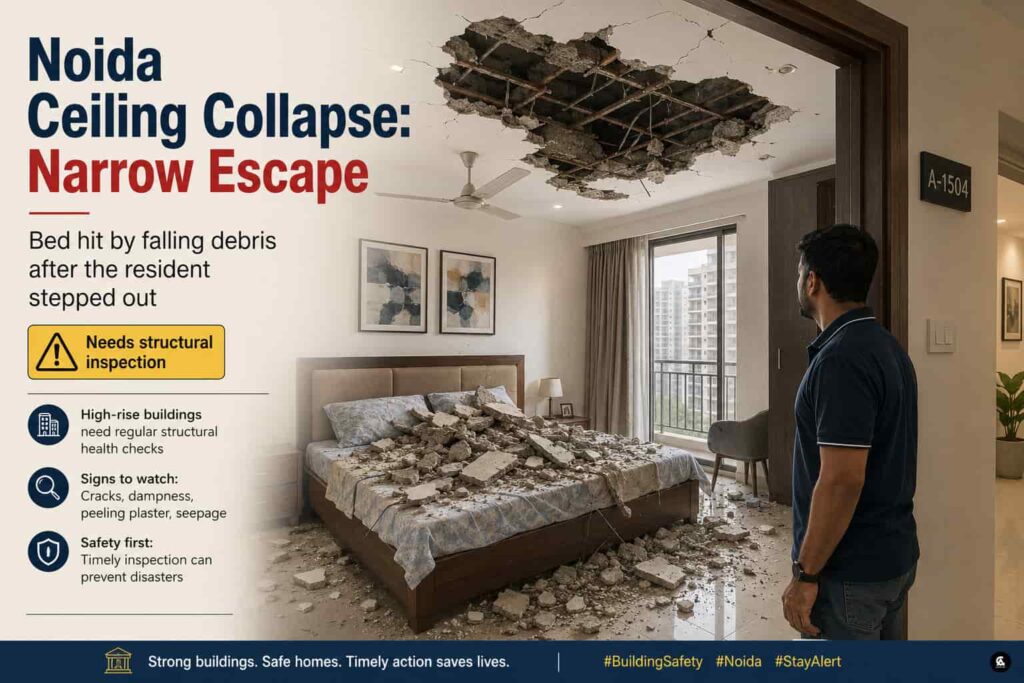
The incident was reported on July 17, 2026, from Gardenia Gateway Society in Noida. According to available reporting, the resident had briefly stepped out to drink water when a substantial section of the bedroom ceiling gave way and landed on the bed. The room was unoccupied at that moment, preventing possible injury.
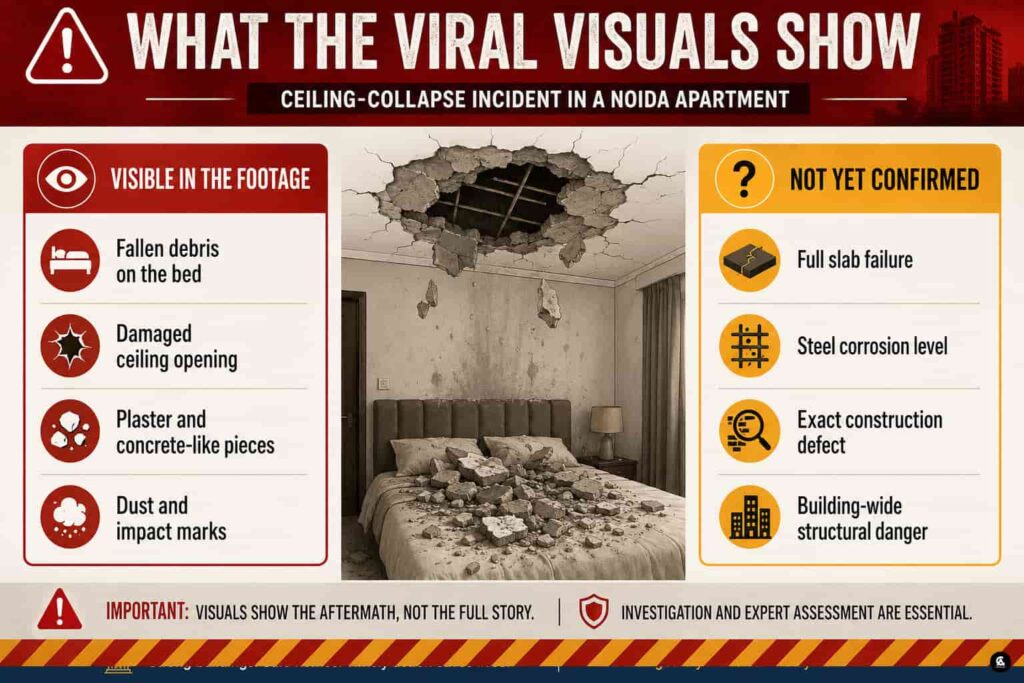
Images and footage showed:
- Large pieces of debris on the bed
- Broken plaster and concrete-like material
- Dust spread across the bedroom
- A sizeable exposed section of the ceiling
Residents reportedly raised concerns that cracked walls, falling plaster, damaged balconies and other defects had been flagged previously. These remain residents’ allegations unless supported by a formal engineering report or official investigation.
At the time of the initial media reports, neither the builder nor the concerned authority had issued a detailed public statement explaining the technical cause of the failure.
Why the wording matters
Some reports described the event as a ceiling collapse, while social-media posts referred to falling plaster. One report described a portion of the reinforced-concrete ceiling giving way, while the published visuals showed both plaster and concrete-like chunks.
Until a technical inspection is released, the responsible description is:
A substantial portion of the bedroom ceiling, containing plaster and concrete-like debris, detached and fell onto the bed.
It would be premature to claim that:
- The complete RCC slab collapsed
- The whole building is structurally unsafe
- Poor-quality steel has been confirmed
- The society faces an immediate collapse risk
Those conclusions require evidence from an independent structural assessment.
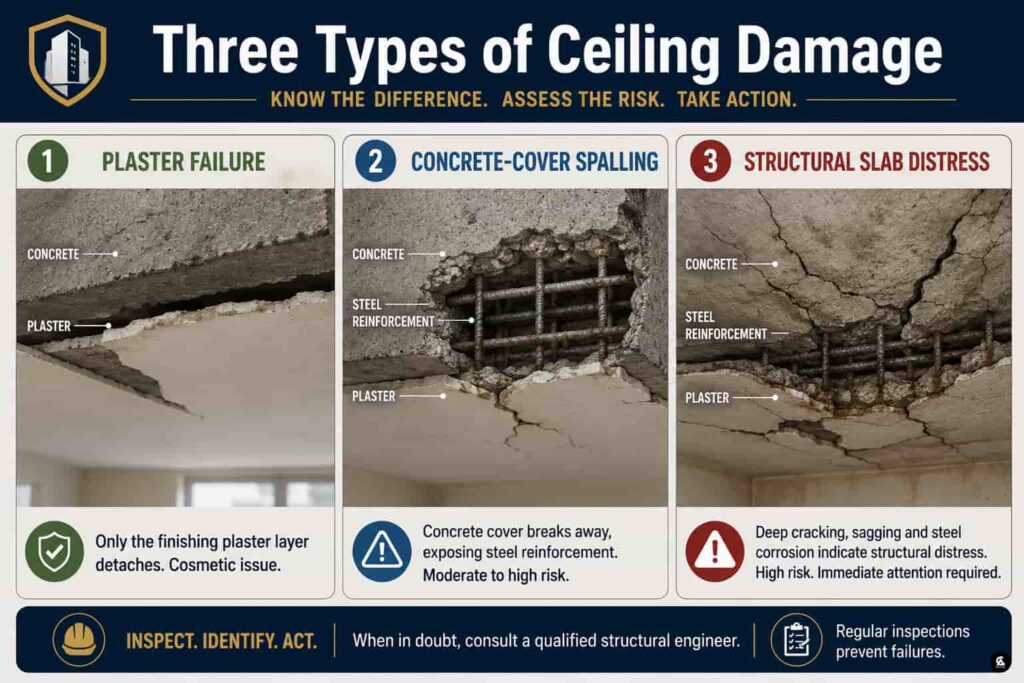
Plaster collapse, concrete spalling and slab failure are not the same
The term “ceiling collapse” can describe very different technical conditions. Understanding the difference is essential before discussing responsibility or repair.
Ceiling plaster failure
Plaster is a finishing layer applied below the RCC slab. It can lose adhesion and fall even when the main structural slab remains stable.
Possible causes include:
- Poor surface preparation
- Weak mortar mix
- Excessive plaster thickness
- Long-term moisture exposure
- Thermal movement
- Repeated seepage
- Hollow or debonded plaster
Falling plaster can seriously injure a person, but it does not automatically mean that the load-bearing slab has failed.
Concrete-cover spalling
Reinforced-concrete slabs contain steel bars covered by a protective layer of concrete. When this cover cracks and breaks away, it is known as concrete spalling.
Possible causes include:
- Corrosion of reinforcement
- Water leakage
- Inadequate concrete cover
- Honeycombing
- Poor compaction
- Carbonation
- Chloride exposure
- Repeated wetting and drying
Corroding steel expands, creating internal pressure that can force pieces of concrete away from the slab.
This is more concerning than ordinary plaster failure because reinforcement may become exposed and deterioration can continue.
Structural slab distress
A structural problem may affect the slab’s load-carrying performance.
Warning indicators can include:
- Deep or widening cracks
- Noticeable sagging
- Repeated concrete spalling
- Exposed and heavily rusted reinforcement
- Cracks near beams or columns
- Abnormal vibration
- Similar damage across multiple floors
- Doors or windows suddenly becoming misaligned
None of these conditions should be diagnosed through photographs alone.
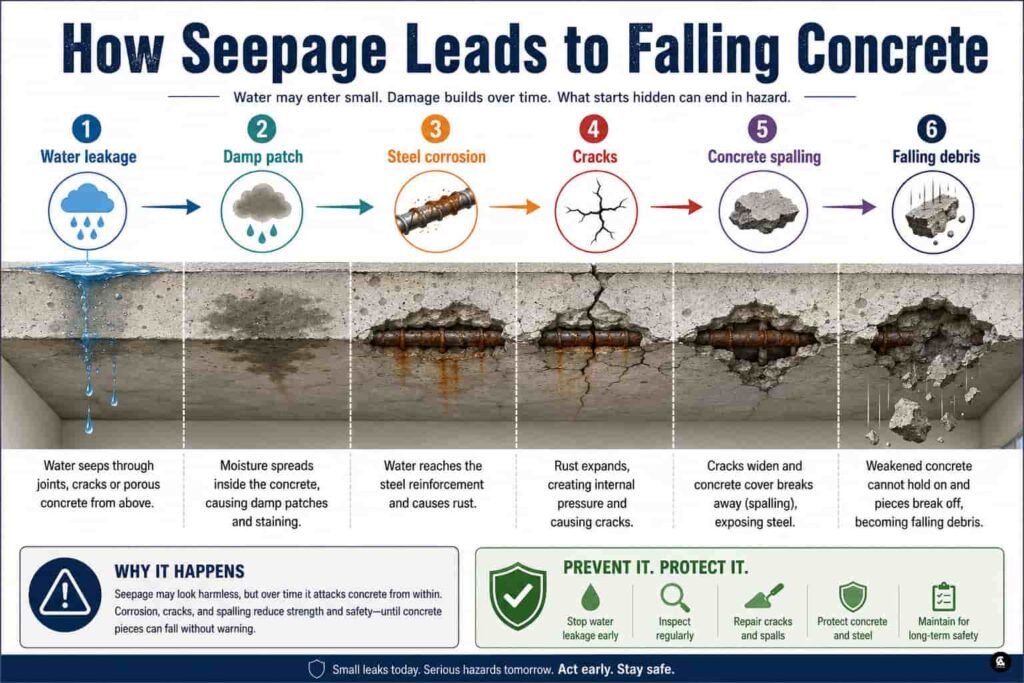
How seepage can slowly damage a ceiling
Water is one of the most common triggers behind ceiling deterioration.
The process may begin with:
- Leakage from an upper-floor bathroom, kitchen or pipe
- Moisture entering the slab or plaster layer
- Paint bubbling or flaking
- Rust-coloured marks appearing
- Reinforcement beginning to corrode
- Concrete or plaster losing its bond
- Pieces eventually detaching and falling
The visible ceiling damage may therefore be the final stage of a problem that began much earlier.
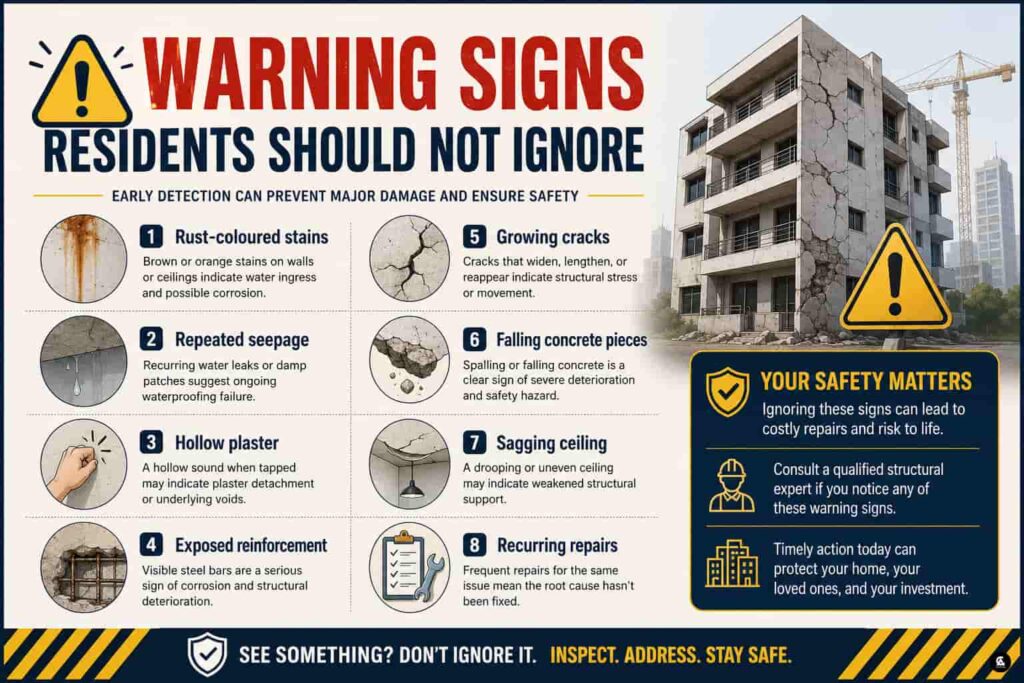
Common warning signs include:
- Brown or yellow damp patches
- Paint repeatedly peeling
- Hollow sound when plaster is tapped
- Rust stains
- Hairline cracks that keep returning
- Exposed steel
- Concrete pieces falling near bathrooms or balconies
- Repairs failing repeatedly at the same location
Painting over these signs does not remove the cause.
Poor workmanship can also create long-term risk
Construction-related causes may include:
- Improper concrete mix
- Poor vibration or compaction
- Insufficient curing
- Inadequate reinforcement cover
- Weak plaster bonding
- Honeycombing
- Defective waterproofing
- Poor-quality repair work
However, the exact cause in the Gardenia Gateway incident has not yet been established publicly through a structural-audit report.
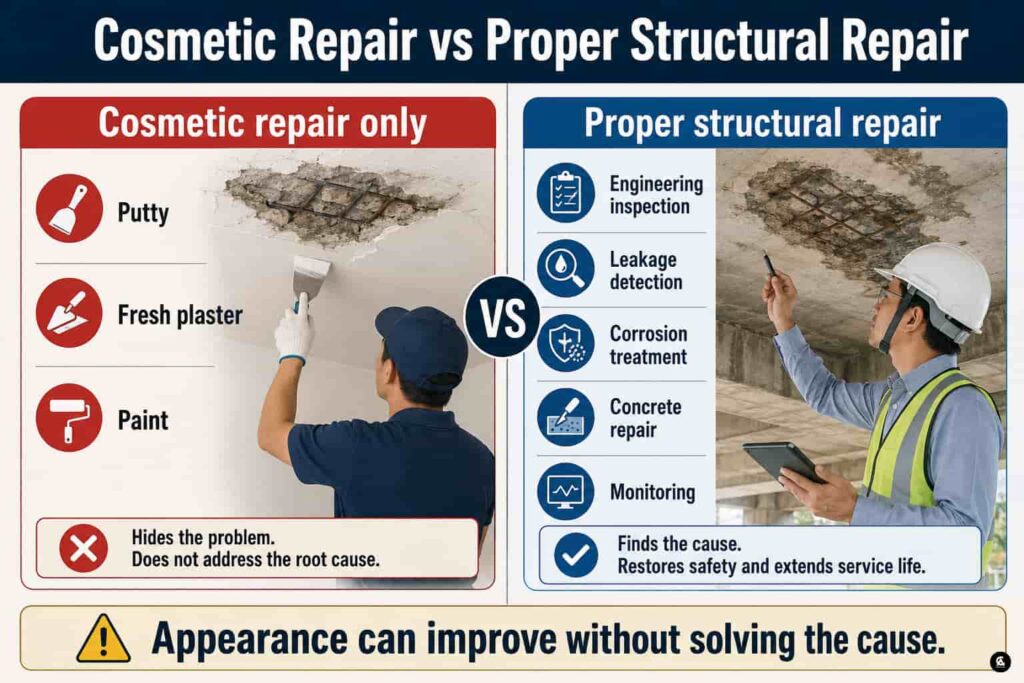
Why cosmetic repair may not be enough
A surface repair generally involves:
- Removing loose plaster
- Applying fresh mortar
- Adding putty
- Repainting the ceiling
This may restore the appearance, but it may not correct:
- Active water leakage
- Corroded reinforcement
- Inadequate concrete cover
- Honeycombing
- Waterproofing failure
- Plumbing defects
- Recurring slab deterioration
The correct repair sequence should begin with diagnosis, not paint.
A safer sequence
- Vacate and barricade the affected area
- Document the damage before disturbance
- Remove only dangerously loose material under supervision
- Identify the source of water or moisture
- Inspect exposed reinforcement
- Conduct appropriate structural tests
- Prepare an engineer-approved repair method
- Inspect adjoining rooms, floors and similar locations
- Monitor the repaired area over time
Where concrete or reinforcement is involved, ordinary masonry repair workers should not independently decide the technical remedy.
Who can conduct a structural audit in Noida?
The Noida Authority’s official building-regulation page lists documents relating to the structural audit of multi-storey buildings and its structural-audit policy.
A structural audit should be conducted by qualified civil or structural engineers, or by competent institutions and agencies recognised under the applicable authority framework.
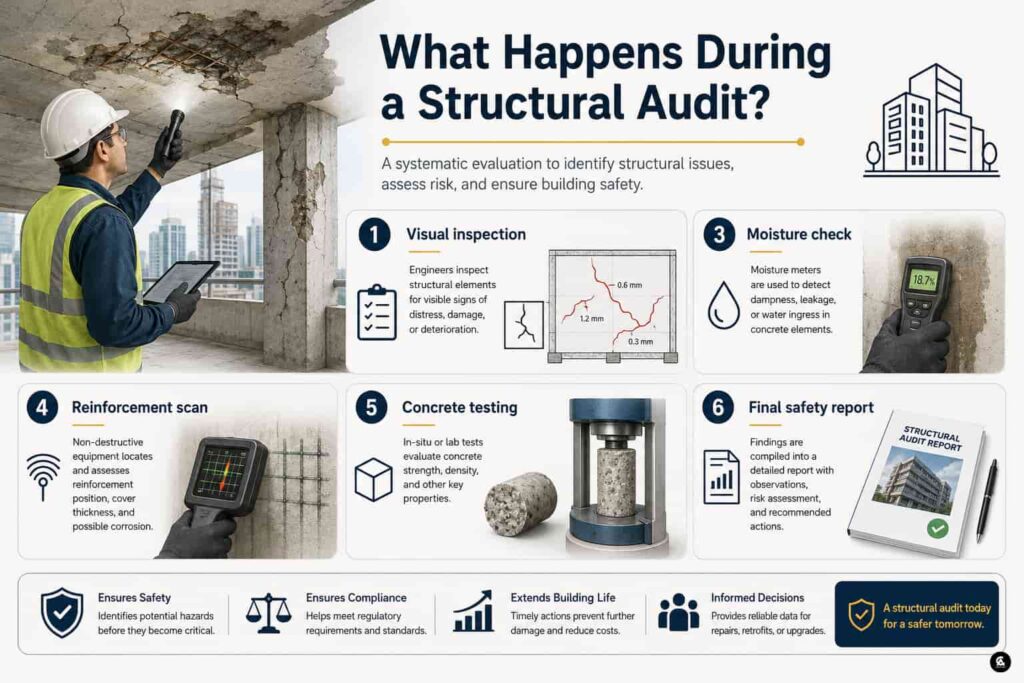
Depending on the symptoms, the audit may include:
- Visual survey
- Crack mapping
- Reinforcement-cover measurement
- Rebound-hammer testing
- Ultrasonic pulse-velocity testing
- Carbonation testing
- Corrosion-potential assessment
- Core testing
- Review of structural drawings
- Waterproofing and plumbing inspection
- Load analysis, where required
Not every building requires every test. The engineer should first inspect the damage and then determine the appropriate testing programme.
What should a useful audit report contain?
A credible report should explain:
- Whether the damage is cosmetic or structural
- The likely root cause
- Whether other flats may be similarly affected
- Which areas require immediate restriction
- What repair method is recommended
- Whether temporary support is necessary
- Who should execute and supervise the repair
- What follow-up monitoring is required
A report that merely recommends plastering without examining leakage, concrete and reinforcement may not be sufficient for a major failure.
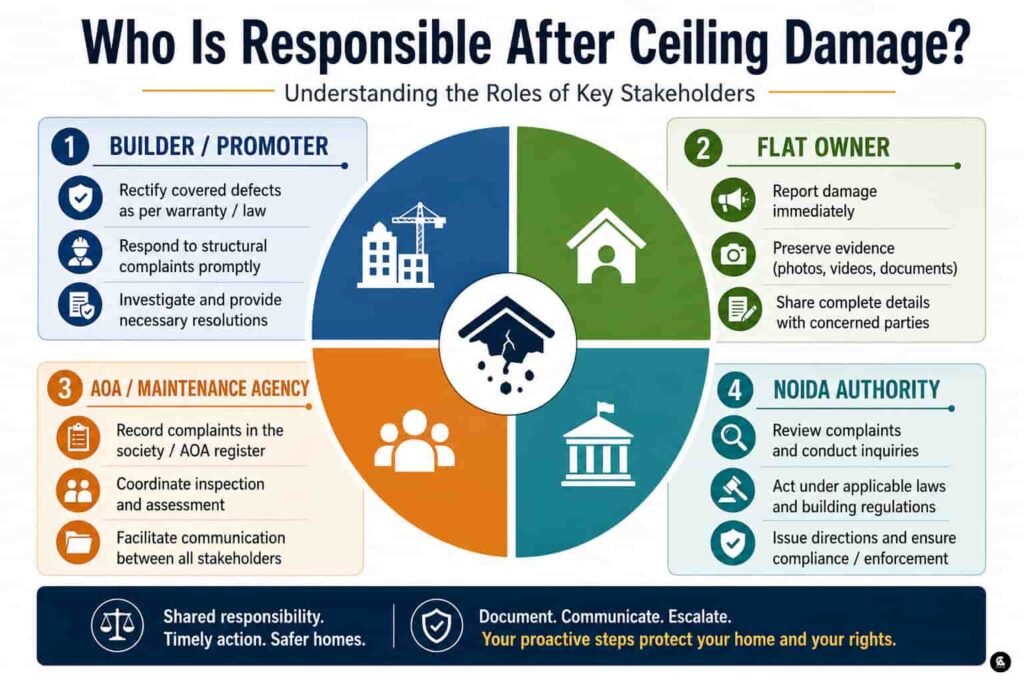
Builder, owner, maintenance agency and AOA: who is responsible?
Responsibility depends on the cause, possession timeline, maintenance arrangement and whether the defect is inside a private unit or connected to common services.
Builder or promoter
Section 14(3) of the Real Estate (Regulation and Development) Act provides a defect-liability framework for structural defects and defects in workmanship, quality or services brought to the promoter’s notice within five years from possession. The promoter is expected to rectify a covered defect without further charge within 30 days; failure can give the allottee a right to seek compensation.
UP RERA’s portal exists to protect homebuyers, improve transparency and provide a complaint mechanism. It also allows users to verify registered projects and submit complaints.
However, before applying this provision to the Gardenia Gateway case, several facts must be verified:
- When possession was handed over
- Whether the five-year period remains applicable
- What caused the damage
- Whether the affected element forms part of the promoter’s defect liability
- Whether any owner alteration contributed to the failure
Flat owner
The owner should:
- Report leaks and cracks promptly
- Avoid unauthorised structural changes
- Preserve photographs and repair records
- Inform the maintenance agency in writing
- Arrange inspection when damage occurs inside the flat
- Protect the tenant from unsafe occupation
An owner should not rush to conceal major damage before an engineer records it.
Tenant
The tenant should:
- Vacate the unsafe room
- Inform the owner and maintenance agency
- Photograph the condition
- Preserve written communication
- Avoid touching hanging or loose debris
- Seek a professional safety assessment before reoccupying the room
AOA or maintenance agency
The AOA or maintenance agency may need to address:
- Common plumbing lines
- Shafts
- Terrace waterproofing
- External walls
- Balconies
- Common structural elements
- Repeated complaints across towers
- Emergency restriction of unsafe areas
An AOA is not qualified to certify structural safety by itself, but it should coordinate a competent inspection and maintain records of complaints and repairs.
Noida Authority
Residents can approach the authority with:
- Written complaints
- Photographs and clips
- Previous complaint records
- Repair history
- Details of similar incidents
- A request for a wider structural audit
The authority’s official website lists its structural-audit policy and directions for multi-storey buildings.
Are ₹70 lakh to ₹2 crore flats automatically expected to be safer?
A report cited listing-portal prices ranging broadly from ₹70 lakh to ₹2 crore for apartments in Gardenia Gateway. This should be treated as a portal-based market range, not an official price list or verified transaction record.
A high property price may reflect:
- Location
- Land value
- Apartment size
- Metro access
- Demand
- Amenities
- Floor
- Market appreciation
It does not by itself guarantee:
- Better concrete quality
- Proper waterproofing
- Strong maintenance
- Timely repairs
- Structural monitoring
A buyer should never assume that an expensive flat is automatically a technically sound flat.
Construction quality and maintenance are separate issues
A building may suffer because of:
- Original construction defects
- Poor waterproofing
- Ageing
- Neglected maintenance
- Plumbing leakage
- Unauthorised alteration
- Delayed repairs
- A combination of several factors
A structural investigation must separate original construction deficiencies from later maintenance failures.
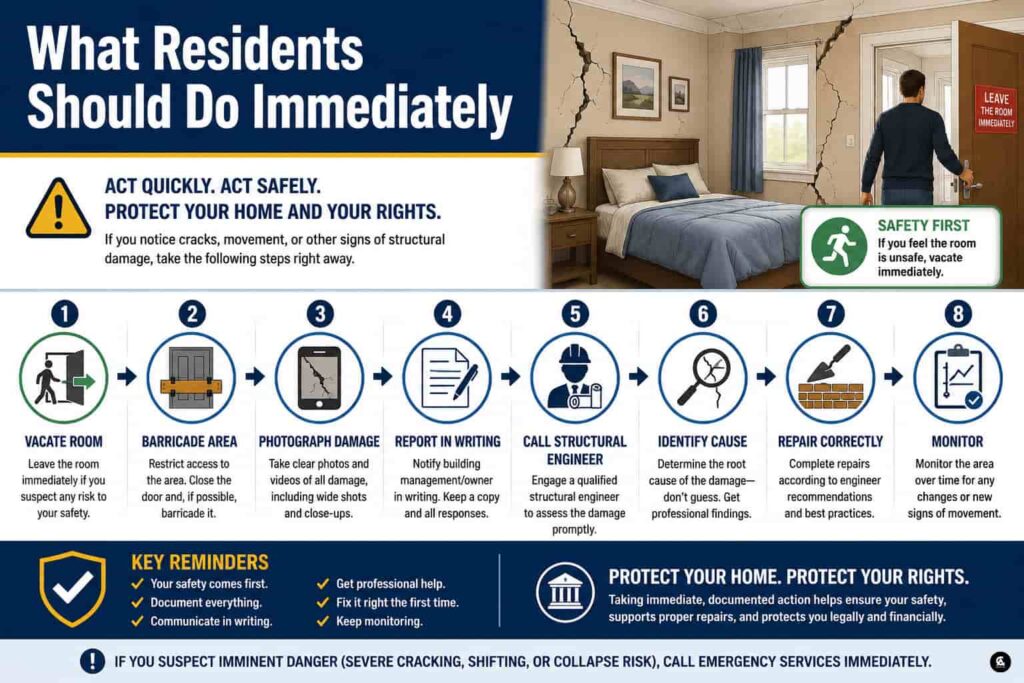
How should residents respond after such an incident?
Residents should avoid panic, but they should also avoid casual repair.
Immediate steps
- Keep people away from the affected room
- Switch off electricity if wiring is exposed
- Photograph and film the damage
- Inform the owner, AOA and maintenance agency in writing
- Request inspection by a qualified structural engineer
- Preserve fallen material where useful for examination
- Record past seepage or repair complaints
- Check the flat directly above
- Inspect similar wet areas in adjoining flats
- Avoid removing all evidence before technical examination
When evacuation may be necessary
Temporary evacuation may be advised when there is:
- Visible slab sagging
- Large active cracks
- Falling concrete in multiple locations
- Exposed and severely corroded steel
- Beam or column distress
- Engineer-recommended restriction
- Continued movement or unusual sound
Residents should follow professional and official instructions rather than social-media speculation.
Why a building-wide inspection may be reasonable
Residents demanded a comprehensive structural inspection after the Gardenia Gateway incident.
A wider inspection becomes particularly important when:
- Similar complaints exist in multiple flats
- Repeated repairs have failed
- Common waterproofing is defective
- Balcony or façade pieces have fallen
- Damage appears along the same structural line
- Multiple floors show seepage and spalling
- The problem may be linked to common pipes or construction practices
This does not mean the whole building is unsafe. It means the possibility of a repeated defect should be investigated systematically.
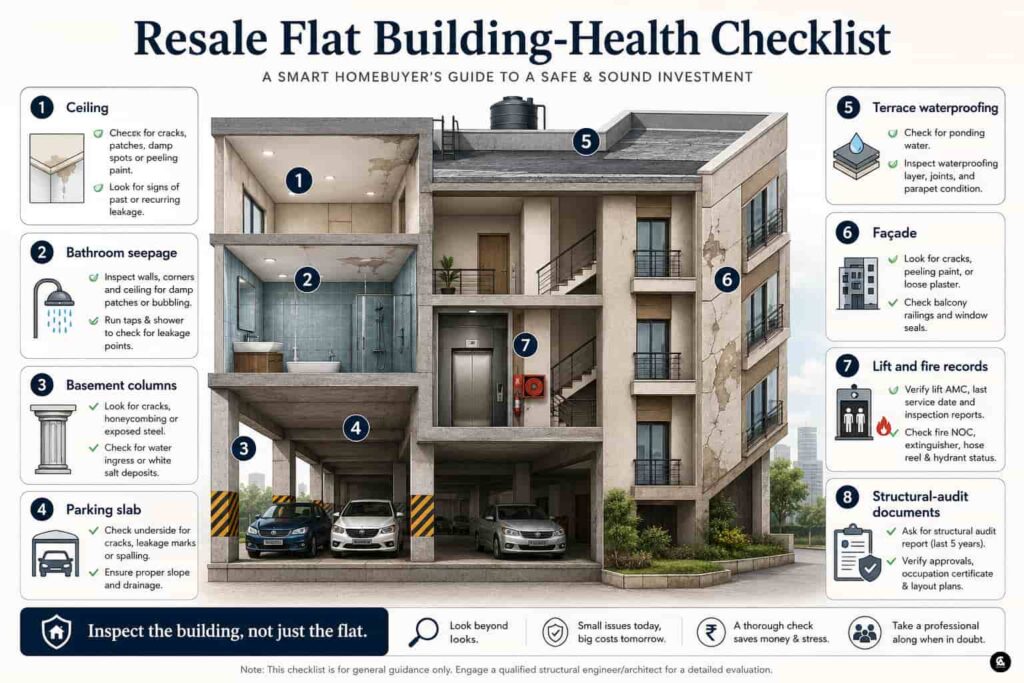
Resale buyers must inspect the building—not only the flat
Most resale buyers focus on:
- Interior finish
- Kitchen
- Wardrobes
- View
- Floor
- Asking price
But a freshly painted flat can hide seepage, cracks and past repairs.
Building-health checklist for resale buyers
Inside the flat
- Look for fresh patches of paint
- Check ceiling corners for dampness
- Inspect bathrooms and balconies
- Tap suspicious plaster for hollow areas
- Check for rust stains
- Look for recurring cracks
- Measure floor slope near wet areas
- Ask whether leakage complaints were previously filed
Common areas
- Inspect basement slabs and columns
- Check lift lobbies and shafts
- Examine terrace waterproofing records
- Look for concrete spalling
- Inspect balcony edges and façade
- Check drainage pipes
- Review fire-safety and lift-maintenance status
Documents
Ask for:
- Occupancy Certificate
- Approved building plan
- Structural-audit report, where available
- Major-repair history
- AOA meeting minutes
- Maintenance complaints
- Insurance details
- Pending authority notices
- UP RERA project information
UP RERA provides project-verification and complaint facilities for homebuyers through its official portal.
Professional inspection
For an older, repaired or visibly distressed property, an independent civil or structural engineer may be more valuable than an interior designer.
Red flags that should delay the purchase
Do not rush into a resale deal when:
- Major repairs are hidden behind fresh paint
- The owner refuses to discuss seepage
- Structural-audit records are unavailable
- Concrete is falling in common areas
- Steel reinforcement is visible
- Multiple residents report similar problems
- AOA minutes mention unresolved structural complaints
- The property lacks clear occupancy documentation
- The seller pressures the buyer to skip technical inspection
- The quoted price depends only on location and ignores building condition
A lower-priced flat in a healthy building may offer better value than a premium flat with unresolved safety issues.
What has not yet been officially established?
At the time of the initial reports, the following had not been publicly confirmed:
- The final engineering cause
- Whether reinforcement corrosion was present
- Whether the complete RCC slab was compromised
- Whether Noida Authority had completed an inspection
- Whether a building-wide audit had been ordered
- Whether the builder accepted responsibility
- Whether the society had been declared unsafe
The incident is a genuine warning sign, but it should not be exaggerated beyond verified evidence.
Carpet Area verdict
The Gardenia Gateway incident is not merely a viral clip about falling plaster. It is a reminder that homebuyers often evaluate property through price, carpet area, location and amenities while paying too little attention to the health of the building itself.
The debris visible on the bed was serious enough to cause injury had someone remained in the room. Residents are therefore justified in seeking a qualified inspection rather than accepting an immediate cosmetic patch.
At the same time, photographs cannot establish whether the failure was limited to plaster, involved concrete-cover spalling or reflected deeper structural distress.
The responsible conclusion is:
Do not declare the entire building unsafe without evidence—but do not cover major ceiling damage with plaster and paint before identifying the cause.
For existing residents, the priority should be documentation, professional inspection and root-cause repair.
For resale buyers, the lesson is equally important:
Do not inspect only the apartment you are buying. Inspect the building that will carry it for decades.
Important disclaimer
This article is based on publicly available media reports and official regulatory information. No publicly released structural-engineering report establishing the exact cause of the Gardenia Gateway ceiling failure was available in the reviewed material. Technical conclusions should be based on an on-site inspection by a qualified structural engineer.





Leave a Reply