

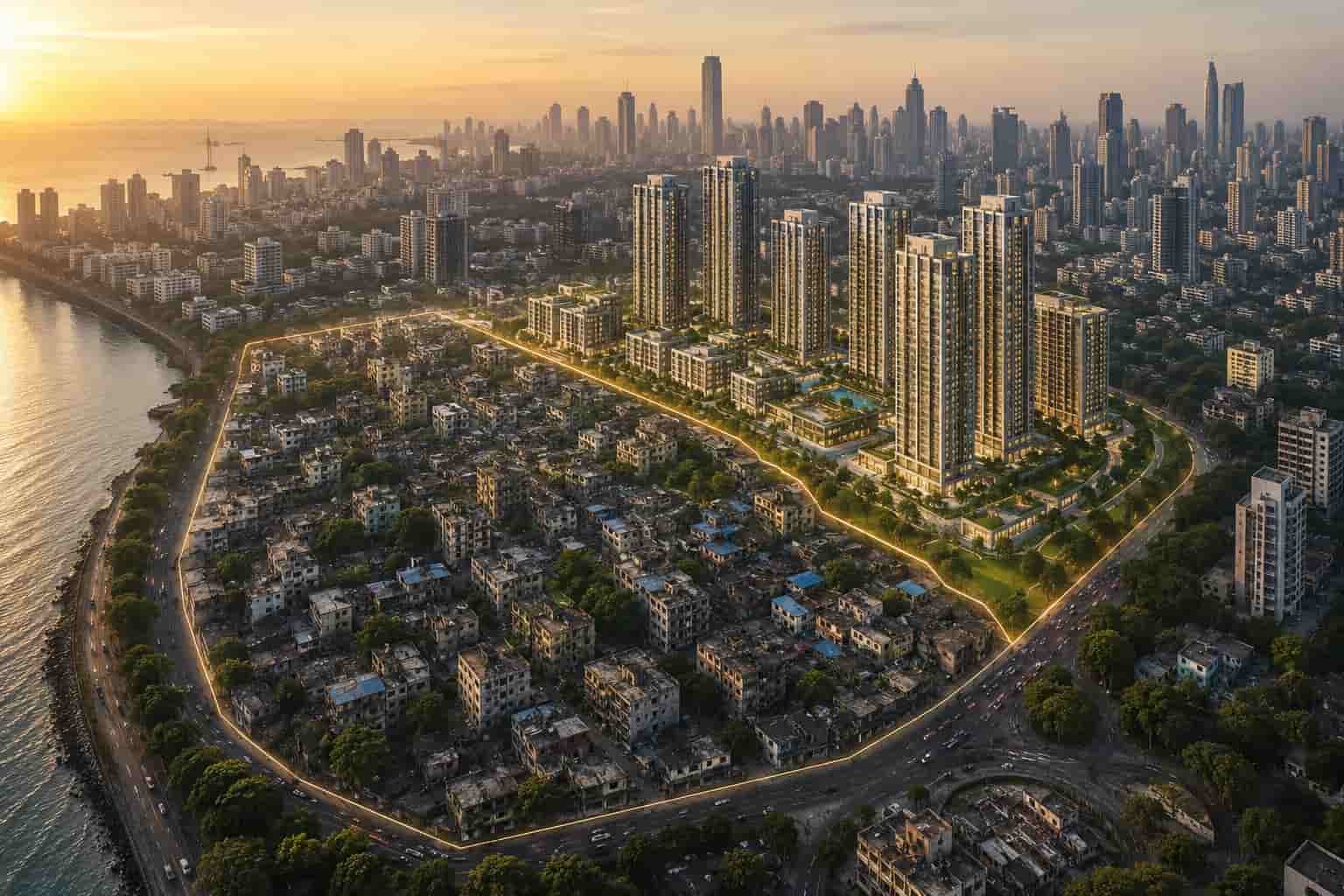
Mumbai’s real estate story is often told through prices. A small flat becomes more expensive. A luxury tower sells faster than expected. A sea-facing apartment becomes a status symbol. But every few years, a story comes that is not only about prices. It is about land.
The latest MHADA redevelopment race in Mumbai is one such story.
According to Economic Times, major names including Adani Properties, Reliance 4IR, Lodha Developers and JSW Realty & Infrastructure have submitted bids for three large redevelopment projects in Mumbai. These projects are located in Worli, Bandra Reclamation and Andheri West, and together they cover around 206 acres of land. MHADA opened technical bids for these projects after tenders were floated on 8 April 2026.
For a city like Mumbai, 206 acres is not just a number. It is a rare land story. In a market where every square foot is heavily contested, large redevelopment parcels in prime locations can change how a neighbourhood looks, how residents live and how future buyers evaluate supply.
This is not empty land, this is old Mumbai waiting for renewal
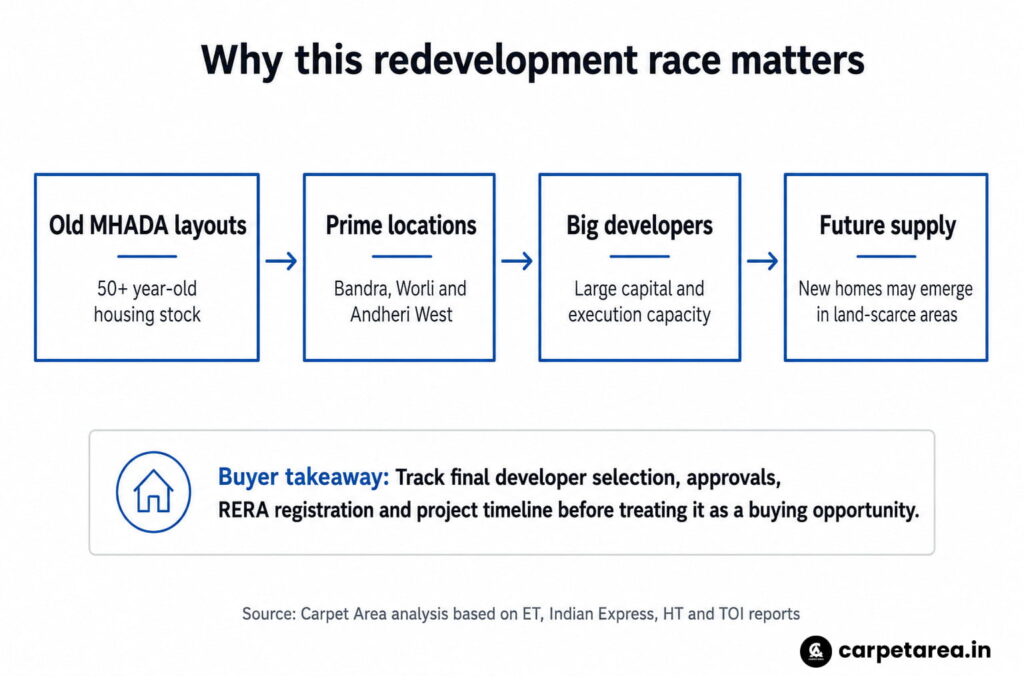
The most important point is that these are not vacant plots waiting for construction. These are old MHADA layouts. Indian Express reported that the three plots are MHADA layouts built more than 50 years ago and have seen little to no development over the years. That is why they have been selected for redevelopment under the Construction and Development Agency model.
This changes the way the story should be understood.
If this was only about a private land deal, the focus would be on who bought the land and what price they paid. But this is redevelopment. That means existing residents, old buildings, infrastructure, rehabilitation, planning approvals and long timelines are part of the same story.
For families living in these colonies, redevelopment can mean a better home, improved infrastructure and a safer building. But it can also mean temporary shifting, uncertainty and waiting. For developers, it is an opportunity to unlock prime land. For the city, it is a test of whether old housing colonies can be upgraded without losing the social character of the area.
Why the three locations matter?
The three locations make this story even more powerful.
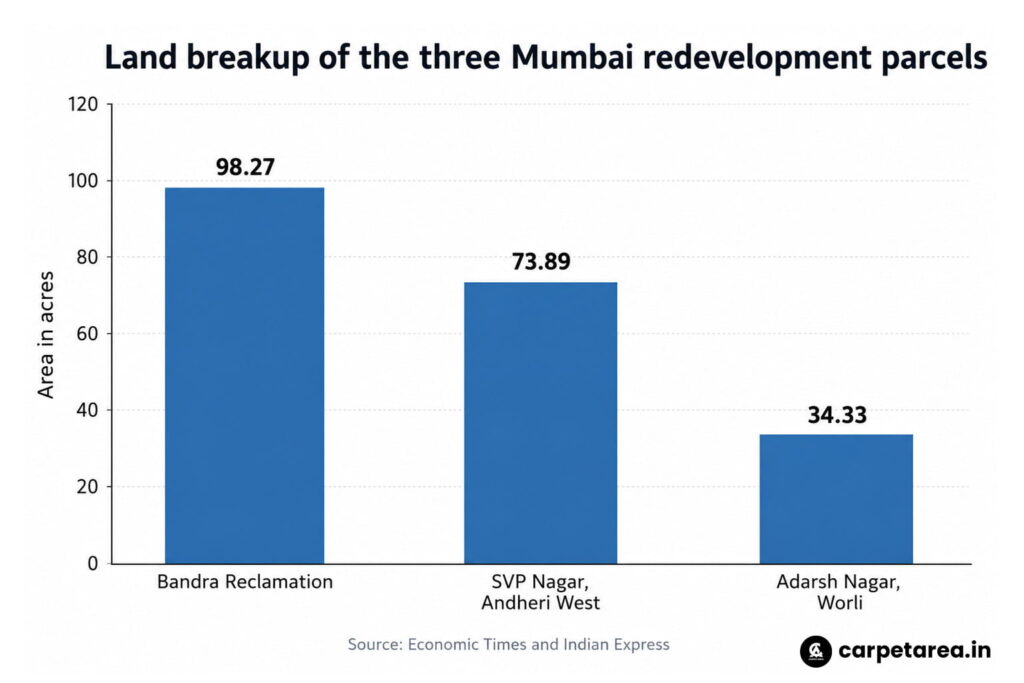
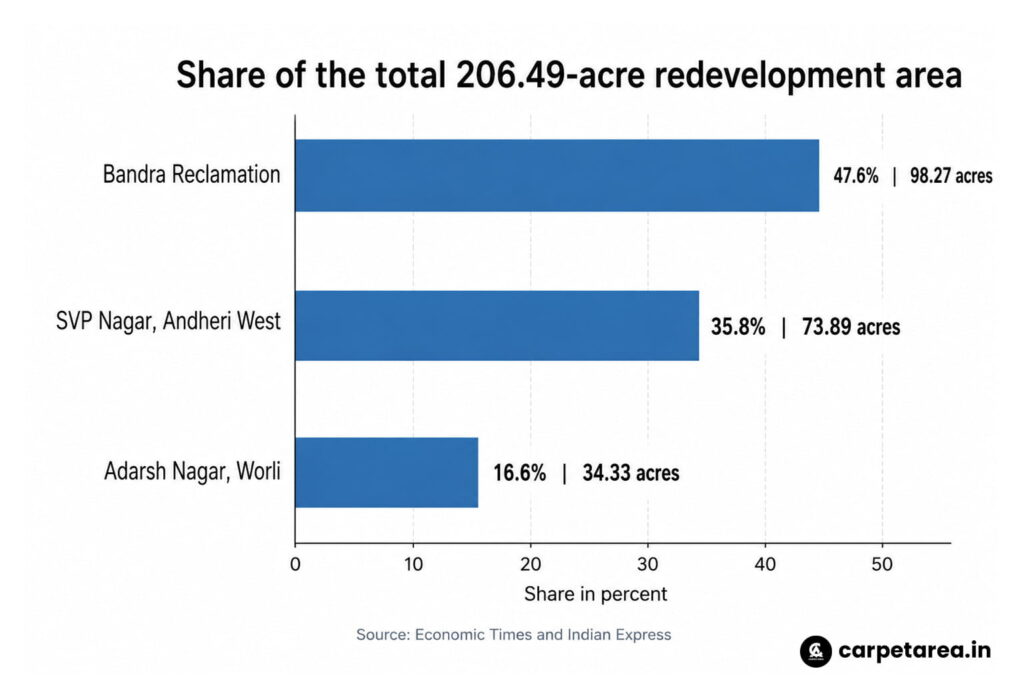
Bandra Reclamation, Worli and Andheri West are not ordinary pockets of Mumbai. They are connected, high-value and strategically important locations. Economic Times reported that the projects are spread across 98.27 acres at Bandra Reclamation, 73.89 acres at SVP Nagar in Andheri West and 34.33 acres at Adarsh Nagar in Worli.
Each location has its own real estate meaning.
Bandra Reclamation has a strong location advantage because of its western suburb positioning and access to premium neighbourhoods. Worli has already become one of Mumbai’s most visible luxury housing markets, supported by sea-link connectivity, business districts and premium tower development. Andheri West is a dense and active residential market, where redevelopment can influence both mid-premium and premium supply.
When redevelopment happens in such locations, the impact is not limited to residents of those colonies. Nearby property prices, future supply, infrastructure demand and buyer expectations can all be affected over time.
Why big developers are interested?
The names in the race are important because they show how redevelopment has become a serious business opportunity in Mumbai.
For many years, redevelopment in Mumbai was seen largely through the lens of individual societies, local builders and long approval battles. But large cluster redevelopment is different. It needs capital, execution capacity, planning strength and patience. When larger developers enter such projects, it signals that old colonies in prime areas are now being viewed as future real estate engines.
For developers, the attraction is clear. Mumbai does not have enough fresh land in prime locations. Redevelopment gives them a way to participate in established neighbourhoods where demand already exists. Instead of creating a new market from scratch, they can build in locations that buyers already understand.
But there is also a challenge. Large redevelopment is not simple construction. It involves residents, government agencies, legal processes, rehabilitation commitments and long-term project management. A big name may create confidence, but execution will matter more than the name.
The bigger MHADA redevelopment push
This 206-acre redevelopment race is part of a larger Mumbai redevelopment direction. Hindustan Times had earlier reported that MHADA floated tenders for the three projects covering a total of 206.49 acres as part of a larger plan to redevelop nearly 480 acres across western suburbs.
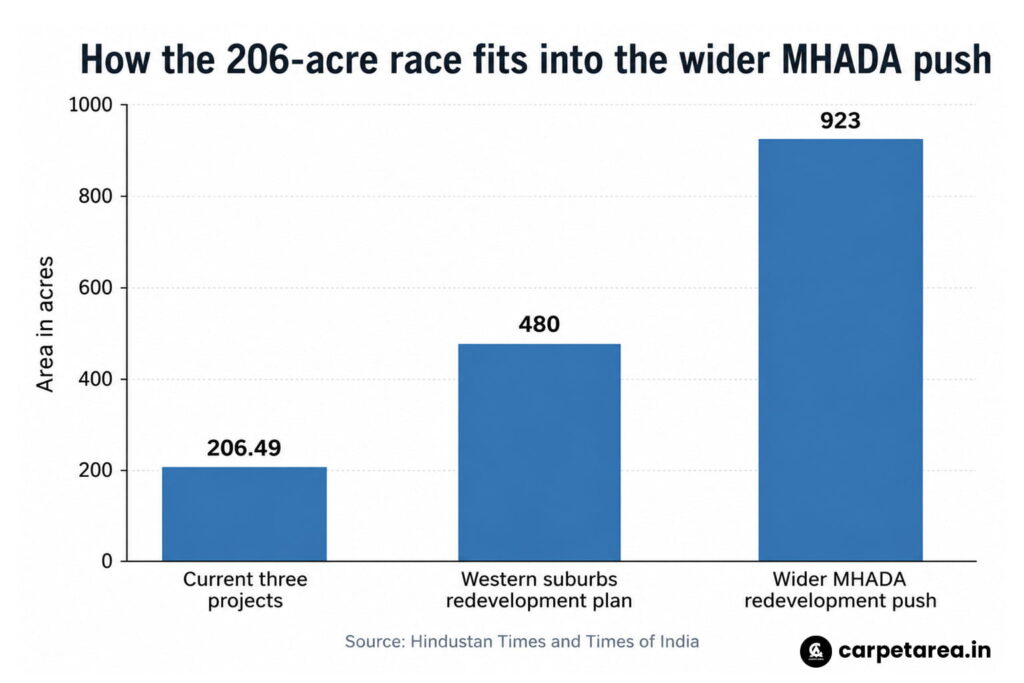
Times of India also reported a wider MHADA redevelopment plan involving 923 acres across Mumbai layouts, with rehabilitation of over 75,000 residents expected over a 5 to 10 year construction period after work begins.
This means the current bidding race is not an isolated event. It fits into a broader idea: Mumbai is trying to unlock older public housing layouts and convert them into modern housing clusters.
For homebuyers, this is important because the future supply of Mumbai may not come only from new suburbs or far-away corridors. A meaningful part of supply may come from redevelopment inside already-developed city areas.
What this means for existing residents?
For existing residents, redevelopment can be life-changing if executed properly.
Old colonies often face issues like ageing structures, limited parking, poor common spaces, weak infrastructure and outdated layouts. Redevelopment can improve these conditions. It can bring better buildings, lifts, open spaces, parking, fire-safety systems and more organised infrastructure.
But there is another side too. Residents may have to shift temporarily. Timelines may stretch. Disputes may arise over carpet area, rent, corpus, eligibility and final possession. That is why the most important question for residents is not only “which developer will win?” The real question is: what exactly will residents receive, when will they receive it and how strongly will the agreement protect them?
This is where the redevelopment model, tender terms and final project agreement become crucial.
What this means for future buyers?
For future buyers, this news should be watched carefully, but not emotionally.
Whenever big names and prime locations come together, the market gets excited. Buyers start expecting luxury launches, new towers and strong appreciation. But a smart buyer should understand that redevelopment is a long process. A bid is not the same as a ready project. A tender process is not the same as a RERA-registered sale opportunity.
Before making any future decision, buyers should track four things: final developer selection, approvals, RERA registration, and actual project timeline. Until those details are clear, the story should be treated as a strong market signal, not a direct buying recommendation.
Still, the signal is important. If these projects move ahead, they can create new housing supply in locations where supply is usually tight. In Mumbai, that can change buyer choices.
Why this can change prime housing?
The real importance of this 206-acre race is that it can reshape the definition of prime housing in Mumbai.
Today, prime housing in Mumbai is often associated with limited inventory, high prices and established luxury pockets. But if large old colonies in areas like Bandra, Worli and Andheri West are redeveloped, new housing stock can enter already mature locations.
This may create three visible changes.
First, old low-rise or ageing colony structures may gradually give way to modern towers and organised layouts. Second, developers may introduce premium or high-end housing products in areas where the land value supports such pricing. Third, surrounding markets may start reacting even before projects are completed, because redevelopment changes expectations.
However, this should not be seen only as a luxury story. It is also a public housing and urban planning story. Existing residents must be protected, rehousing must be fair and infrastructure must be upgraded to handle the new density.
The Carpet Area view
The Mumbai redevelopment race matters because it brings together everything that defines modern Indian real estate: land shortage, old housing stock, big developers, public agencies, resident rights and premium market demand.
For buyers, the lesson is simple. Do not look at redevelopment only as a price story. Look at the land, the location, the approval stage, the resident settlement process and the delivery timeline.
For Mumbai, this may become one of the most important redevelopment phases in recent years. If executed well, it can improve old colonies and create fresh housing supply in prime locations. If delayed or poorly handled, it can become another long redevelopment struggle.
That is why the 206-acre race is important. It is not just about who wins the bid. It is about how Mumbai chooses to rebuild itself from within.


Leave a Reply