

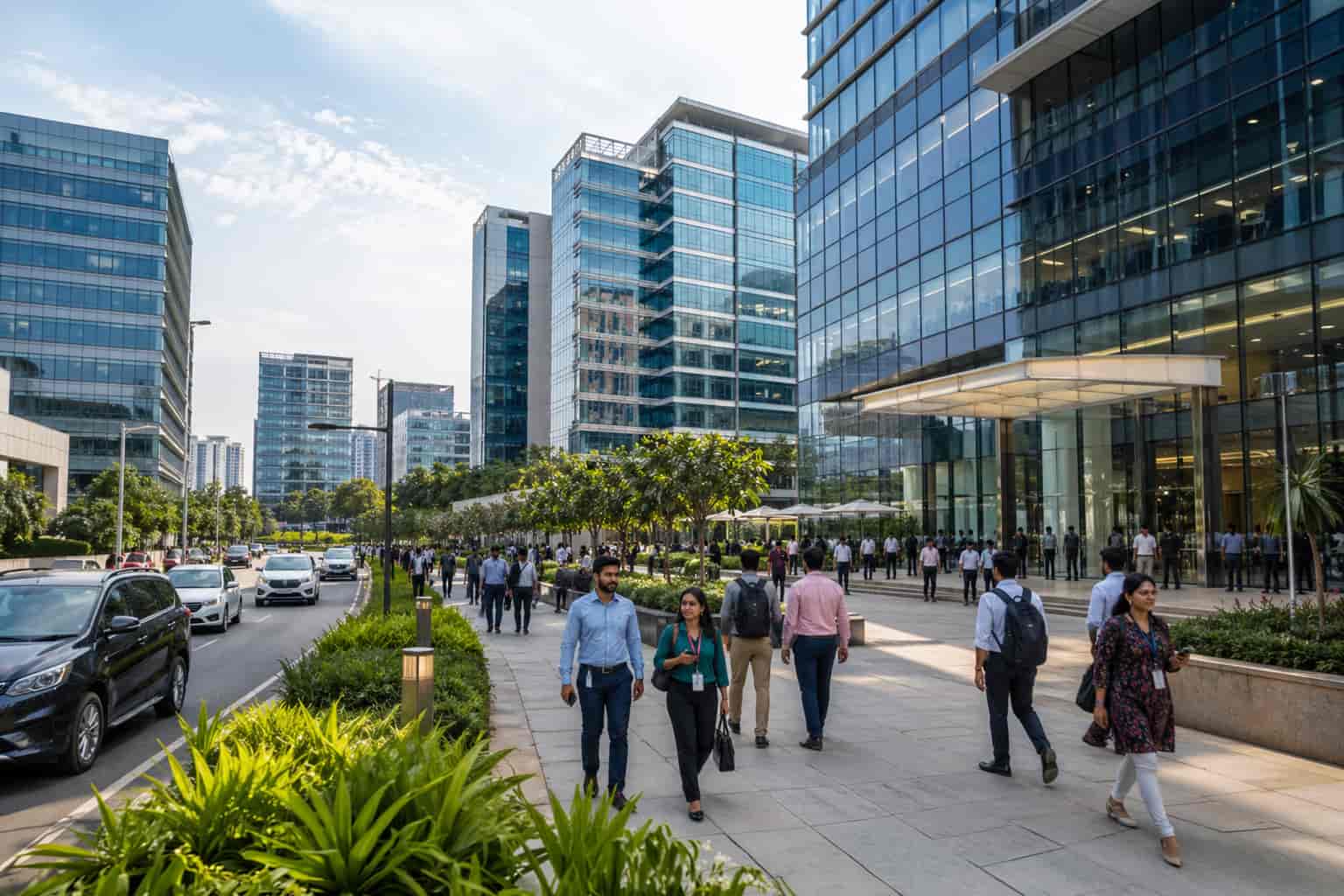
Bengaluru’s dominance in India’s office market is not a new story, but what is interesting right now is how firmly the city is still holding that position even as competition intensifies across the country. Hyderabad has grown sharply, Mumbai remains powerful, and Delhi-NCR continues to attract major occupiers, yet Bengaluru keeps finding ways to stay in front. That matters because office demand is one of the clearest signals of economic confidence in real estate. When companies continue to lease space in large volumes, it usually means they are planning for growth, hiring, and long-term expansion. In that context, Bengaluru’s latest performance is not just a city-level update. It is a sign of how central the city remains to India’s commercial-property story.
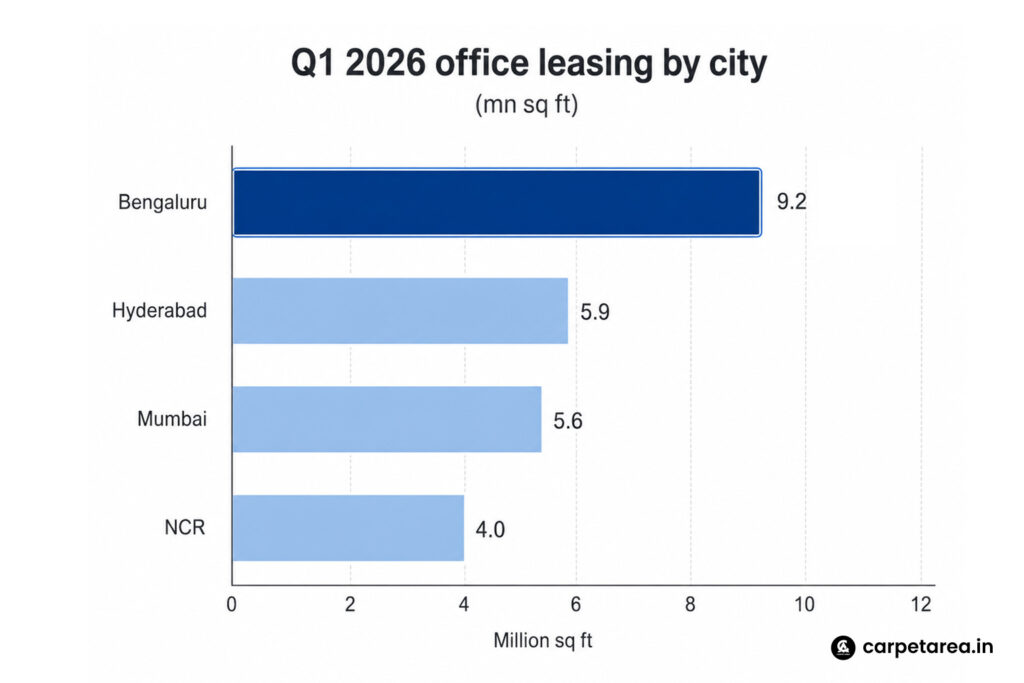
The headline number is strong enough on its own. In the first quarter of 2026, Bengaluru led office leasing across India’s top cities with 9.2 million square feet of absorption, according to Knight Frank data reported by Hindustan Times. That put it ahead of Hyderabad at 5.9 million square feet, Mumbai at 5.6 million square feet, and NCR at 4.0 million square feet, in a quarter where total office leasing across the top eight cities reached 29.9 million square feet, up 6% year on year. Put simply, Bengaluru alone accounted for a very large share of India’s office market activity in a record quarter.
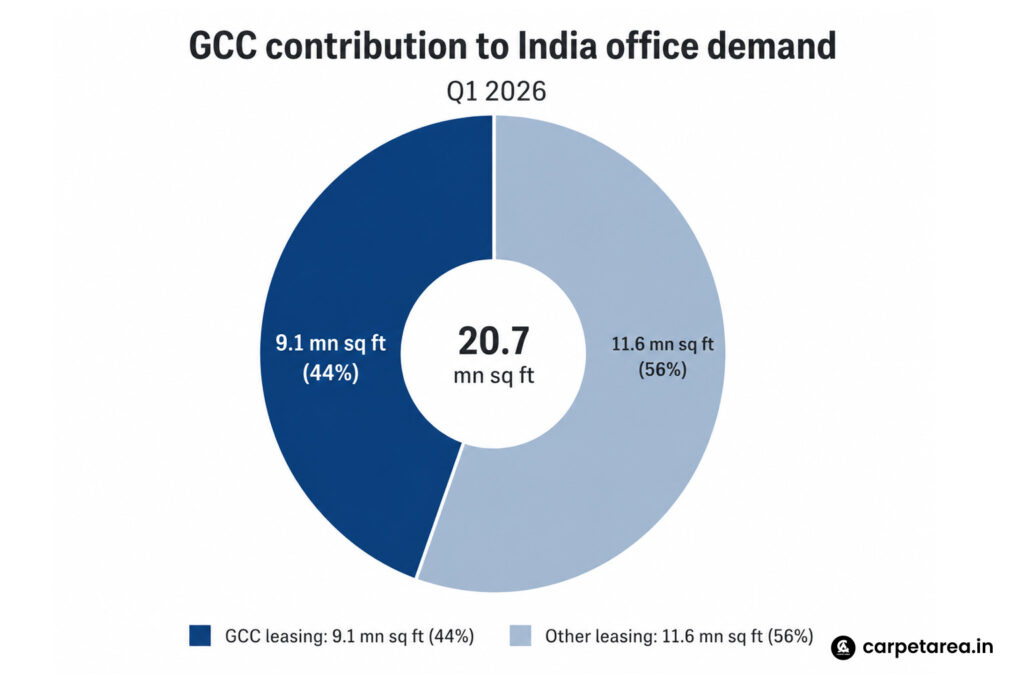
That lead becomes even more meaningful when seen against a broader set of reports. CBRE’s Q1 2026 office figures said India’s total office absorption stood at 20.7 million square feet, with record-high GCC leasing of 9.1 million square feet driving the market. Separate ET Realty coverage of the same CBRE data said Bengaluru held the largest overall share of office leasing at 29%, while also emerging as the top GCC hub. So whether you look at Knight Frank’s broader top-eight-cities lens or CBRE’s market snapshot, the conclusion is the same: Bengaluru was at the front of the pack.
One reason this matters so much is that Bengaluru is not leading only on volume. It is also leading on relevance. The city continues to sit at the centre of India’s technology, engineering, and GCC ecosystem. JLL said earlier this year that Bengaluru solidified its position as India’s GCC capital in 2025, and that is continuing to shape leasing activity in 2026. GCCs are no longer a side story in office real estate. They are one of the main engines of demand, and Bengaluru remains their preferred base more often than not.
This is where the city’s office-market strength becomes more than just a leasing statistic. Global Capability Centres lease space differently from many conventional occupiers. They usually think long term. They look for talent depth, scalability, infrastructure, quality office stock, and a business environment that can support large operations over time. Bengaluru’s advantage is that it checks many of those boxes at once. That is why the city keeps attracting big occupiers even when other markets are also improving. This is an inference drawn from its sustained GCC leadership and repeated dominance across major leasing reports.
There is also an ecosystem effect at work here. Once a city builds enough depth in technology, engineering, finance, flex spaces, and professional services, demand starts reinforcing itself. Companies want to be where talent is. Talent moves toward places where jobs are concentrated. Investors follow stable demand. Developers respond by creating new supply. Over time, that creates a self-sustaining cycle. Bengaluru appears to be benefiting from exactly that kind of cycle. It is not just attracting office demand because it had a strong year. It is attracting demand because it has built a broader business and talent ecosystem that continues to feed growth. This is an inference supported by the consistency of Bengaluru’s leadership across multiple reports.
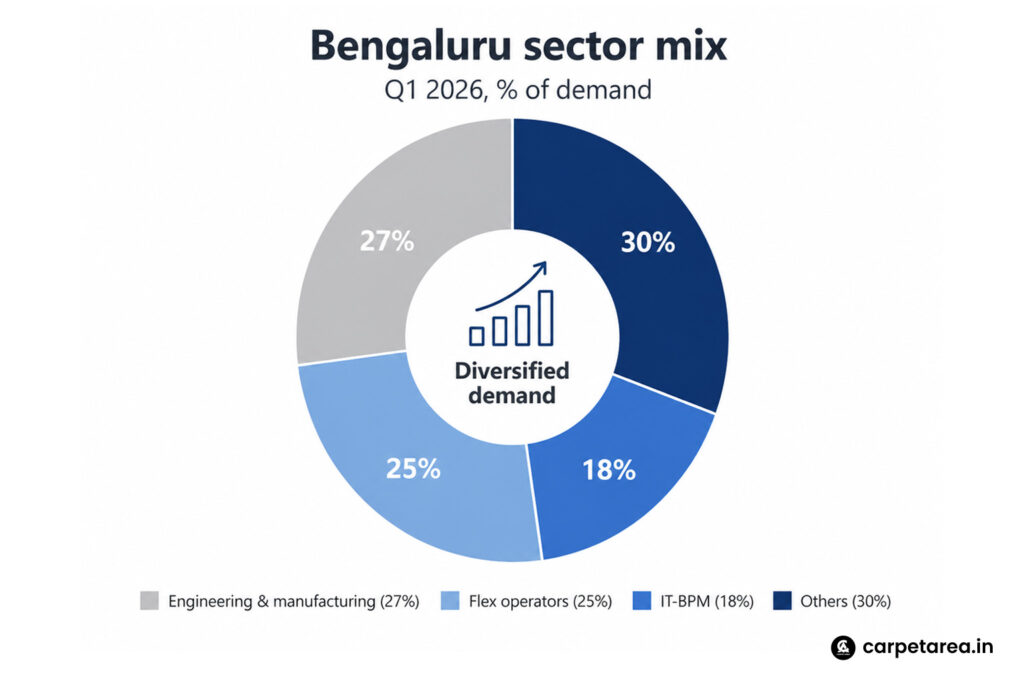
The composition of Bengaluru’s office demand also tells an important story. Cushman & Wakefield’s Bengaluru office Q1 2026 market report said fresh leasing accounted for 72% of gross leasing volume, while engineering and manufacturing led sectoral demand with 27%, flex operators took 25%, and IT-BPM followed with 18%. That mix is useful because it shows Bengaluru is not relying only on one occupier type. The city still has strong tech credentials, but demand is becoming broader and more resilient. When multiple sectors are active at the same time, a market usually becomes stronger and less vulnerable to one industry slowdown.
This also helps explain why Bengaluru keeps showing up at the top even when the market becomes more competitive. Some cities may do very well in specific categories. Hyderabad has been excellent in GCC growth. Mumbai remains a heavyweight in business and finance. NCR continues to attract major corporate occupiers. But Bengaluru’s edge is its combination of scale, depth, and diversity. It is not just doing one thing well. It is performing across several demand channels at once. That makes its office story more durable than a short-term city surge.
For developers, this creates a very attractive but demanding environment. Strong leasing demand is good news, but it also raises expectations around supply quality, location strategy, and timing. Occupiers in Bengaluru are not just taking any available building. They are increasingly looking for Grade A space, better campus environments, stronger sustainability credentials, and flexible formats. Colliers said in March that India’s office demand in 2026 is expected to remain high at 70-75 million square feet, supported by a deeper and more diversified occupier base, and Bengaluru sits right at the centre of that outlook.
For investors, Bengaluru’s office-market leadership offers a different kind of comfort. In uncertain times, capital usually prefers markets where leasing demand is visible, vacancy is under control, and occupier quality is strong. Economic Times reported recently that India’s overall office vacancy has fallen to 13.85%, the lowest since the pandemic, because of strong leasing and continuing GCC expansion. Bengaluru’s market leadership fits neatly into that larger picture of commercial resilience. It suggests that the city is not only active, but active in a market where fundamentals remain supportive.
Another reason Bengaluru’s office dominance matters is that it spills into the rest of the real-estate market. When office demand is strong, it rarely stays limited to office towers. It affects residential demand, retail activity, rentals, mobility patterns, and local urban development. Professionals relocating for work need housing. Supporting businesses need commercial and warehousing space. Daily consumption activity rises. This is why strong office leasing often has a wider multiplier effect across city real estate. In a place like Bengaluru, that multiplier is especially powerful because the city already has a deep base of knowledge workers and multinational occupiers. This is an inference based on how office-led growth typically affects broader urban real-estate activity.
Of course, leadership does not mean the city has no challenges. Bengaluru still has to deal with infrastructure pressure, congestion, and the constant need to add new quality office stock without reducing efficiency. But the fact that it continues to lead despite these pressures actually makes the story more impressive. The market is not operating under perfect conditions. It is performing strongly because occupiers still see enough long-term value to commit large volumes of space. That is a sign of confidence, not just momentum.
The bigger takeaway is that Bengaluru’s office-market leadership is no longer just a legacy reputation. It is being renewed quarter after quarter through actual leasing numbers, GCC expansion, diversified occupier demand, and the city’s continuing role as India’s business and technology engine. In a year when commercial real estate has become one of the brighter parts of the property market, Bengaluru is not just participating in that growth. It is helping define it.
In the end, Bengaluru’s office dominance is important because it shows what long-term market strength really looks like. It is not built only on one record quarter or one hot sector. It comes from a combination of scale, talent, institutional demand, and business confidence that keeps renewing itself. Other cities are growing fast, and India’s office market is becoming more competitive. But for now, Bengaluru still looks like the city everyone else is trying to catch.




Leave a Reply