

Mumbai’s property market has delivered a very clear message this season, and it did not come from a luxury launch, a record transaction, or a premium tower on a new corridor. It came from the response to affordable housing. The latest MHADA Mumbai lottery attracted more than 16,400 applications for 2,640 homes, turning what could have been seen as a routine housing scheme into one of the sharpest signals yet about the city’s deep affordability pressure. The homes were opened for applications from the end of March, and the draw has been scheduled for 15 May 2026.
At one level, the story is simple. Too many people want a reasonably priced home, and too few such homes are available. But at another level, the response reveals something larger and more important about Mumbai real estate. It shows that real housing demand has not disappeared. In fact, it remains extremely strong. What has become difficult is not desire, but access. When a scheme offering 2,640 homes draws over 16,400 applicants within weeks, the market is effectively telling us that affordability is still the biggest unresolved issue in the city.
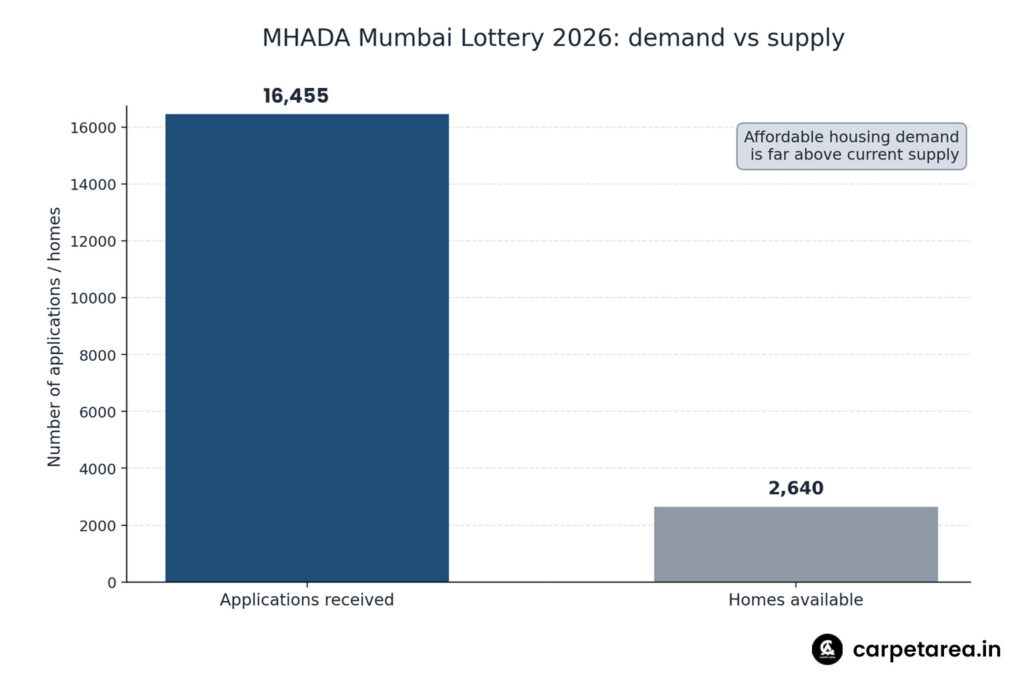
That matters because there is often a gap between how real-estate markets are discussed and how ordinary buyers experience them. The public conversation is usually dominated by price growth, redevelopment, luxury launches, premium rentals, and investor momentum. But for a huge number of households, the real question is much more basic: can I still buy a home in this city without stretching my finances beyond reason? The MHADA response suggests that thousands of people are still looking for that answer, and very few opportunities feel genuinely within reach. This is an inference drawn from the scale of applications relative to the number of homes on offer.
The numbers become even more revealing when you slow down and look at them properly. More than 16,400 applications for 2,640 homes means the demand is running at over six times the available supply. That is not a small mismatch. It is a structural gap. In practical terms, even if every home is allocated efficiently, a large majority of interested applicants will walk away without a unit. And these are only the people who actually applied. The real housing need is almost certainly much larger, because many households may have stayed out due to eligibility limits, low expectations, confusion around the process, or simple resignation about their chances. That last point is an inference, but it is a reasonable one in a city where affordability remains stretched.
This is why MHADA schemes continue to matter so much in Mumbai. They are not just housing allotments. They are one of the few remaining pathways to ownership for households that are priced out of much of the open market. In a city where mainstream residential values can quickly become unrealistic for lower- and middle-income families, regulated or publicly offered housing options carry far more emotional and financial significance than an ordinary project launch. The very fact that the latest lottery attracted such heavy interest underlines how central this role has become.
There is another important layer to this story. The strength of response also challenges one lazy assumption that sometimes enters housing discussions: that buyers have become weak or uninterested. That is not what this data suggests. If anything, it suggests that demand is alive and intense where pricing feels even remotely reachable. The problem is not the absence of buyers. The problem is the absence of enough stock that matches real household budgets. That distinction matters because it changes how we interpret the market. A slower or selective housing cycle does not automatically mean people no longer want to buy. It often means the market is not offering enough that they can actually afford. This interpretation is supported by the mismatch between applications and available units.
The timing of the scheme also adds to its importance. The 2026 MHADA Mumbai lottery was announced with applications opening on 30 March, while the draw was set for 15 May. That gave the market a defined window, and the response built quickly enough to become a major talking point. Hindustan Times, citing MHADA data, reported that by the evening of 12 April alone, 16,455 applications had already been received, along with 8,529 earnest money deposits. Those numbers do not just show curiosity. They show serious purchase intent from a large pool of hopeful buyers.
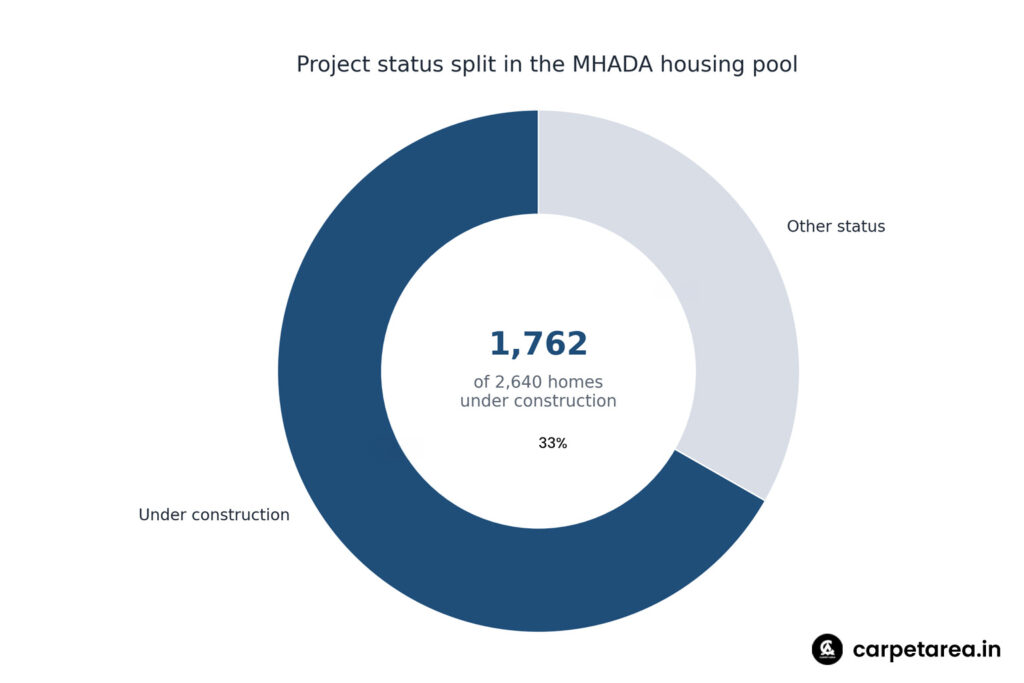
Some additional details from market coverage make the picture even sharper. Reports indicate that a large share of the homes on offer are under construction, with projects in locations such as Vikhroli, Goregaon, and Borivali. That means applicants are not merely chasing ready inventory in prime addresses. They are responding to the broader possibility of a more affordable route into ownership, even if it involves location compromises or waiting periods. That is a strong sign that the emotional pull of ownership in Mumbai remains powerful when the pricing barrier comes down even slightly.
For policymakers, this should be read as more than a successful lottery. It should be read as a warning and an opportunity at the same time. The warning is obvious: if demand is this intense for a relatively modest pool of homes, the affordable housing shortage remains severe. The opportunity is just as clear: where supply is structured correctly and brought within financial reach, demand is ready and waiting. In other words, affordable housing in Mumbai is not a weak category that needs to be artificially stimulated. It is a strong category that needs to be served at scale. That conclusion is an inference, but it is grounded in the response data.
For developers, the message is equally important. Much of the market’s public excitement may still cluster around premium launches, gated lifestyles, and aspirational branding, but the deeper volume story in Mumbai remains rooted in affordability. A city can generate headlines from high-ticket transactions, but it generates social and economic stability from wider housing access. The MHADA response is a reminder that the most dependable base of demand may still lie in the segment the formal market struggles hardest to serve. That does not mean every private developer can suddenly deliver ultra-affordable housing. But it does mean the city’s demand map cannot be understood honestly without acknowledging how large this underserved segment really is. This is an inference based on the reported oversubscription.
The comparison with previous public housing responses also gives useful context. In late 2025, Mumbai’s civic body drew a little over 2,000 applications for 426 affordable homes in its first independent online lottery for EWS and LIG buyers. That was notable in its own right. But the 2026 MHADA response is much larger in scale, both in homes offered and in applications received, which reinforces just how much pent-up affordable demand exists when supply is meaningful enough to attract citywide attention.
For ordinary readers and potential buyers, perhaps the biggest takeaway is this: Mumbai’s affordable housing problem is no longer something that needs to be explained through abstract policy language. The numbers explain it themselves. More than 16,400 applications for 2,640 homes is not just a successful response. It is a public measure of urban stress. It tells us that ownership still matters deeply, that thousands of families are ready to act when the chance appears, and that the gap between aspiration and available supply remains painfully wide.
In the end, this MHADA lottery is about much more than a draw date or an application count. It is about what those applications represent. They represent households still trying to stay connected to the idea of owning a home in Mumbai. They represent pressure building beneath the market’s premium narratives. And they represent a truth that real estate professionals, city planners, and policymakers cannot afford to ignore: in Mumbai, affordable housing is not a side issue. It is still the main story.


Leave a Reply