

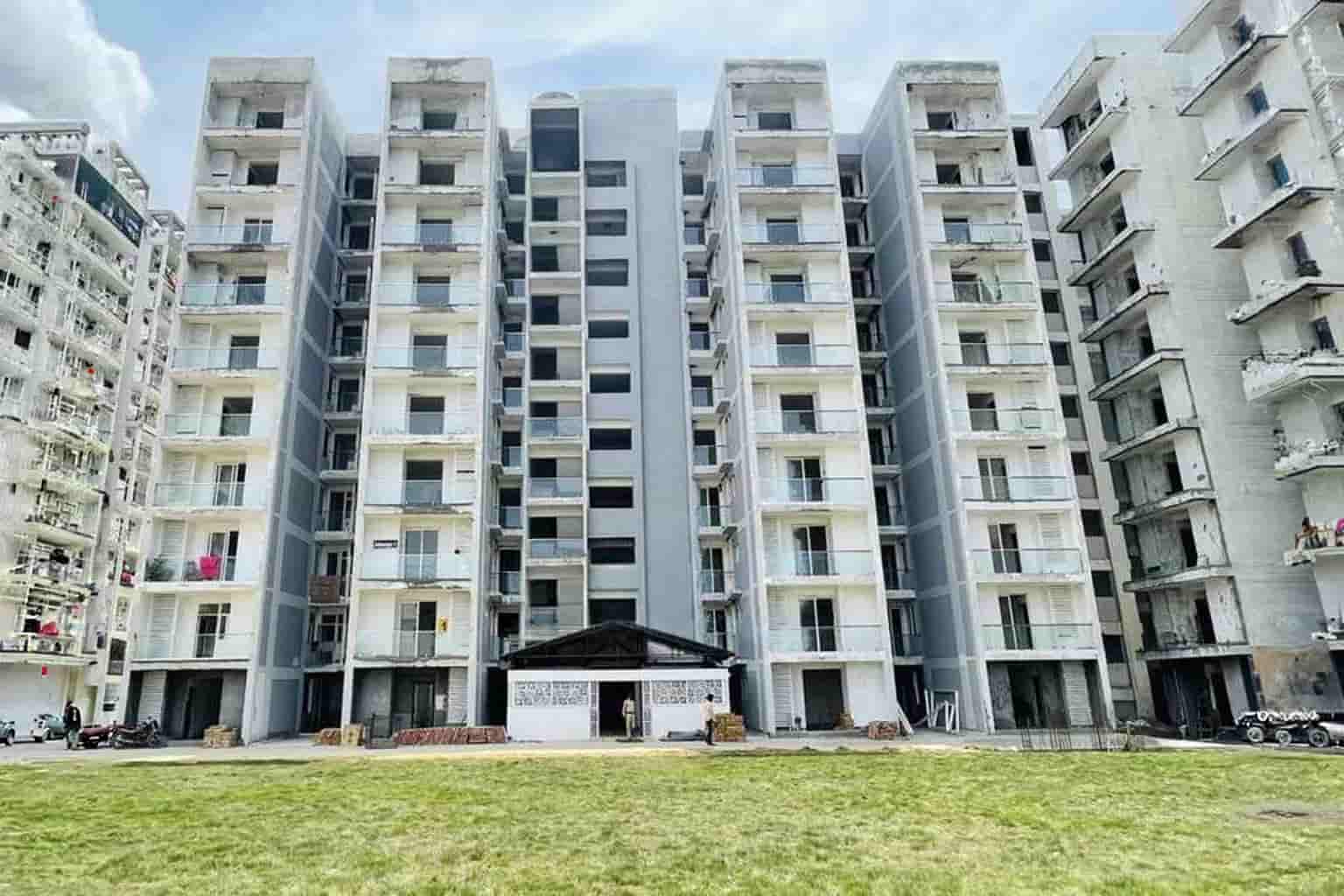
Government property auctions often attract buyers because they appear more transparent, structured and reliable than many private-market transactions.
However, the latest Uttar Pradesh Avas Evam Vikas Parishad e-auction deserves a closer look.
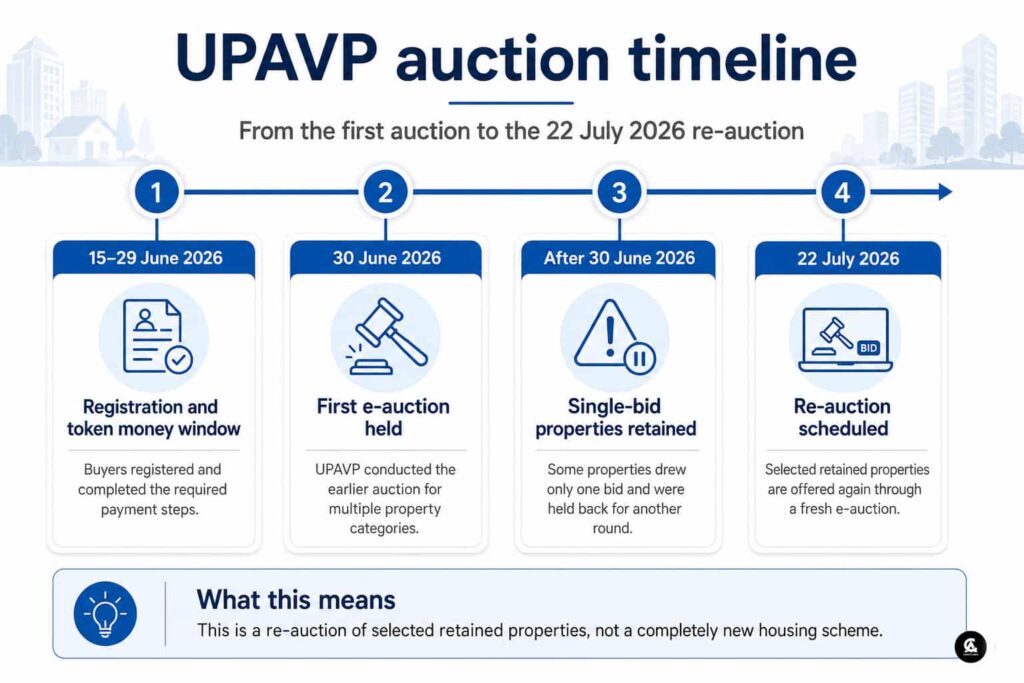
UPAVP has scheduled an e-auction for 22 July 2026 involving selected residential, non-residential and educational properties. These properties are not entering the market for the first time. They were included in the earlier auction held on 30 June 2026, but reportedly attracted only one valid bid each.
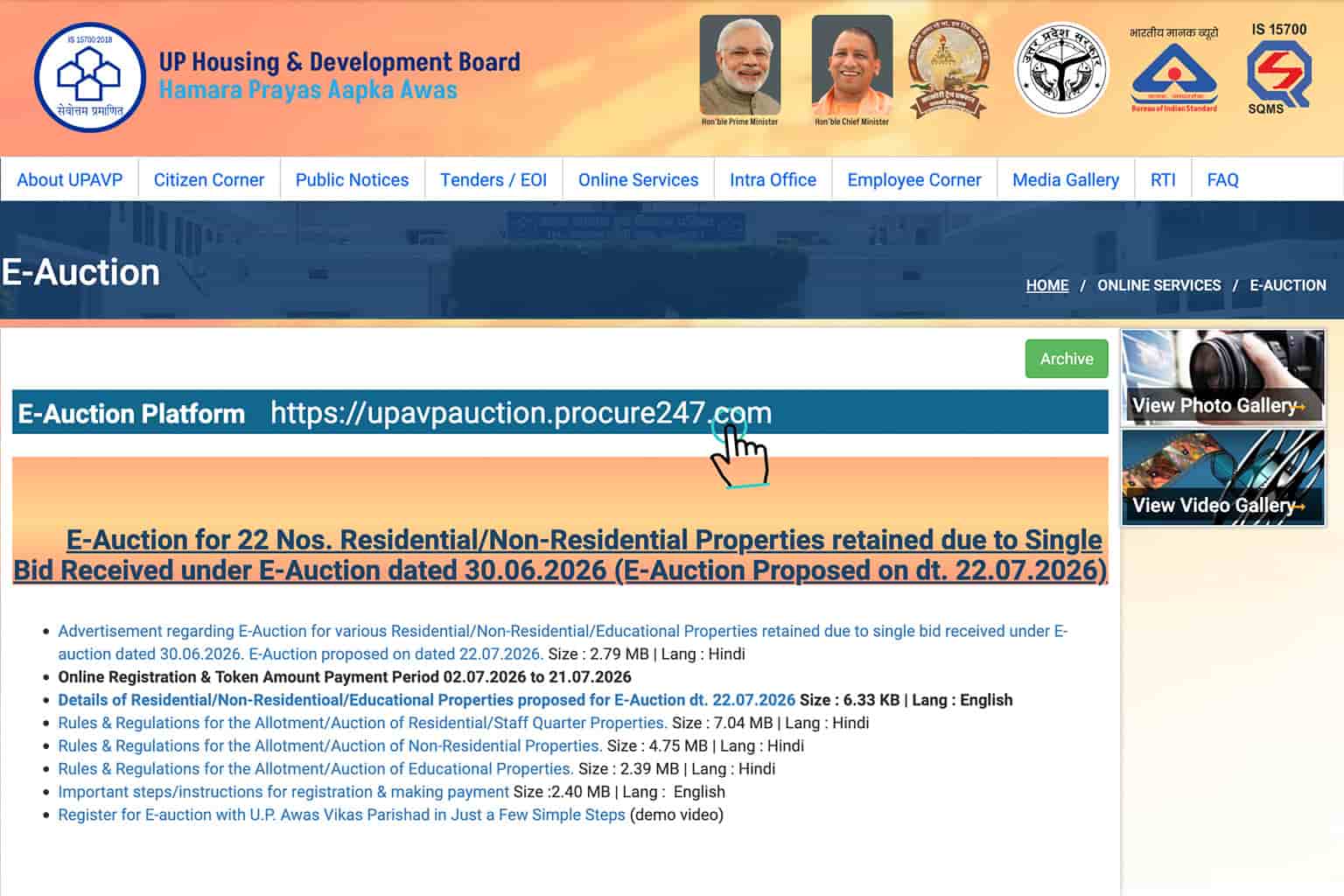
Instead of immediately allotting them on the basis of a single offer, the authority retained them and decided to conduct another round of bidding.
This creates an interesting situation for buyers.
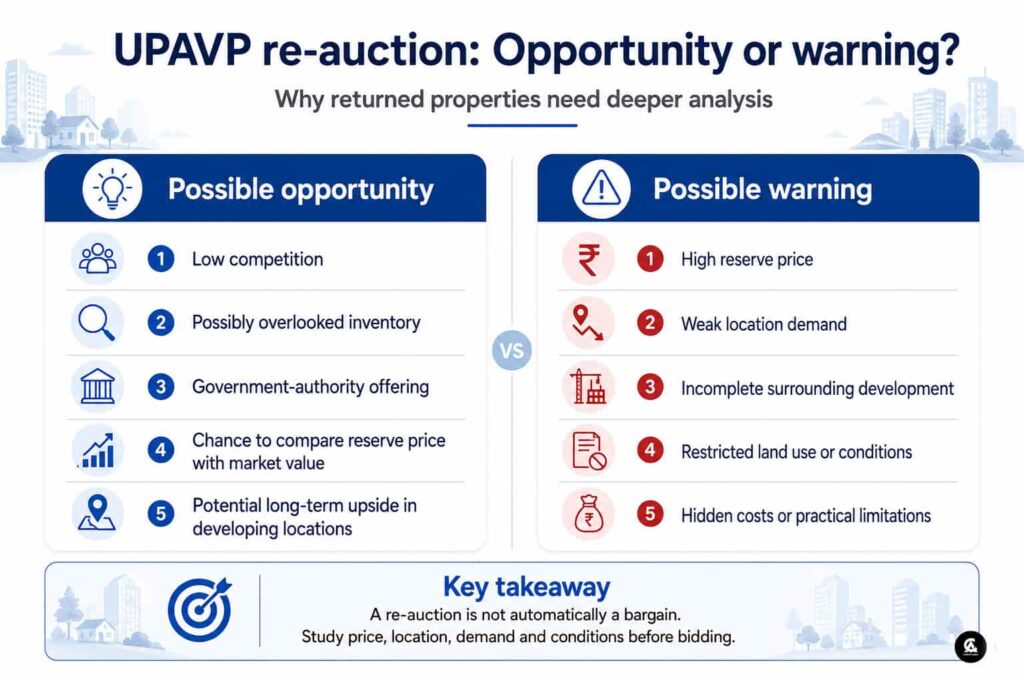
On one side, the re-auction may offer access to overlooked government-authority properties with limited competition. On the other, the weak response in the previous round may indicate concerns related to price, location, development, demand or property conditions.
The real question is not whether these properties are available.
The real question is whether they are worth bidding for.
What has UPAVP announced?
The Uttar Pradesh Avas Evam Vikas Parishad has announced that selected residential, non-residential and educational properties retained after the 30 June 2026 auction will be offered again through an e-auction on 22 July 2026.
The earlier auction covered properties under UPAVP schemes situated across several zones, including:
- Lucknow
- Meerut
- Agra
- Bareilly
- Kanpur
- Varanasi
- Gorakhpur
The earlier registration and token-money period reportedly ran from 15 June to 29 June 2026, followed by the auction on 30 June.
The upcoming event should therefore be described as a re-auction of selected retained properties, not as an entirely new housing or plot scheme.
Buyers should verify the latest registration dates, token-money requirements, property details and auction terms from the official UPAVP website and the designated e-auction portal before making any payment.
Why were the properties retained?
An auction is generally designed to generate competition among multiple participants.
When only one bid is received, the authority may decide that the property has not been adequately tested against market demand. Accepting a single offer may prevent the authority from discovering whether another buyer is prepared to offer a better price.
By retaining the property and organising another auction, UPAVP gets another opportunity to attract more bidders.
For buyers, however, the ingle-bid history is an important signal.
It does not automatically mean the property is poor, overpriced or unsuitable. But it also should not be ignored.
Why might a property attract only one bidder?
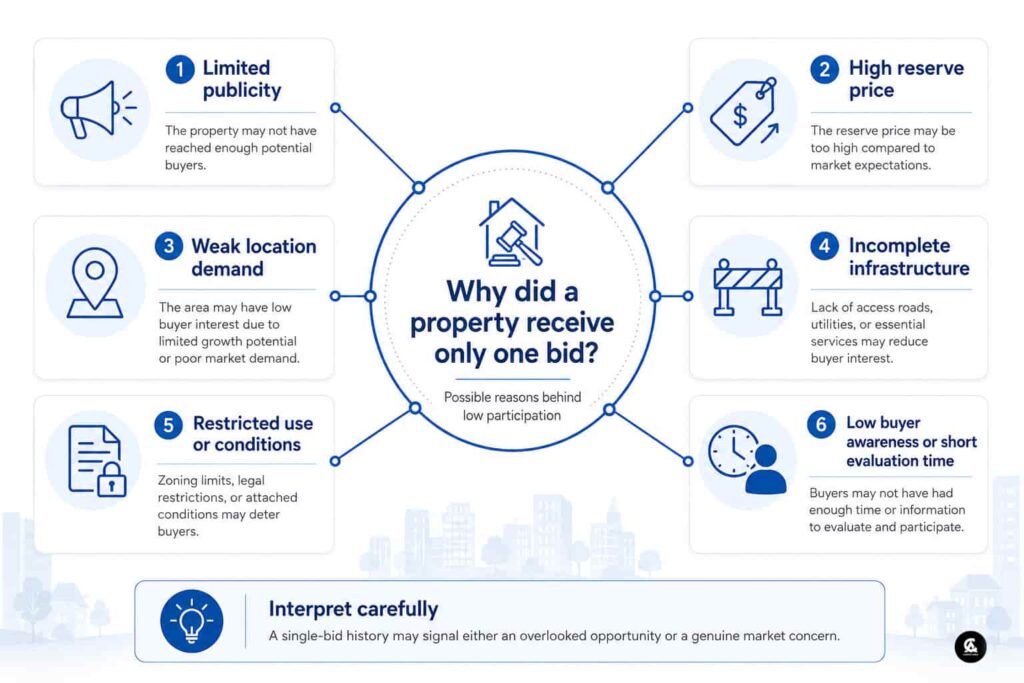
Several explanations are possible.
The auction may not have reached enough potential participants. Buyers may not have had adequate time to inspect the site, arrange the required funds or study the auction conditions.
Some properties may be located in emerging areas where development has not yet reached a stage that attracts immediate end users.
In other cases, the reserve price may have been higher than market expectations. The property may also have limitations related to road access, land use, surrounding occupancy or commercial demand.
Therefore, low participation may indicate either:
- an overlooked opportunity, or
- a genuine market concern.
The reason can only be understood by examining the specific property.
Is the re-auction an opportunity or a warning?
A repeat auction should not be viewed with either excessive excitement or unnecessary suspicion.
There may be genuine opportunities in properties that received limited visibility during the first round. A well-located plot or unit can remain unnoticed because the auction did not receive adequate publicity or because buyers lacked sufficient information.
At the same time, some properties may have attracted little interest because their reserve prices, locations or conditions were not appealing enough.
Where the opportunity may lie?
A serious buyer may find value where competition remains limited.
Properties situated in developing areas may offer long-term appreciation if infrastructure and occupancy improve over time.
Government-authority inventory can also appeal to buyers looking for a more structured allotment process, although authority ownership does not remove the need for independent verification.
A repeat auction may therefore suit buyers who are willing to study the property in detail instead of making decisions based only on popularity.
Where the warning may lie?
A property may return to auction because the market considers its reserve price too high.
The surrounding scheme may have poor road access, incomplete services, weak occupancy or low commercial activity.
Some properties may also carry restricted land-use conditions or obligations that reduce their flexibility.
The fact that a property is being sold by a government authority does not automatically make it suitable, affordable or profitable.
What should buyers verify before bidding?
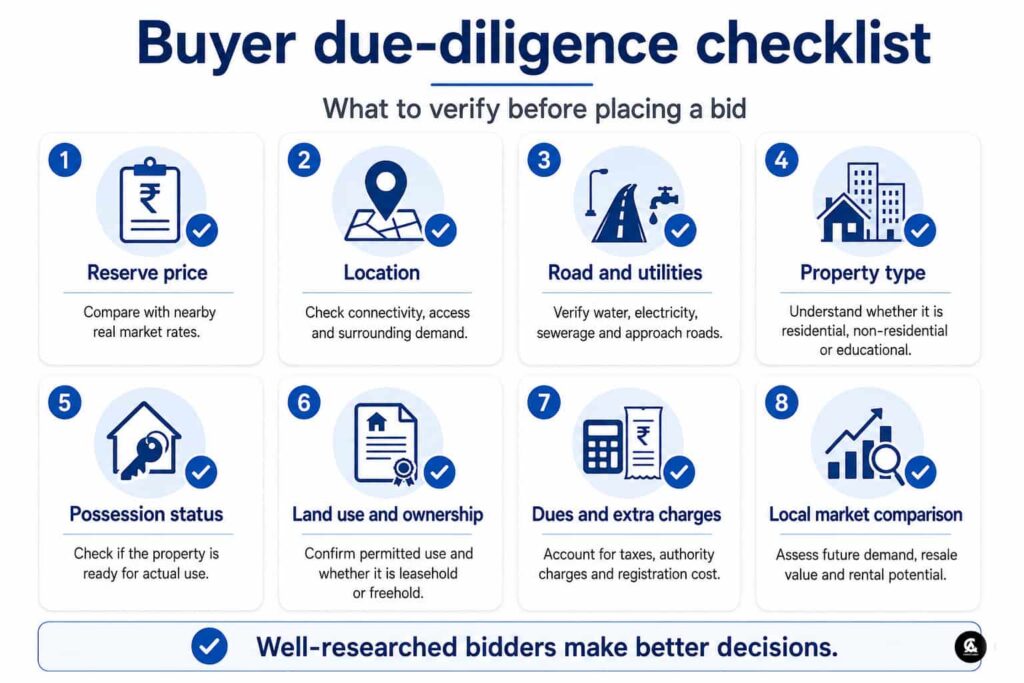
The most important step is due diligence.
Buyers should not depend only on the auction listing, scheme name or reserve price. Every property must be evaluated independently.
Reserve price
Compare the reserve price with actual market transactions in the surrounding area.
Online listing prices can be misleading because sellers often quote higher amounts than the prices at which deals are eventually completed.
Speak with local residents, brokers and existing property owners before deciding whether the authority’s price is reasonable.
Location
Visit the exact property location.
Check whether it has proper road access, public transport, nearby habitation, healthcare, schools, markets and other essential services.
For commercial properties, examine visibility, footfall and surrounding business activity.
Roads and utilities
Confirm whether water, electricity, sewerage, drainage and approach roads are available and functional.
A property may appear attractive on paper but remain difficult to use if basic infrastructure is incomplete.
Property category
Understand whether the property is residential, commercial, institutional, educational or meant for another specific purpose.
Different categories can have different construction requirements, payment conditions and permitted uses.
Possession status
Verify whether the property is available for immediate possession or subject to development, approval or documentation-related conditions.
Land use and ownership
Check whether the property is freehold or leasehold.
Read the permitted land use carefully. A buyer should never assume that an educational or institutional property can later be freely converted into a residential or commercial asset.
Dues and additional charges
Ask whether any authority dues, maintenance liabilities, lease rent or other charges remain payable.
Market comparison
Compare the property’s total cost and future potential with other government and private properties available in the same area.
The reserve price is not the real cost
One of the most common auction mistakes is to focus only on the reserve price or winning bid.
The final financial burden can be significantly higher.
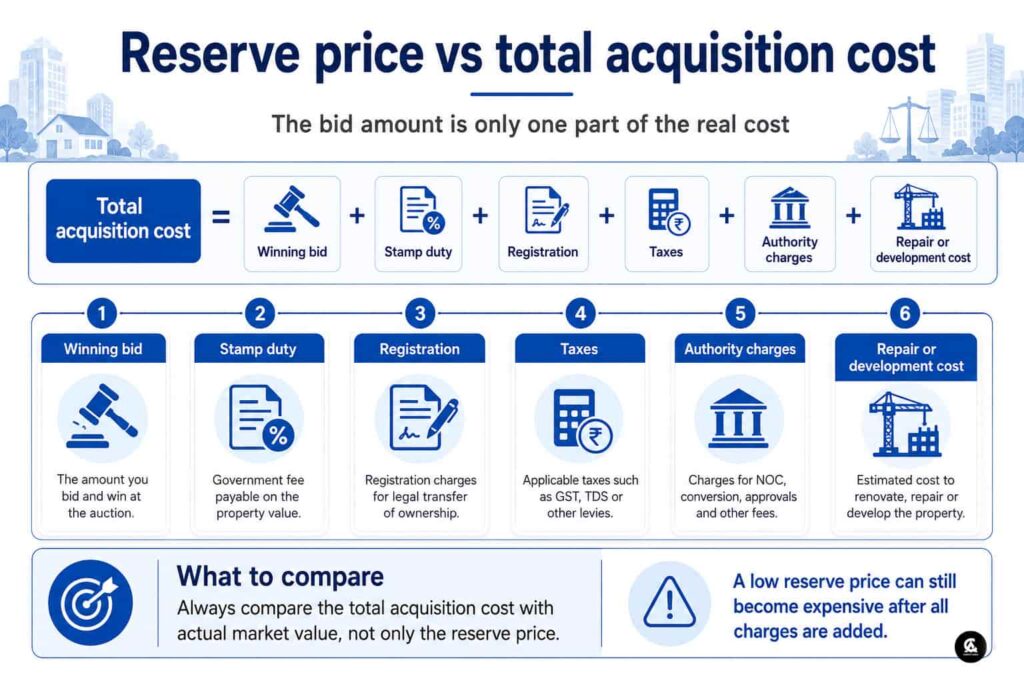
The total acquisition cost may include:
- Winning bid amount
- Stamp duty
- Registration charges
- Applicable taxes
- Authority charges
- Lease-related payments
- Maintenance dues
- Repair expenses
- Construction or development cost
A useful calculation is:
Total acquisition cost = winning bid + government charges + authority dues + repair or development cost
The buyer can then calculate:
Effective property rate = total acquisition cost ÷ usable or permissible area
This effective rate should be compared with realistic market prices, not merely with advertisements.
A property that appears cheap at the reserve-price stage can become expensive after competitive bidding and additional charges.
How does the UPAVP e-auction process work?
The exact procedure must be confirmed from the current official notice, but authority e-auctions usually follow a structured digital process.
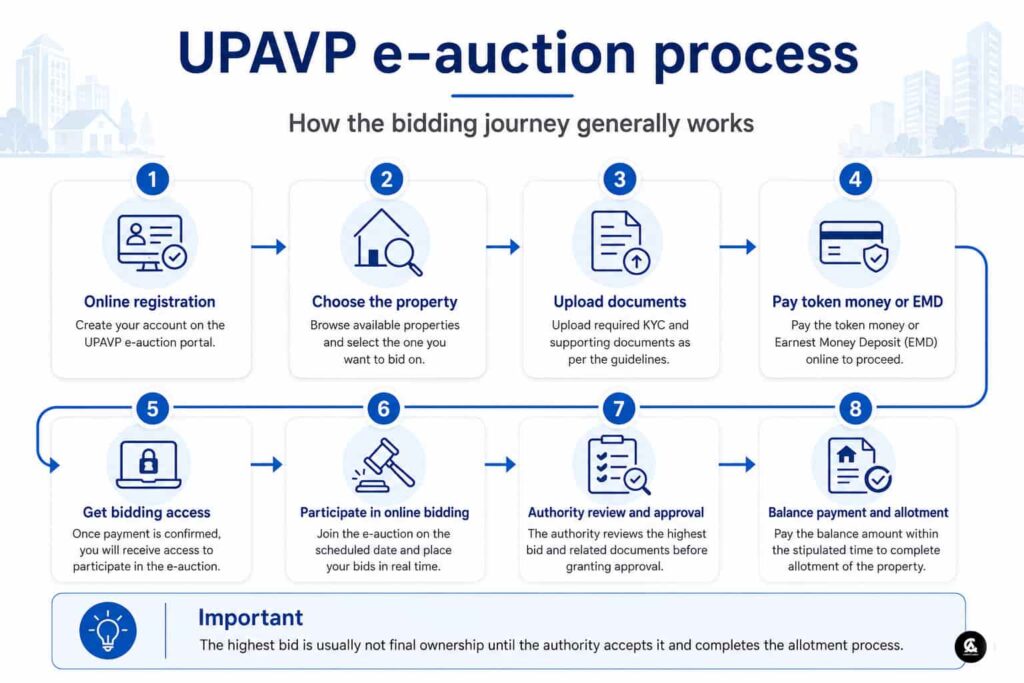
The general stages are:
- Register on the designated e-auction portal
- Select the relevant property
- Upload identity and supporting documents
- Deposit token money or earnest money
- Receive bidding access after verification
- Participate in online bidding
- Wait for authority review and approval
- Pay the balance amount within the prescribed time
- Complete the allotment and possession formalities
The highest bid should not automatically be treated as final ownership.
The authority may still review the offer, applicant documents and compliance with auction conditions before issuing formal acceptance.
Who should consider participating?
The auction may suit different buyer categories, but each category must use different evaluation criteria.
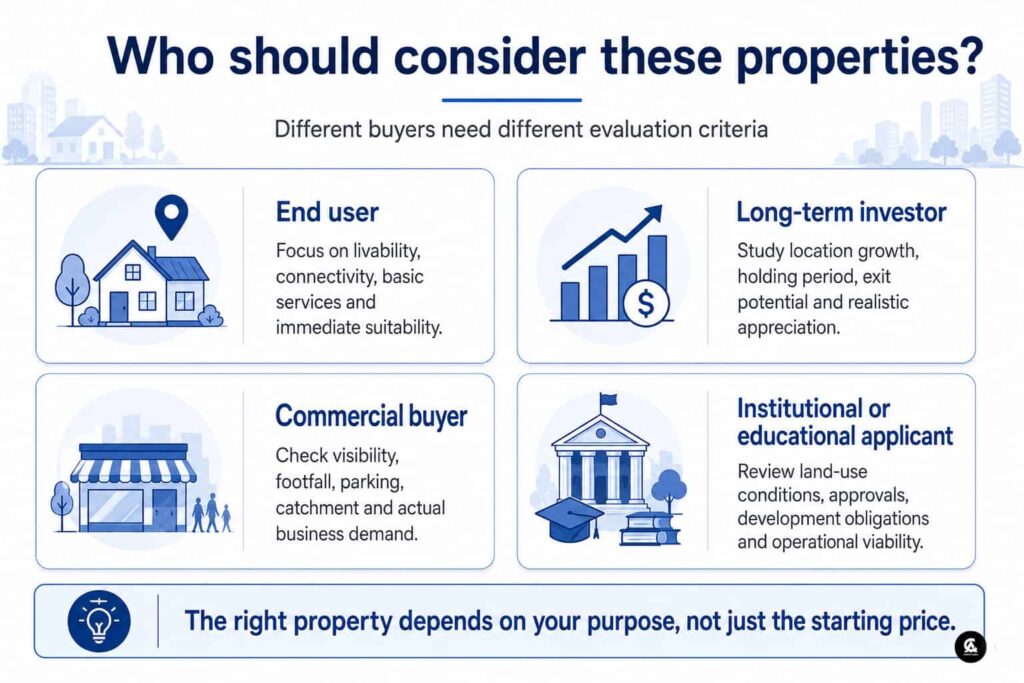
End users
An end user should focus on livability.
The property should have practical access to markets, healthcare, education, transport and basic infrastructure.
A low auction price cannot compensate for a location that is unsuitable for daily life.
Long-term investors
An investor may consider properties in developing areas, but only after examining infrastructure plans, local demand, resale liquidity and the expected holding period.
Future appreciation should be based on visible development, not only on speculation.
Commercial buyers
A commercial buyer should study footfall, road visibility, surrounding population, parking and local spending capacity.
A low-priced commercial property in an inactive location may remain vacant for a long time.
Educational and institutional applicants
Such applicants should review land-use conditions, approval requirements, construction timelines and operational obligations.
These properties should not be purchased simply in the hope of future land conversion.
What are the major red flags?
Certain warning signs should lead buyers to slow down or avoid bidding.
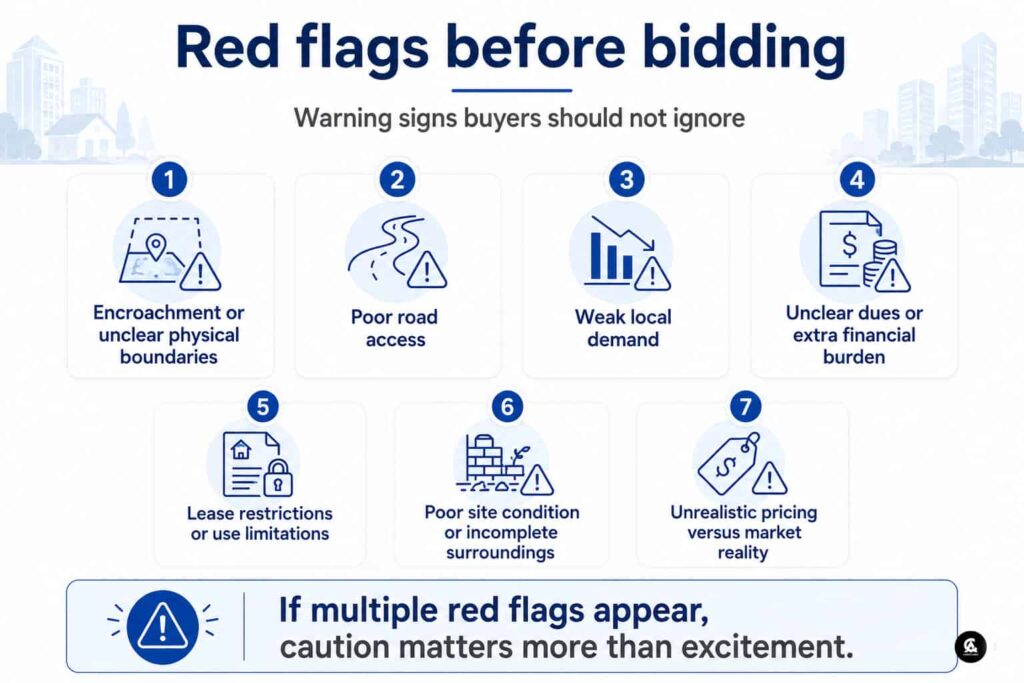
Encroachment or unclear physical boundaries
Inspect whether the property boundaries are clearly visible and free from unauthorised occupation.
Poor road access
A plot with narrow, incomplete or disputed access can become difficult to use, finance or resell.
Weak local demand
Study whether people are actually buying, renting or operating businesses in the area.
Unclear financial liabilities
Buyers should understand all authority dues, taxes, maintenance costs and development charges before bidding.
Lease or use restrictions
Some properties may have restrictions on transfer, construction or permitted activity.
Poor site condition
Uneven land, debris, incomplete infrastructure or difficult access can add substantial cost.
Unrealistic pricing
A government reserve price should still be tested against market reality.
If the total cost becomes higher than comparable private or resale property, the auction may not offer meaningful value.
How can buyers score a property objectively?
Auction bidding can become emotional.
A bidder may continue raising the price simply because another participant is competing for the same property.
A structured property scorecard can reduce this risk.
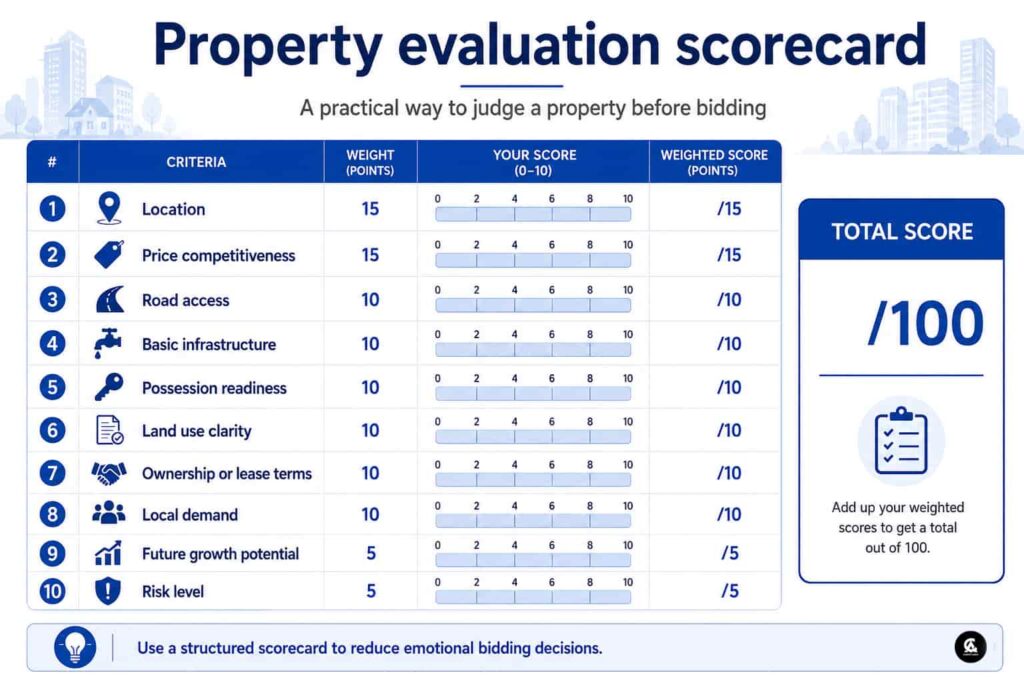
Buyers can assess the property out of 100 using factors such as:
- Location
- Price competitiveness
- Road access
- Basic infrastructure
- Possession readiness
- Land-use clarity
- Ownership or lease terms
- Local demand
- Future growth potential
- Overall risk level
Location and price can carry higher weight, while speculative growth expectations should carry lower weight.
A property with a high reserve price, weak location and unclear possession should not be considered attractive merely because it belongs to a government authority.
What should be the final decision rule?
Before participating, buyers should answer six questions:
- Does the total cost fit the budget?
- Does the location support the intended use?
- Are legal and land-use conditions clear?
- Has the property been physically inspected?
- Does local demand justify the price?
- Has a strict maximum bidding limit been fixed.
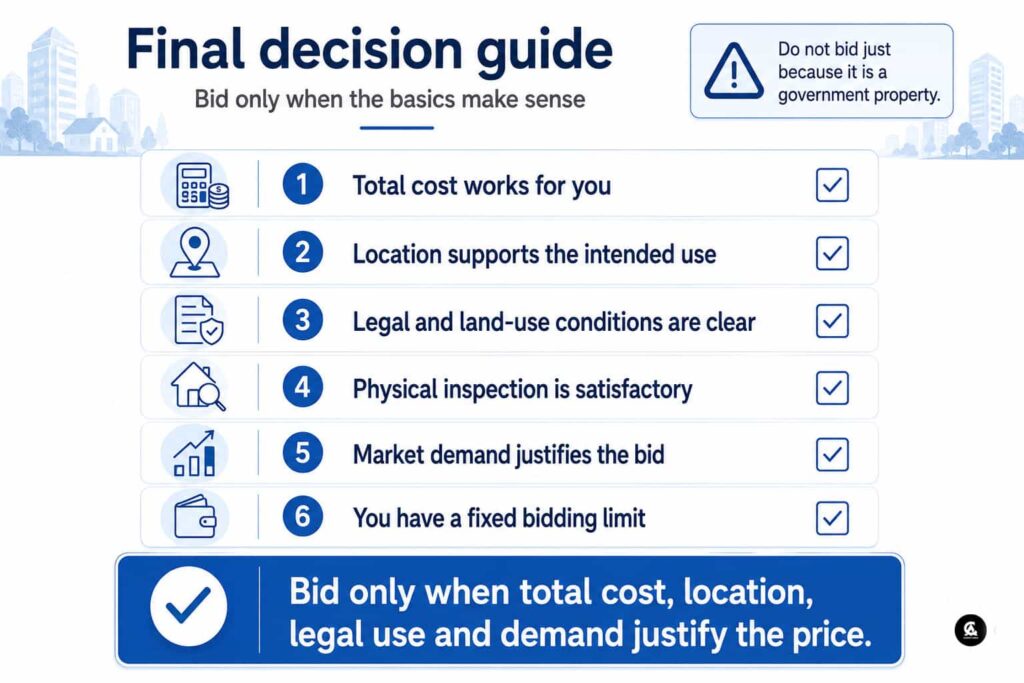
The buyer should participate only when all major questions produce satisfactory answers.
The maximum bid should be decided before the auction begins.
Once online bidding becomes competitive, participants often increase their bids to avoid losing. This can convert a reasonable purchase into an overpriced transaction.
Winning should never become more important than value.
Is this an affordable housing scheme?
No.
The UPAVP event scheduled for 22 July 2026 should not be described as a conventional affordable housing scheme.
An affordable housing scheme generally involves declared prices, eligibility conditions, application procedures and allotment through a lottery or another fixed mechanism.
This is a competitive e-auction.
The final price will depend on the number of participants and the bids submitted. Registration or token-money payment does not guarantee allotment.
Some residential properties may still offer value, but that conclusion must be based on property-specific analysis.
Final assessment
The UPAVP e-auction scheduled for 22 July 2026 is a genuine property opportunity, but it is not a guaranteed bargain.
The properties are returning because they reportedly attracted only one bid in the earlier auction held on 30 June.
This may mean that some assets were overlooked. It may also indicate concerns related to reserve price, location, development, demand or property conditions.
A repeat auction creates a second opportunity for the authority and the buyer, but it also makes due diligence more important.
The correct approach is not to bid simply because the property comes from a government authority.
The buyer should participate only when the total acquisition cost, physical condition, permitted use, location and market potential justify the price.
A property becomes an opportunity only when research supports the decision.
Sources:-
- Uttar Pradesh Avas Evam Vikas Parishad official website
- UPAVP official news and auction notices section
- UPAVP e-auction archive
- Official UPAVP e-auction portal
- Property-specific auction documents and conditions



Leave a Reply